Showing posts with label Christianity. Show all posts

Tuesday, 15 November 2022

Reframing the Present: Secularisation and the Rule of Law - 2022 Redux


            2022 Introduction

This is the last of the redux series where I'm republishing material from the defunct Spectre-Online website. This was a somewhat ambitious essay from autumn 2015 which attempts to argue a heterodox position on the influence of theology for modern jurisprudence and political categories more generally. As a piece of political-theology it's heavily influenced by my reading of Harold J Berman's two volume Law and Revolution, as well Giorgio Agamben's work on so-called economic -theology found in his Kingdom and the Glory.

There's a degree of naiveté shown here in my ignorance of the "dark side" of the process whereby the Medieval Catholic Church became a centralised transnational bureaucratic power, and how the birth of scholasticism was integral to that process. An excellent counterpart - or counterhistory even - can be found in R.I. Moore's The War on Heresy, which documents - from the ground up - the role that nascent Catholic legal science had in building the case for the Albigensian crusade.

Scholasticism gave a fixed and uncomprehendingly bureaucratic zeal to the clerics charged with prosecuting the war on heresy in the Languedoc and wider region of what is now South Western France. All too often the spectre of a "Manichean", or otherwise dualist Gnostic heresy was the convenient shorthand to gloss local disputes or reform activity which ran against the grain of the Church's attempt to centralise and systematise the faith. The invention of the heretic, with an almost standardised set of beliefs and posing an existential threat to the unity of the faith, emerged in the Paris schools of the twelfth century, coeval to the birth of scholastic rationality and the newly confident Church's drive to reform the secular world. Ranged alongside a French monarchy looking for excuses for expansion, the end result was a military campaign, unprecedented in its brutality, which historians now frequently refer to as genocide.

The second obvious naiveté in this text stems from it being written prior to the populist wave of 2016. While the displacement of the Church's claims to universality onto modern transnational institutions like the EU, IMF, World Bank, etc, is plain to see, my lament for the loss of a counterbalance to contest the Globalist (for that is what I'm talking about avant la lettre) pretentions of international finance proved to be premature. I read in those paragraphs a desire for a new movement, not a new Church, and certainly not what we got; a ragtag association of conspiracy theorists, 4Chan shit-posters, Boris Johnson and Donald Trump. I'm being unkind, and the past seven years (only seven!) cannot be reduced to any one tectonic shift around worn-out political categories (least of all Left and Right). That's why the study of political-theology is so fruitful in destabilising our preconceived notions of how social and political life are put together. Now, the so-called Culture War really does look like the return of the wars of religion or the prelude to a crusade. As it was in the Middle Ages the battle lines are frequently being drawn between the rooted, parochial folk inhabiting the material world, and that assertive class of transnational administrator whose reified conception of how the world works depends for its stability on the ever present threat of the heretic.  


2015 text

"God is himself law; therefore law is dear to him" Sachsenspiegel (Saxon Law) of Eike von Repgau, Early 13th Century


Of all the grand narratives supposedly put to the sword during the era of post-modernity secularisation seems peculiarly resistant. While we are familiar with critiques of Western progress, cultural superiority and ethics, the narrative that would have us believe we in the West live in predominantly irreligious societies, and thus have passed through some process by the name of secularisation remains common wisdom. This idea is implicit in the way we see ourselves and how we frame our dealings with other cultures, and has become increasing acute in the post 9/11 world where the complexity of the global situation and the West's part in the multiplying fields of conflict are reduced to simple binary oppositions.  David Cameron provided a paradigm example of this kind of simplification in a recent speech on the ideology of Islamic State:

"It (ISIS) says religious doctrine trumps the rule of law and Caliphate trumps nation state and it justifies violence in asserting itself and achieving its aims. The question is: How do people arrive at this worldview?” (1)

One might critique this simplification by replacing the words religious doctrine with economic necessity or globalisation and Caliphate with American/Western hegemony. But this reversal - while having some truth to it - would gloss over what I think is the more important opposition Cameron sets up, which is the one between religious doctrine and the Rule of Law. Here the Prime Minister is drawing directly on a common assumption of secularisation, and from a particularly Protestant context, which draws a fundamental separation between human and divine law. This is one of the key assumptions of secularisation theory, that it involves purifying the legislative and governmental functions of the State from any kind of religious influence. That we in the UK live in such a state despite bishops sitting in the house of lords, an established church, and a sovereign who is also head of that church, is taken for granted. 

But what precisely secularisation consists in, and where and when did it occur, is still a vexed question, the answers to which very often fall back on the sort of grand narrative type of historiography that we are meant to have left behind. The answers may vary but inevitably they include many of the most recognisable events in Western historiography; the renaissance, the reformation, the scientific revolution, the enlightenment, the French revolution, the industrial revolution, etc. Here we are confronted with a process supposedly ending in the present and yet seemingly without an origin. I would argue that this thing we call secularisation is a far more complex idea than it is generally taken to be and that an on-going critique of our assumptions regarding religion and the West is vital to understanding the current predicament we face in politics and culture. With such a vast topic a detailed treatment isn't feasible here. Instead it might be worth taking a historical perspective on the supposedly common sense opposition between religion and the Rule of Law.


A Note on the "New Atheists"

As is well known the question over religion's place in society and international affairs has been constantly raised over the last fifteen years or so, given impetus by 9/11 and the war on terror. There has been no more prominent voice during this period than the so called New Atheists with Richard Dawkins and the late Christopher Hitchens being their most visible public figures. Their "debates" and public actions have more often than not focussed on opposing religion to their own brand of secular, empirical and scientific world view. As such they tend to spend most of their time debunking bible stories and criticising the irrational belief in higher beings rather than enquiring into the sociological and philosophical intersection between religion and modernity. They assume a break, so to speak, between the two and so their actions display an almost incredulous attitude towards those who haven't got the message yet.

This analytic/empirical attachment to the God question has skewed public discourse on religion to the detriment of other approaches which might yield a less partisan, less triumphantly antagonistic form of enquiry. One obvious source of that antagonism is the presupposed association of secularism with rational government and democracy, and thus their opponents with religious dogma, fanaticism and authoritarianism. Cameron's quote above fits squarely within this form of thought. To get beyond this antagonistic staging of debate around religion it is vital to turn away from the limited questioning around the existence of God and instead enquire into the history and operation of religion as a form of social ordering centred around the sacred. To do this broadens the enquiry to take account of the intersections between the history of philosophy, science, and most critically, the development and formation of Western legal and governmental systems. In doing this however, in particular to put the role of science into question, is a step too far for the New Atheists and their analytic empirical commitments.

To borrow a distinction from Ian Paisley, the activity of the New Atheists in public is in fact not to debate but to dispute religion. Their aim is to displace it from public discourse and to install their own version of secular empirical rationality as  "established". Thus they hope to remove the need to debate it in the future. In this sense it is broadly correct to describe the kind of militant atheism practiced by Dawkins et al as a kind of secular religion, construed as a form of totalised social ordering and fundamental set of principles beyond question.


Western legal rationality and the Canon Law: The Papal Revolution

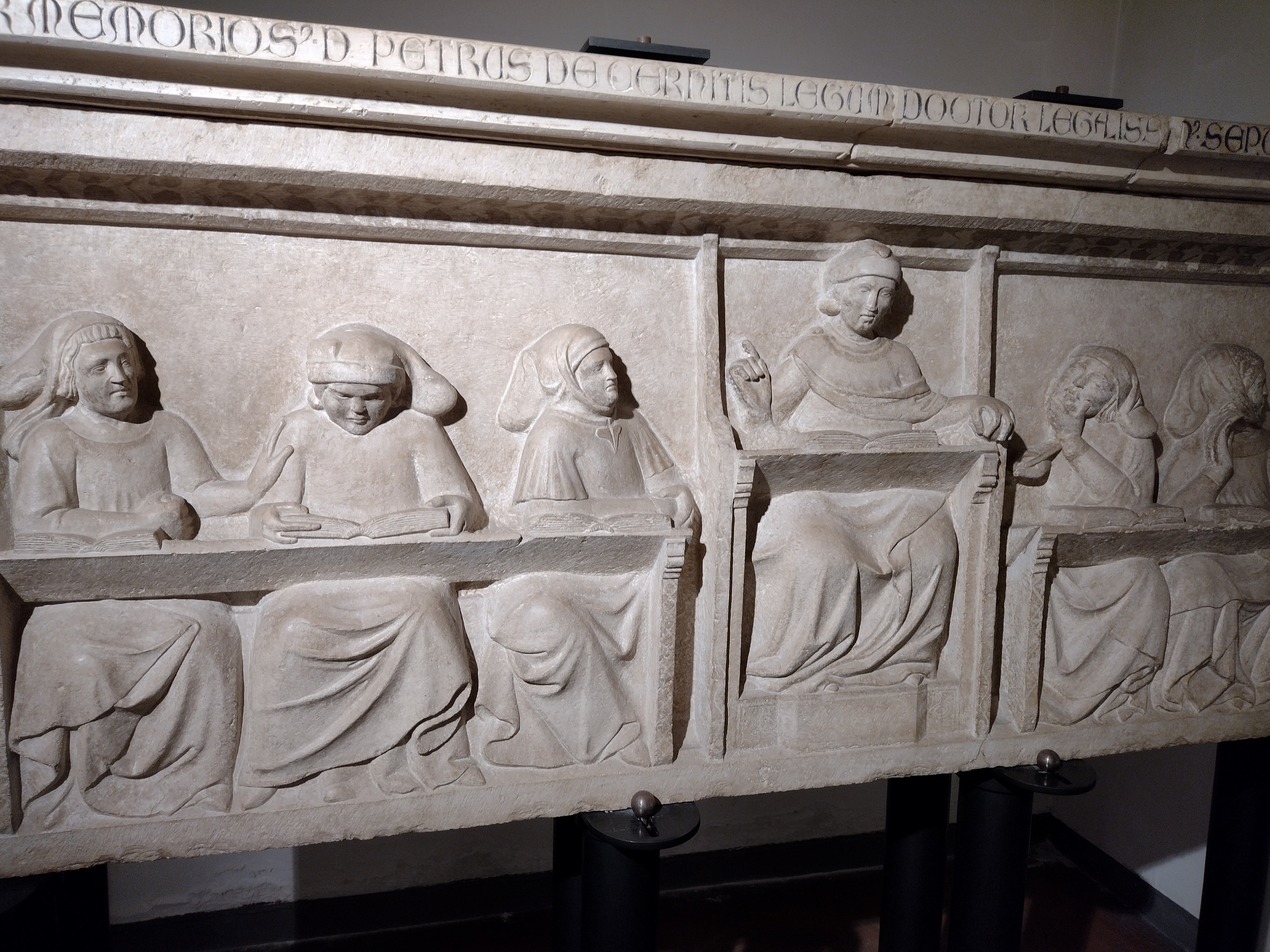
To begin to  critique the accepted narrative on secularisation we need to go further back than the well known events listed above. Back further than the reformation and renaissance, back to the very heart of Medieval Europe. At the end of the eleventh century Europe experienced what some scholars have described as the first of the great revolutions; the so called Gregorian or Papal revolution. To summarise, it involved a declaration of independence by the Papacy from the control of Kings, lords and the Emperor within the multitude of Germanic proto states that made up the bulk of central and Western Europe at that time. But the infamous Dictatus papae of Pope Gregory VII was more than just a declaration of independence. Among its 27 statements it asserted for the first time the unity of the Church as a transnational body with the Pope as its supreme head; that the Pope may appoint or transfer bishops as he sees fit, and only he may depose them; and of particular importance was the statement that only the Pope can approve laws for the church. This was a new and powerful declaration of the dualism of secular (meaning temporal or earthly) and ecclesiastical powers and jurisdictions which came to be known as the Two Swords theory.

In the period after the disintegration of the Western Roman state and prior to the eleventh century these powers tended to be tied together in the concept of sacred Kingship where the ruler was not simply an enforcer of the peace but the spiritual head of the community; God's vicar entitled to dispose of ecclesiastics as he saw fit and intervene in church policy and governance within his respective territory. The freedom of the church from secular control and the declaration of the Pope's supremacy over spiritual matters began the process of eroding this notion of Kingship. The King was to be a layman whose role increasingly came to be seen as keeper of the peace and law-maker within the jurisdiction of temporal affairs only. However, as is well known, the Dictatus papae also made the radical claim that the Pope could himself depose Kings and Emperors, in accordance with the theory the ecclesiastical sword was ultimately superior to the temporal sword. This shouldn't obscure the fact however that the first tentative moves towards the separation of Church and State were made by the church itself, and it had to fight hard to assert this independence with the so-called Investiture controversy and the martyrdom of Thomas Becket being two significant flashpoints.

But the Church's declaration of political separation was only one part of the revolutionary changes that took place in the eleventh and twelfth centuries. More important for the emergence of the idea of the Rule of Law was the concurrent development and systemisation of the Canon law inspired by the newly rediscovered Roman Law books of Justinian. Scholars such as those at the recently founded law school at Bologna began examining the legal doctrines of the church in light of Justinian's texts which they took to be a complete and ideal legal system, a ratio scripta endowed with near biblical authority. To do this they employed the method of analysis and synthesis developed by Saint Anselm, Peter Abelard and others known to us as Scholasticism. Since they assumed that the edicts and responsa of the Roman Law were true and just they could in effect be treated as first principles. But since both the Roman Law, and the writings and Canons of the Church contained gaps and contradictions, a process of dialectical reasoning had to be employed to smooth out the different legal norms contained within; abstracting, classifying and synthesizing conflicts.

Legal historian Harold J Berman has argued that this movement represented not only the emergence of modern rationalised legal science but of the modern scientific method more generally. The glossators of Roman law and the Canon lawyers worked by formulating hypotheses that could serve as a basis for ordering phenomena (in this case legal phenomena) in the world of time that could yield probabilities and predictions rather than certitudes and necessities. Their approach moved dialectically by establishing general legal principles and then relating them back to particulars in predictions (2). Certainly this wasn't the sort of exact empirical science favoured by Dawkins but it did have an experimental side insofar as the developing system was tested in practice in the ecclesiastical courts and in the conflict between overlapping legal jurisdictions throughout Europe. The apogee of this work came in the mid twelfth century with Gratian's decretum, a collection of church Canons which formed the basis of Canon law until the 20th century. It is thus not an exaggeration to describe the Canon law that emerged from the Papal revolution as the first recognisably Modern legal system complete with a professional body of lawyers and a student body to study and develop it. But more than this it coincided with the independence of the church from secular control and its rise as a form of transnational state in its own right. This new state with its officials and sovereign (Pope) was to be a state based on law, a Rechtsstaat which in practice placed considerable limitation on the power of the Pope up to the point of theorising conditions where he should be deposed.  

As the legal system of the church developed so too did its legal practices, which in turn influenced the legal practices of the hitherto unsystematic and arbitrary forms prevalent in the Germanic kingdoms. Trial by compurgation (oath helping), ordeal or battle were rejected and superseded by the investigative or inquisitorial procedure which emphasised the establishment of the facts. To be sure the Catholic inquisition would later come to be associated with the worst of the Medieval church, but in the twelfth century these new procedures constituted a dramatic shift towards a more rational, logical and more distinctively modern jurisprudence where the direct intervention of God was ruled out. The Canonists and Glossators of the Roman law took up an agonistic relationship to the secular laws of the various Germanic and Frankish kingdoms, both supporting and challenging them, giving rise to many basic legal concepts we still carry with us today. Indeed the principles of reason and conscience were proclaimed by the ecclesiastical jurists as weapons against the formalism and magic of Germanic law (3). This relationship hinged upon the freedom of the Church and the fact that the boundaries between temporal and ecclesiastical power which inaugurated the Papal revolution were constantly being contested.

What we tend to think of as the religiosity of the Medieval Canon law and its conflict with secular state affairs was in fact always already a process of secularisation. The Glossators and Canonists endowed the Roman Corpus Juris, as it was known, with a sacred quality comparable to the Bible itself. They took it in effect as a total system developed over centuries that not only reflected the best that mankind's reason could produce, but also represented a common law of all peoples under God. This universalism and the Church's newly acquired mission to reform the secular world was a defining shift in the minds of Medieval people in comparison to previous centuries where the earthly realm was seen as little more but one of chaos and decay; a world sliding away into dust before the coming of The Kingdom of God which the Church was to patiently await. The period of the Papal revolution however saw a massive shift in Medieval European society. The invasions from the North, South and East of Europe finally came to an end, populations rose and thousands of new towns were founded along with increases in trade and artisanal production. Amid these changes the church declared its unity and independence and its mission to reform the secular world; a mission in which Law came to play a defining role. This shift in legal ideology might be summarised as the move from a chaotic irredeemable law of an irredeemable world to a systematic legal rationality that could aim to approximate divine justice itself and in doing so reform that world.


From the Two Swords to the global oikonomia

The above summary is obviously brief and simplifies considerably what was a complex and multi-facetted era in European history. It should however suffice to demonstrate that Cameron's assertion of the opposition between religion and the Rule of Law is wholly misplaced and in fact the Medieval church was instrumental in desacralizing Kingship and bringing to a closure the era of Germanic folk-law which reigned in Europe after the fall of the Roman state. We owe to the Papal revolution of the eleventh and twelve centuries and to the philosophers, theologians and jurists of that time the modern notion of a rational, logical, law governed world, one capable of embodying an ideal of Justice and ultimately the Rule of Law itself.

It should be noted that subsequently during the Reformation, and English and French revolutions it was the jurisdiction of the ecclesiastical courts that was primarily attacked and only secondarily, over time, the content or procedure of the law itself. In England after Henry VIII broke from Rome the authority of the Pope was taken up by the monarch who not only maintained but even extended the jurisdiction of the ecclesiastical courts. It wasn't until the 19th century that the jurisdiction of church courts in England was thoroughly curtailed and the secular legal system took up what Michel Foucault has called its "pastoral power". In the modern era it is the secular powers that have assumed the task of judging and shaping the soul of Man.  It is only in the 20th century that the idea developed initially by the Canon lawyers, that the law should represent something universal for all peoples, something that embodies higher values beyond mere contingent political interest, has faded from view. More to the point the church's role in championing such a position and challenging the secular power to meet that obligation has almost entirely evaporated (although Pope Francis seems at times to hint at a revival of this tradition). It is Berman's thesis that this eclipse of universality constitutes the great crisis in law today. Without a common consciousness that the law should embody universal values about ends and purposes of society people lose respect for it and more often it becomes what Karl Marx and Max Weber believed it was; merely an instrument for the prevailing power.

I am more of the view that what has occurred over the last century or so is not the eclipse of universality but rather its displacement into a new field, namely economy. The IMF, World Bank, and other transnational financial institutions have issued their own Bull of unam sanctam and hold sway over the governments of nation states to a degree the Pope could never had imagined. For us unlike the peoples of Medieval Europe there is no Two Swords theory that would have the secular and spiritual authority vying for position, criticising and constraining each other's power. Nor does the universal law of the market admit of any other values aside from profit and competitive positioning. The nature and actuality of justice is no-longer contested as a political concern and is increasingly identified under neoliberal economisation with market outcomes. The American political philosopher Wendy Brown's recent analysis of the "revolution of neoliberalism" claims that under such conditions what disappears is precisely this capacity to limit, this platform for critique, and this source of radical democratic inspiration (4). Since the transnational apparatus for global finance holds both swords they can influence the laws and economies of sovereign states (need I mention Greece, Chile, South Korea) while judging the soul of human life according to the logic of homo economicus.

It is the radical thesis of Italian philosopher Giorgio Agamben that the paradigm for modern globalised economy was gestated in the Western church's theories of the divine economy and Providential government of creation (5). Just as the Medieval church came to see Law as a way of reforming the world and directing moral conduct towards a state mirroring that of the divine Kingdom, the modern era uses it - and governance more generally - as a way of reforming national economies and directing individual economic conduct towards market norms. The supposedly natural and immutable form of marketized world governance is however a Providence divested of its messianic fulfilment, and as such is a potentially eternal government of the world without the possibility of an eschaton.  

This dark thesis suggests a controversial way of looking at secularisation. According to this view secularisation is not a concept operating within historical processes but rather a "signature" which continually marks history, showing where the forms, modes and underlying metaphysical assumptions have shifted from the field of religion to those of politics and economics. While this is by no means uncontested ground we should perhaps be open to the possibility that our contemporary era is more marked by the ideas and signatures of theology than we are led to believe.


References.

1 - Cameron warns of 'quietly condoning' IS ideology (BBC News, 19 June 2015, http://www.bbc.co.uk/news/uk-33192306)

2 - Berman,Harold J - Law and Revolution: The Formation of the Western Legal Tradition ( Harvard University Press, 1983) - pg151

3 - Berman,Harold J - Law and Revolution: The Formation of the Western Legal Tradition ( Harvard University Press, 1983) pg251

4 - Brown,Wendy - Undoing the Demos: Neoliberalism's Stealth Revolution (Zone books, 2015)

5 - Agamben, Giorgio - The Kingdom and the Glory (Stanford University Press, 2011)

Thursday, 27 September 2018

Francis Bacon's Form-of-Life


Narrative and Form-of-Life
Over twenty-five years since his death the life and work of Francis Bacon continues to fascinate. He stands as the most ‘bankable’ of 20th century artists whose paintings now count among the most expensive ever sold at auction. These bloated figures generated by the art market are in stark distinction from the relatively humble environs of Bacon’s working life, the last three decades of which was spent at his small, sparse apartment at 7 Reese Mews in South Kensington.

Since his death the number of biographies, catalogues and scholarly works have steadily accumulated, shedding light on hitherto unknown aspects of his working practices and the intrigues of his personal life. It’s perhaps a sign of the times that these latter intrigues are the principle subject of so much recent biographical and documentary work on the artist. It is also a measure of just how much he guarded his private life from public scrutiny and how much personal mythmaking he practiced that many of the clichés about Bacon and his times have been up for revision. We know well the image of Bacon the Colony Room stalwart and rover of Soho clubs, just as we do Bacon the fine dining, hard drinking nihilist of post-war London. Little however was known about his formative years in Ireland or his early career as an interior designer while living with the Australian painter Roy De Maistre.

Francis Bacon with Lucian Freud
Posthumous documentaries and memoirs by the likes of Michael Peppiatt and Daniel Farson have increasingly turned attention towards his sexuality and relationships as the principle source not only for his subjects but for the supposedly tortured, ruggedly carnal spirit of his work. As Peppiatt puts it at the introduction to a recent BBC documentary: “This is the central enigma of Bacon; where did the darkness come from?" It’s significant that despite his own regular protestations against narrative interpretation, Bacon’s work holds the epithet enigmatic perhaps more than any other artist of the post-war period. His starkly distorted portraits of bohemian figures like Muriel Belcher and Henrietta Moraes, or fellow artist Lucien Freud, sit alongside more complex and difficult arrangements of figures and settings; most notably the series of so-called Black triptychs featuring George Dyer after the latter's death in Paris in 1971. These works are far harder to reconcile to a non-narrative interpretation and with the artist now dead a quarter of a century, few are still trying to maintain Bacon's line of refusing the autobiographical. Nevertheless he always maintained that his work was not an attempt to say anything in particular, let alone something of the nature of Man.

Francis Bacon and George Dyer
Yet when pushed by David Sylvester during one in that series of classic interviews, Bacon speculated that the so-called violence in his paintings might be attributed to the violent times he had lived through, both during the Irish war of Independence and the inter-war years in Europe, during which he visited Berlin and Paris. He was at pains to say however that this did not mean that he attempted a direct transference of such experiences onto the canvas, as if he were passing a general comment on the violence and disorder of the early 20th century. For Bacon, the violence of painting has nothing to do with the violence of war. It's was to do - he said - "with an attempt to remake the violence of reality itself. And the violence of reality is not only the simple violence meant when you say that a rose or something is violent, but it's the violence also of the suggestions within the image itself which can only be conveyed through paint". He would also speak of "emanations" which have to do with the personality and the attempt to remove some of the screens through which we live to get to the raw sensations beneath. Nevertheless the subjects for his work were often directly autobiographical; they were friends, lovers, or images drawn from Bacon's paint spattered archive weaved into familiar situations from his own experience.

How is it then that a work can simultaneously be non-narrative and a direct expression of a particular life? I suggest that this seeming contradiction can be resolved only if one views Bacon’s life and oeuvre as indistinguishable parts of a Form-of-Life. That is to say, a life, the works of which can never be separated, or abstracted from its form. Thus in the case of Francis Bacon, self-narrativization is absent since the work produced by that life is a direct emanation of that life’s mode of living. This notion deserves some explication.

Henrietta Moraes (1966
The concept of form-of-life appears in the later writing of Ludwig Wittgenstein and designates that realm of pre-linguistic experience out of which meaning and understanding arise. It's not something that one can describe with a series of propositional statement but rather the basic level that gives those statements sense. It is - to use Heideggerian jargon - our immanent mode of being-in-the-world and relates to our practice as living, acting beings and not to the function of self-reflection. My use of the term here also reflects the recent work of Giorgio Agamben who deploys the concept as a way of exploring alternative forms of political association apart from those based on property and obedience to an external rule giving authority. His principle subject in this investigation was the early Franciscan monastic community. In this latter example the notion that one does not have a property in one's life but rather a collective form of use is especially interesting for looking at Francis Bacon's biography.

Bacon himself was well read in 20th century theories of subjectivity. John Edwards’ photographs of Bacon’s studio include detailed images of his book shelves, which in addition to collections of Greek plays and poets like T.S. Eliot, included volumes by Freud, Sartre, Nietzsche, Heidegger and Lacan. Occasionally he wore his existentialist derived nihilism in boastful fashion, as when asked by an interviewer for French television why he had given so much attention to painting teeth he replied exuberantly “…after all what is left of you after you’re gone but your bones and your teeth”.

Two Figures (1953)
The concept of Form-of-Life also allows us to better understand Bacon's often repeated quote of Valéry, that what he wanted to achieve in his painting was to "give the sensation without the boredom of its conveyance". In the Sylvester interview from 1966 he further elaborates by claiming that once a story enters into the interpretation of a work, that's when the boredom comes upon you. The storytelling then, the narrativization of the work, is what creates the distance, the act of conveyance, that blocks the violent return to reality and sensation which the artist strove for. The obverse to this insight is that Bacon's understanding of the place of painting was as a means to an immanent experience of reality, one without narrative or cognitive distancing; pure sensation without the burden of understanding. The raw life in Bacon's figures truly cannot be separated from their form, which is to say from the life out of which and in which they were created. Such works of immanence could only take the artists own life as their material, though not in an autobiographical way.

Considering this view, a painting like Two Figures (1953) (also known affectionately as the buggers) is not a representation or a retelling of an event in Bacon’s relationship with Peter Lacey, but a concretisation of the experience, an image produced in paint that in Bacon’s words returns the viewer to reality more violently. It is an image of the thing suffuse with more pathos than a photograph or illustration of the coupling could ever contain.

Áskēsis and Materiality
In the case of a life and work inseparable in their form, what practices might bring together and hold the existence of the two in place? What were these practices - these áskēsis - deployed by Bacon and what concepts might we use to bring them to light? Certainly we can agree - as has often been said - that Bacon's work stages a conflict between illustration and abstraction; the two poles if you like, both of which occasioned the artist's distain, and the struggle between which appears in his own practice through the desire for order and the use of accident.

Painting 1946 (The Butcher Shop)
Here then are two concepts which Bacon himself offers, as he does explicitly when he tells David Sylvester of his desire for an ordered image, but that it should come about by accident. The quintessential Bacon image in this regard is Painting 1946, sometimes called the butcher shop. One would not imagine that such a thoroughly unique composition could come about by anything except considerable preparation and sketches. Bacon however testifies that he originally wanted a very different picture; first a chimpanzee, then a bird alighting into a field. Then, when all the marks he had made and rejected came together, the image that suggested itself was one he could never have conceived of without the use of accident. It was a technique he constantly applied in numerous different forms, from experimenting with throwing paint to using sand and dust (sometimes scraped up from his studio floor) mixed in with the paint. He would often gamble everything on the next brushstroke, unable to take it back due to using the reverse, unprimed side of the canvas, which would soak up the paint and prevent reworking. When the gamble didn't pay off or he was dissatisfied with the final result he would destroy the picture. It is thought he destroyed just as many paintings as he 'let out' over his lifetime, despite potentially throwing away millions of pounds in the process. There are even stories of him buying back his own work in order to destroy it.

At the other pole Bacon imposed order on his pictures using a number of devices which he developed throughout his career. The most familiar is the use of a enclosed space in which to situate the figure. In his "first" work, Three Studies for Figures at the Base of a Crucifixion (1945) the biomorphic monsters are framed within an ochre and red space demarcated by black lines. They strain against their confinement, positioned awkwardly in the extreme forground. Anger and frustration pour from them. The figures from the 1950s continue this use of space and if anything make the aspect of constraint more explicit by the depiction of cages, frames and fences and the use of much darker colours. Bacon paints the confinement of both animals and humans. Monkeys strain against wire while in the series of pictures titled Man in Blue the figure is held behind a desk or cocktail bar, often in front of what could be curtains, but that look more like the bars of a prison cell. The pallet is shades of darkest blue. Still in the 1950s, in his famous series of Popes - which blend into and out of the series of figures depicting his lover Peter Lacey - the Pontiff is framed by the architecture of his chair, which in some versions seems to morph into the frame of a bed or hexagonal cage.

Three Studies for Figures at the Base of a Crucifixion (1945)
Bacon would sometimes describe such devices as an "armature" onto or within which he could arrange the figure. For pictures such as Crouching Nude (1951) and Figure on a Dais (1958) these devices offset the at times rough and aggressive brushstrokes giving a spatial dimension to the figure's anguish. Later in the 60s and 70s these armatures became more elaborate with the use of rails, improbably designed boxes and rooms, the aspects of which conform to no known physics. Most mysterious of all was the appearance of additional figures which the artist called attendants, the function of which seemed to be to give the appearance of being observed, or judged.  Martin Harrison, who compiled the artist's catalogue raisonné has shown how Bacon was influenced by K.C Clark's book of photographs showing positioning in radiography. As with Eadweard Muybridge's book, so beloved by Bacon, the pictures show bodies in unusual positions and in addition use circular edits on the photo negative to highlight areas of interest to the radiographer. Bacon used a similar device in several paintings in the late 60s and 70s. Three Figures and a Portrait (1975) uses two such circles which home in on the body of the then deceased George Dyer. Was their use an attempt to add a sense of mystery to the composition? Or, like the rails and cages were they just another armature, another way of showing the figure, heightening the sensations within?

Three Figures and a Portrait (1975)
This repeated motif of restraint, of confinement - particularly in conjunction with figures from his private life - naturally leads us to reflect on the artist's sexuality and his taste for masochism. It's only in the last ten years that the degree and ferocity of the violence meted out to Bacon by his lover during the 1950s, Peter Lacey, has become widely known. In the most recent documentary film on the artist Nadine Haim recalls that control was central in Bacon's life but that in his violent relationship with Peter Lacey he had very little and on several occasions received serious injuries as a result of the former Airman's rages. 
Bacon himself was coy or silent about these dark encounters and those with other men throughout his life. Peppiatt recalls that on appearing in a bruised state and being asked what had happened, the artist would fix you with a Basilisk stare merely replying "what do you mean?"

His notorious taste for "rough trade" would sometimes lead him to being done over and relieved of the wads of cash he like to carry round for gambling and buying everyone drinks. Psychoanalytic speculation - not least by some of his former friends and associates - would have Bacon's amenability to pain as having its origin in childhood beatings by his father's stable-hands. Certainly his own admission that he both hated and felt sexually attracted to his father cannot but add weight to the psychoanalytic interpretation. However, one could also see in his relinquishing of control to the other in masochistic sexual relations, another form of practice, another way of opening up the possibility of joyful accidents. Just like the throwing of paint, the gamble of one more brush-stroke or distortion, Bacon aims at what Michel Foucault termed a "limit experience" opening up both new possibilities of sexual enjoyment and ways of depicting the figure in paint. In both domains the flesh (or meat as Bacon would say) is the ultimate medium; what Gilles Deleuze in his study on Bacon called a "zone of indiscernability" between man and animal which is the object of Bacon's compassion and horror.

Between Man and Animal. Head 1 (1947-48)
Despite these encounters and the artist's assertion of living a “drifting life” Peppiatt recalls that Bacon did not take well to change, and despite his reputation could go long periods away from the hedonistic night-life of Soho to focus on his work. In the David Silvester interviews from the 1960s he claimed to almost always get up early in the morning to paint even if he’d been out drinking the night before; a claim he made again during the Melvin Bragg interview of 1987 for BBC's Culture Show. One should also bear in mind that masochistic submission is not antithetical to self-control. Submitting oneself in such a relation demands the self-suppression of basic instincts of resistance and a disciplined handing-over of will to the other. It is in this sense that we might understand Bacon's love of gambling and chance. Fortuna is not for him the capricious goddess cruelly dealing out plenty and loss. She is what makes visible the gap between animal and man, blind instinct and radical contingency. As a true gambler Bacon is not in love with winning but with chance itself. Standing opposite fortuna  in Bacon's small pantheon are the Erinyes (Eumenides) the infernal goddesses which forever torment man with demands for vengeance and violence. The Greek tragedian Aeschylus was a significant influence on Bacon who liked to quote from The Oresteia. They are the subject of his Three Studies for Figures at the Base of a Crucifixion (1945) and appear frequently in his work, haunting his figures in reflections or hovering outside of windows.

Order and accident in painting, masochism and self-control in personal life. This schema lays out a somewhat formalistic description of Francis Bacon's áskēsis. What's missing is a unifying trait, an ethos which brings together these forms of living and gives them their modality. Again the Sylvester interviews, this time from 1973, give us a clue. When asked what he felt his painting was concerned with besides appearance Bacon offers a gnomic answer: "It's concerned with my kind of psyche, it's concerned with my kind of - I'm putting it in a very pleasant way - exhilarated despair".

Materiality in the Life and Work
He was often charged by his interlocutors as fostering hopelessness, a charge he cheerily rebutted with claims that he was an otherwise very positive and optimistic person. Here I think we find Bacon's atheistic sensibility writ large. When he talks about "exhilarated despair" or man as a piece of meat, what he refuses (as we have already seen) is any possibility of transcending the finality and materiality of human life. No salvation, no deliverance from the world of violence and accident. One could perhaps imagine Jean-Paul Sartre, who Bacon encountered at the Gargoyle club in Soho in the early 1950s raising a glass of Champaign with the artist to toast everything that is born without reason, prolongs itself out of weakness and dies by chance. Bacon was a lover of life which for him meant chance, accident, and the knowing anticipation that every day could be your last. Unsurprisingly with such an ethos Bacon had little time for weakness and had even less for the post-war Welfare settlement. From cradle to grave just sounded so boring.

Study for a Bullfight No.1 (1969)
Nowhere is Bacon's vitality, his love of chance and fleshly materiality brought together in a more visceral way than in the bullfight, which was the subject of several paintings from the late 1960s onwards. He owned several books of images on the subject and may have been introduced to it by his friend the surrealist Michel Leiris. With his trademark distortions in Study for a Bullfight No.1 (1969) the bodies of the matador and the bull seem to merge in a sweeping movement of human and animal flesh; again that zone of indiscernability, which acts as a permanent crossing point between humanity and the animal. The bullfight stages this almost metaphysical boundary as a pitched contest where the ultimate risk is pain and death. Such a gamble couldn't not appeal to Bacon's sensibility. His last completed painting is a remarkably poignant one depicting a bull, almost just a shadow, passing between a black and a white space. Most of it is raw canvas, but the composition suggests an awful finality, that of a man who knew he was close to death. Dust (to which we all return) is mixed in to form the ghostly texture of animal.

Study for a Bull (1991)
Bacon the atheist found profundity in flesh. He would say of his many depictions of the human scream that he wished to paint the mouth with all the beauty of a Monet landscape. What a strange comparison to make, the colours of the human mouth and a landscape. But again it was perhaps another instance of Bacon signalling his valuing of human materiality above the traditional themes of painting. For him all the "beautiful colours" of the mouth were just as valuable as that of the natural landscape, a traditional site of the artistic sublime. For Bacon the anti-Romantic, a screaming mouth has just as many qualities as an enormous vista. According to Edmund Burke in his classic study, the sublime reminds us of humanity's limitations and finitude; an experience he associates with a sense of terror. Bacon characteristically turns this insight towards an experience of immanence, seeing in the scream - literal terror - that same sensation of the sublime, but within the materiality of human flesh itself. The ultimate mark of finitude, of radical contingency in human life is the flesh.

Fra Angelico, Fresco, Museo di San Marco, Florence
To conclude, I believe an unusual comparison may be drawn between Francis Bacon and the 15th century Italian painter Fra Angelico (Guido di Pietro). Both artists obsessively painted around the same themes throughout their lives. Bacon's Popes, men in blue and depictions of lovers and friends find their counterparts in Fra Angelico's classical religious themes. The passion of the crucifixion is mirrored in the passion of Bacon’s figures who seem affected by an existential suffering. No-where else is this seen more than in the series of pictures of George Dyer - painted after his death in Paris – known as the Black Triptychs. When Pope John-Paul II beatified Fra Angelico he noted the “integrity of his life and the almost divine beauty of the images he painted”. William Rossetti noted that he was wont to say “He who illustrates the acts of Christ should be with Christ”. Fra Angelico painted out a true inner experience of faith which permeated his whole life and for which his art was an inseparable part. Bacon, more a man of anti-faith, none-the-less lived and worked by an inner conviction about the nature of man and the inevitability of suffering in this world. This irreducible connection between the life’s work and the way of living is emblematic of the kind of Form-of-Life shared by both Angelico and Bacon. Perhaps it would be going too far to suggest that Bacon's masochism was a modern expression of the imitatio christi, an irrepressible desire to embody the suffering of the 'son of man', the condition of suffering and finitude into which we are all thrown.
Triptych, May–June 1973 depicting George Dyer
We might however stretch the comparison just a little further and see in Bacon's personal sensibility on death and human materiality a distinctly modern version of the memento mori. As he says to David Sylvester: "But then, perhaps, I have a feeling of mortality all the time. Because, if life excites you, its opposite, like a shadow, death, must excite you. Perhaps not excite you, but you are aware of it in the same way as you are aware of life, you're aware of it like the turn of a coin between life and death. And I'm very aware of that about people, and about myself too, after all. I'm always surprised when I wake up in the morning".

To revel in a radical evocation of chance in one's life, through working practices, ways of living or by relinquishing one's pleasure to the will of another, Bacon forges a kind of existentialist sacrament out of which came his art. This ever-present practice of living by which he continually opened himself to an experience of finitude, possibility and sensation was the core of Francis Bacon's form-of-life.