Back in May The Battleground published a collaborative record of field recordings by myself and their editor in chief Joel Schalit who also very kindly sorted out mastering the recordings. The collection takes as its subject the London borough of Hounslow and the acoustic ecology of this part of the city which sits beneath the Heathrow Airport flight path.
The Battleground also very kindly organised a a joint launch and discussion event along with my good friend Josh White whose latest book Tories are Dead was published this Spring.
For the release I wrote an essay of reflections on the recording process and the practice of field recordings more generally. Writing this was something of a cathartic experience for me, since making the recordings in the summer and Autumn of 2023 was one of the last creative things I did while living in that area of West London. In November I moved out to Fleet in Hampshire and then two years later to Ash Vale just over the border in Surrey.
Plans are in the works to finally make available the collection of field recordings I made in the Borough of Kensington and Chelsea over two days in August 2017 as a response to the Grenfell fire and which were the focus of this blog entry a year later lamenting the fact I'd done nothing with them. Well, almost nothing. I did use a small selection of them to produce this track from an EP I released in 2022. The title Twinkle@Street Piano (For Grenfell) refences the source of the recordings and two nuggets of urban acoustic ecology encountered during those two longs days nine years ago.
"Everything proceeds as if space had
been trapped by time, as if there were no history other than the last
forty-eight hours of news, as if each individual history were drawing its
motives, its words and images, from the inexhaustible stock of an unending
history in the present".
Marc Augé -
Non-Places: An Introduction to Supermodernity (1995)
How to describe the becoming non-place of my place of birth? How to
put into words the feeling of homelessness on finding oneself inescapably
funnelled into the habits of a tourist in places you have frequented for over
four decades?
Southwark is my home borough. It holds my family home, my first years
of schooling, and many of the places I most associate with my childhood and youth.
At its Southern tip it grazes the edge of Crystal Palace park, home to the
ruins of that legendary 19th century edifice, which more than any other
symbolised the coming age of transparency and globalisation. A glass house,
originally conceived to hold a trade fair; a house with transparent walls, so
that the divisions between inside and outside were dissolved, giving the
illusion of total visibility, illuminated by the burning sun of commerce and
the industrial spirit of the age.
Southwark's midriff comprises the less storied neighbourhoods of
Peckham and Camberwell; the one known for being the home of fictional
"dodgy-dealer" Del Boy Trotter, the other containing what was
formerly London's murder mile (I believe it lost this crown in the mid-2000s to
Clapton-Hackney). At one time I had a dentist based on the crossroads at Loughborough
Junction; the dark heart of Camberwell on the frontline of a turf war between
various competing drugs gangs servicing the local markets in Peckham and
Brixton.
I was sixteen or thereabouts and had to go for a filling. For the
first time I was given a local anaesthetic in the gums before the drill went
in. Now, this wasn't the first filling I'd had and with hindsight I might have
inquired why previous tooth doctors felt able to grind away at my pearly whites
without a second thought to my state of suffering. In any case when I emerged
into the April afternoon the left side of my face was still totally numb. This
didn't however stop me from trying to rid my mouth of the taste of dental
detritus by pouring a bottle of warm fizzy drink into it. Cue moment of pure
physical comedy as I made a futile attempt to keep the liquid from falling out the
side of my flaccid mouth onto my new trainers.
Futile as I say, however, my efforts had not gone unnoticed by two
gentlemen conducting a no doubt entirely innocent transaction under the cover
of a partially derelict railway arch (these were the days when London railways
arches were used to store railway equipment or drug dealers, rather than
artisan tequila producers ). In the face of their chortling I tried with my
unfeeling-flappy-face to explain my temporary palsy, to no effect but to appear
even more sub-normal than before. I gave up and had the ignominious experience
of being offered a pity rate on whatever happy pills these two noble souls were
about to unleash on the borough. I passed, and scampered back up towards Red
Post Hill and the safety of East Dulwich.
Southwark's Northern region extends from Elephant and Castle in the
West out as far as Rotherhithe and Surrey quays in the East. At the centre of
this near five mile stretch of riverside real estate lies London Bridge and the
area encompassing Borough market and Southwark cathedral. This is the original
Olde Southwark, of the bishops prison, the clink, the black friars and the
Winchester Geese; of dozens of coaching inns lining the high street, and of
course the famous bridge itself, its Medieval predecessor the site of spiked
heads of executed criminals and several multi-storey houses along its length.
The present bridge dates from the 1970s and replaced the one that was bought by
Missourian entrepreneur Robert P. McCulloch in 1968. The area has seen more
change over the last two decades than it probably has in the preceding two
centuries, and is for me paradigmatic of the becoming non-place of London, a
city of transients, where no-one really lives and for even born and bred locals
like me the experience of being there seems to have lost all intelligibility.
If the transformation of London bridge into a non-place has particular
emotional resonance for me that may be because I have so much personal history
bound up there. I have worked and played, lived, loved and lost within that
small enclave. But this history and its sudden impossibility is perhaps the
signal experience of a becoming non-place, since now I find I can no longer
memorialise, nor take stock of the passing time. The places and the faces are
no longer recognisable and do not seem to recognise each other. Ironically this
transition coincides with London Bridge having become a "destination"
and place to have "experiences"; which is to say it has entered fully
into the network of consumer and tourist and thus no longer caters for those who
linger, let alone those who dwell.
"The general de-temporalization leads
to the disappearance of temporal sections and caesurae, the thresholds and
transitions which create meaning. The feeling that time passes more quickly now
than before is also due to the absence of a pronounced articulation of time. This feeling is intensified by the fact that events follow each other in quick succession
without leaving lasting traces, without becoming experiences. Because of the
missing gravitation, things are encountered only fleetingly. Nothing carries
weight".
- Byung-Chul Han -
The Scent of Time
Borough market is one of the great old markets of London alongside
Smithfields and Spitalfields, and was once a place where people actually came routinely
to buy produce - mostly wholesale - though in the late 90s the market was
rebranded for retail, selling high-end meat, fish, cheese and speciality
produce. It was expensive but it still felt like a place you might go to buy
quality fresh food, perhaps for a special occasion - my mother and I still
maintain this tradition buying our cold meat and cheese there before every
Christmas. Until recently the surrounding area, however, still had a somewhat
grimy, vaguely Dickensian edge to it. The backstreets running West of Borough
High street were a mixture of Georgian terraces, derelict warehouses and the
crisscrossing of overhead railway lines that ran out in three directions from
the station.
The rhythmic thumping of trains passing across the viaducts above the
market are on my playlist for classic London soundscape. The old London Bridge
mainline station was on a huge raised platform of arches with road tunnels
running beneath, in-between which were a number of longstanding shops and
attractions, not least the London Dungeon. Whatever they used to pump into that
place to give it that musty old smell would leak out into those tunnels, making
them a less than salubrious place to be after dark. On a sweltering night in
the summer of 2001 two men died beneath the railway arches there after consuming
a lethal combination of drugs and alcohol at the SE1 Nightclub.
The London Dungeon, part of a chain of cheap thrills, historically
inaccurate horror based attractions, was based beneath the station from the
mid-1970s to 2013. Most of it was rather lame waxworks exhibits themed around
things like water torture, garrotting and the black death. The Jack the Ripper section
- where you were led from crime-scene to crime-scene as if investigating the
murders yourself - used a lot more historical documents, including photographs
of the victims. In the darkness, surrounded by the Victorian brickwork of the
railway arches, the mocked up Whitechapel streets seemed pretty convincing, as
was the piped voiceover reading police reports of the discovery of Mary Ann
Nichols and Annie Chapman as a spotlight picked out a partially clothed female
form slumped in the doorway.
I remember finding that stuff really quite disturbing, much more so than
the depictions of Sweeney Todd or ridiculous looking fake medieval torture
instruments. I was 14 when I first went there and remember jokingly asking for
a Whisky from the fast food kiosk at the end. I've never liked drama shows
that made extreme violence and murder of women into their standard plot device,
and I think my experience of the London Dungeon might have played a part in
that. My mum always refused to take me there - in the end I went with my
Godfather - she would say that they made into entertainment things which were
still happening in parts of the world. As I got older I came to agree with her
and wouldn't recommend a visit at its current location in County Hall. I still
associate Tooley street with that smell, with dark alcoves and grim discoveries.
Now it's all gone, even the roads that ran beneath the station which I
would frequently traverse on my way between my student halls and the Absolutely
Starving cafe to pick up a bacon baguette. The new incarnation of London bridge
station has smashed through most of the old railway arches and replaced them
with modern supports which has allowed this huge airy space to appear where
before there was a network of occluded passages, walkways and covered streets.
Now, it's all bright and shiny and smells of disinfectant and fast food. A
transparent space, just like the Crystal Palace. I was once slapped by a girl
in the bowels of London Bridge Station. Now that place is gone too, and with it
the reminder of the lesson the slap taught me.
"Without the monumental illusion before
the eyes of the living, history would be a mere abstraction. The social space
bristles with monuments - imposing stone buildings, discreet mud shrines -
which may not be directly functional but give every individual the justified
feeling that, for the most part, they pre-existed him and will survive him.
Strangely, it is a set of breaks and discontinuities in space that expresses
continuity in time".
Marc Augé -
Non-Places: An Introduction to Supermodernity (1995)
Let us unto the stews! And what stews did Southwark once have! Not
quite as legendary as the houses of ill repute that Shakespeare's prince Hal
would visit on Cheapside, but the sex workers of Olde Southwark have left their
mark in the poignant space of Crossbones Graveyard and garden of remembrance on
Redcross Way, a dank unprepossessing street that also features the wonderful
Boot and Flogger wine bar and, ironically, the Most Precious Blood Catholic
Church. The graveyard is a paupers graveyard, and during the Medieval period
was unconsecrated ground. The women who worked in the area were known as the
Winchester Geese as they were granted a licence by the Bishop of Winchester,
who held jurisdiction over what was then something of a lawless area, known as
much for its bear baiting and theatres as its brothels. Today the patch of land
holds a number of memorials created by the Friends of Crossbones to the "outcast
dead" buried there, and is also the site of monthly ceremonies of
remembrance and an annual Halloween festival presided over by the poet and
playwright John Constable, whose Southwark Mysteries cycle of poems did much to
publicise the existence and importance of the site. It is one of the few places
of ritual and remembrance to remain in the area. A place where the deep history
of London still lives through the people who come together to remember and
memorialise.
I described the Shard of Glass in an essay on this site in 2019 as
equal parts corporate and military architecture, like a watchtower standing in the
Green Zone of an occupied territory. The anomic corporate space and identikit
retail experience, the sense of being at the intersection of any number of
anonymous capital flows; the tower's smooth glass exterior perfectly
allegorizes the faceless world of price signals and an international class who
are at home everywhere and no-where on the upper levels of the Crystal Palace,
far above the captured city and its bewildered population, staring into the
screens of their phones.
I mistakenly compared the giant spire-like construction to a Cathedral
consecrated to global finance. Now, this might be true from the perspective of
the power of the Qatari royal family who effectively own the thing, but as a
metaphor it falls down precisely on the point made by Marc Augé in that the
Shard, despite its vast size is no monument, nor does it introduce a
discontinuity into space that allows the marking of historical time. It is,
just as I said in 2019 just the most recent iteration of that model of total
transparency and fluid modernity that characterises the paradigm of the Crystal
Palace. It doesn't so much dominate the area as thoroughly consume it, undermining the distinction between inside and outside, drawing everything into its orbit. It's also a giant spectacle that invites professional narcissists to
visit and snap a pouting selfie on one of the upper levels. This touristic
ephemerality can be seen all over the market and the riverside as businesses and
the local council turn every possible corner into an opportunity for spectacle
and consumption, not least consumption of the self. As a result of the swarms of tourists dumping
food waste the lovely garden surrounding the market side of Southward Cathedral
has been closed to the public.
Since the Shard's construction
and the completion of the newly transparent station, the collapse of the
'anthropological place' that was London Bridge has only continued at pace. The
emptiness and non-relational quality of that building has seeped into the
general experience of the area as a whole. The addition of pop-up street food
and tent bar shanty villages like Flat Iron Square, Vinegar Yard, and a little
further inland Mercato Metropolitano, have only added to the feeling of a
superficial pan-international sludge of spectacle and non-place entertainment
clogging up the area. This is what it means when a place becomes a
"destination" where people anticipate viewing themselves having
experiences which are only marked by the selfie or the video taken on the ever
present camera eye of mobile phones.
There are still some little havens of genuine life such as the living
community at Crossbones Graveyard, and there is also the Old Operating Theatre
housed at the top of the tower of the 18th century church of old St Thomas'
hospital where my mum now volunteers. Some still hidden gems like the Boot and
Flogger or the Horseshoe Inn remain, but for how long? The latest venture to
open is Borough Yards, which opens up yet more of the copious railway arches
near the market to yet more chain food outlets and designer clothes stores.
Walking through there a few weeks ago I found myself lost and unable to
navigate my way through. The artifice of the construction job had, like the Shard
and the station, rendered transparent and continuous an area that was formerly
full of light and shade, that contained old monumental architecture, some in
decay, some not, but it was a place that existed in time. Now it is little more
than a hellscape of cleaned up brickwork that leads nowhere and turns everyone
who enters into a tourist observing themselves in the endless walls of sheet
glass.
The story of London Bridge over the last twenty years is the story of
London, of its Disneyfication, its selling off and succumbing to plague
tourism, the wilful destruction of its liveable environment and heritage, and
its conversion into a vast space of permanent transience that is always busy
but no-one seems to stick around. A non-anthropological space as Augé would put
it; a non-place, where it is no longer possible to create a form-of-life.
This is another
piece of previously published work which originally appeared on the now defunct
Spectrum Online political zine. This one was a reaction to the Grenfell fire of
June 2017 and was written in one sitting. I recall I was hot and pissed off.
I'd walked to the river at Richmond and sat people-watching while drinking
beer. The fire had occurred two or three days earlier and was the latest horror
in what seemed like a Spring of endless darkness. I felt despondent and decided
the choice was between diving into the next bottle or heading home and putting
it down in black and white; I chose the latter.
My exposition here, which rereading I can
appreciate for its vitriol, nevertheless was floated on a still latent notion
of possible redemptive change. In this resides my naivety. I write here as if
in intimate acquaintance with rock bottom, and yet the following four years
would cast this series of security and social disasters in an almost nostalgic
light. We had yet to face the interminable months of Brexit wars and my
optimism for the Corbyn project - at this point at its zenith owing to the 2017
election result - would be slowly eviscerated by a combination of friendly fire
and one of the most relentless media/establishment onslaughts Britain has ever
witnessed. I have a bad habit, common I imagine amongst those with past involvement
with the far Left, of reading too much into popular reaction in the immediate aftermath
of a significant event.
It did seem in that week that something had
snapped in the country; that the loss of Theresa May's Parliamentary majority,
and the apparent endorsement of Corbyn's Labour, opened up a glimpse of a
future (outside the EU) which wouldn't be a deregulated Gammonist tax haven
with flag-shagging as its national sport. The Grenfell fire and the national
outrage it evoked looked like it could be the last straw. It wasn't to be. After
two years of cold civil war over the meaning of Brexit the nation was
exhausted. I know I was. The slogan "Get Brexit Done" and Boris
Johnson's matey mop-top grimace looked to a significant proportion of former
Labour voters in the North of England like a bankable punt to get Britain back
on the rails. Now BoJo is going and I could write a similar piece about the
sickness and degeneracy of his Premiership. That imaginary epitaph, which I did write for his predecessor
would however not contain the outrage mixed with messianic optimism which I display
here. Still too Liberal. Still not looking reality in the face. That will come
with the Pandemic.
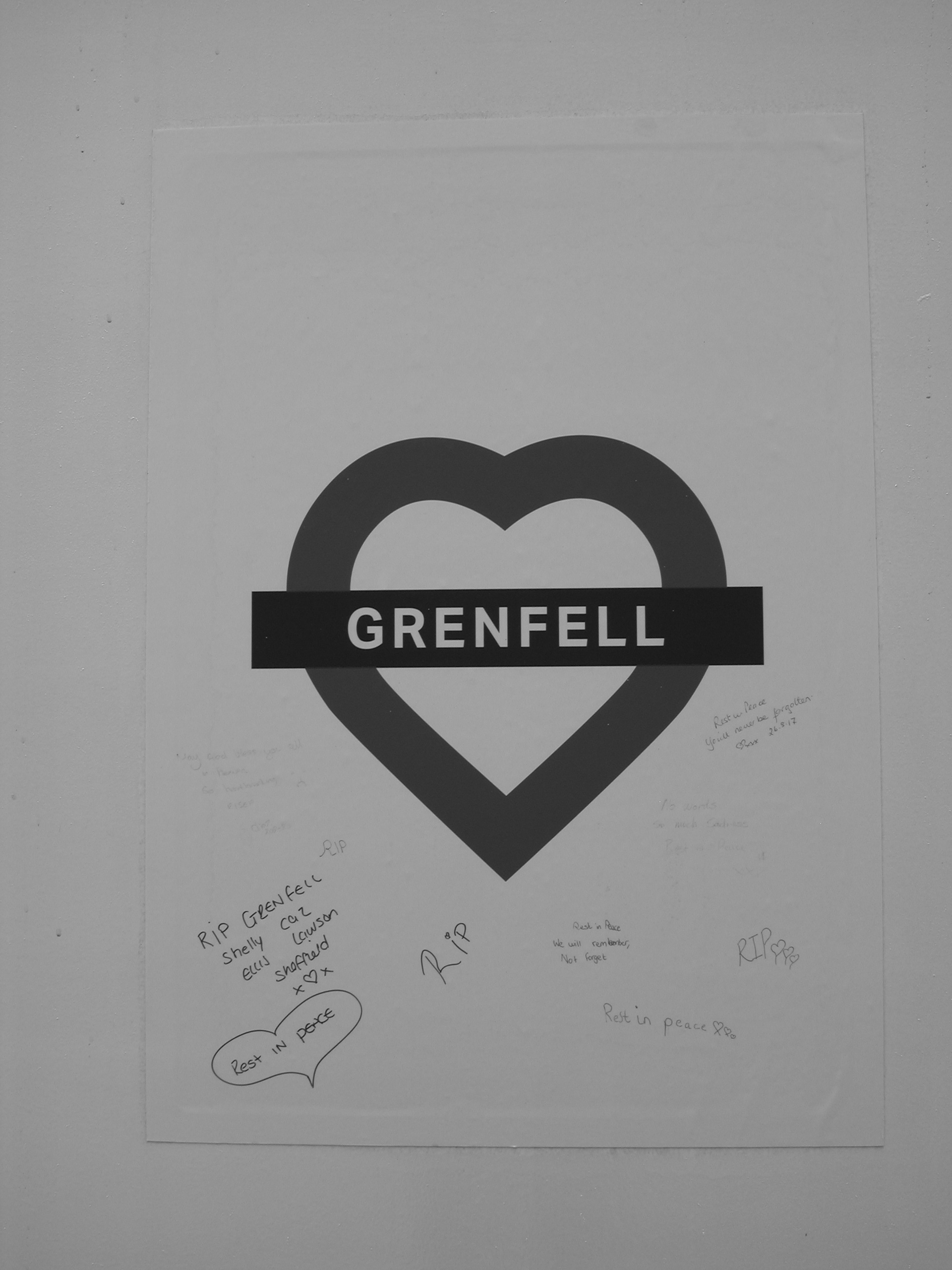
The photographs were taken during my 2 x 10mile walks around Kensington and Chelsea in August 2017 to collect sound and image material for a "sound portrait" of the borough. Three months after the fire the tributes were still there.
2017 text
It seems
fitting right now that a new series of Twins Peaks is appearing on our screens.
David Lynch's most well known production about a small town in the North of the
United States, traumatised by the slow revealing of its dark underbelly could
be a metaphor for Britain in2017. The original series began with the murder of a
local homecoming queen; an act which on the surface appears totally out of
place amid the scenes of bucolic small town life; a darkness that could only
have been visited upon the community from outside. Eventually the surface is
broken to reveal that what appeared wholesome, functional and everyday was
built upon layers of corruption, violence and lies. The darkness which seemed
to have come from outside is discovered to be rooted at the very foundations of
the town itself. In the last few weeks something similar may be happening in
Britain.
Two
terrorist attacks, one surprise election result and one horrific tower block
fire have left Theresa May's beleaguered premiership teetering on the brink.
More important than that; more important for the possibility of lasting radical
change, is the feeling, palpable in the country, that some hitherto unknown
darkness, which the powers that be have spent the best part of two decades
telling us was outside, out there" trying to destroy our way of life",
is in fact right here. It runs through everything, from the transformation of
London into a vast foreign investment portfolio, to the filthy money and
weapons moving back and forth from Western governments to the Middle East, from
the cuts to public services and the doctrine of austerity, to the acts of mass
murder in Manchester and London, and of course this week in one of the richest
places on earth, the abandonment of the country's poor to death by fire in
their own homes.
It started
after the Manchester Arena bombing when the role of the intelligence services
and Theresa May's Home Office in maintaining an extreme anti-Gaddafi faction
(The Libyan Islamic Fighting Group) was revealed, and that the then home
secretary had allowed bomber Salman Abedi to travel age 16 to fight in Libya and
to return unhindered. ().
Only a few weeks prior she was seen virtually kissing the hands of Saudi King Salman bin Abdulaziz Al Saud while agreeing a multi-billion pound weapons
deal with the Wahhabist state that is currently using those weapons and others
supplied by the US to pulverise parts of Yemen back into the Middle Ages,
creating the world's most serious food crisis, which the UN has described as a
"man-man humanitarian catastrophe". Those weapons she told Parliament
back in September 2016 were important to "keep people on Britain's streets
safe".
The polls were already closing as we entered June. The Prime
Minister's robotic and evasive non-performances could scarcely be defended by
her own party, while Jeremy Corbyn was seen addressing thronging crowds wherever
he went and seemed at ease among ordinary people drawn to his program of an end
to austerity and renewed investment in public services. An arrogant and
skeletal manifesto followed from the Tories which few cabinet ministers had
even seen before being asked to defend. May's bunker mentality extended to her
own party. Like the aging Emperor Claudius she relied on a few personal
advisors for her connection to the real world. When called out on the blatant U-turn
over the so-called dementia tax she steadfastly denied anything had happened.
Like her speech in front of Downing St the day after the election, she seemed
to occupy a different logical space to the rest of mankind. Strong and stable -
the mantra with which she called the election, began to look at best deluded,
if not mildly deranged.
Then on June 2nd, six days before the polls opened, another atrocity.
The van and knife attack at London Bridge instead of playing into the
government's rhetoric on security and stability seemed to have the opposite
effect. Labour grabbed the initiative, focusing the public debate on cuts to
police numbers during Theresa May's time at the Home Office. And again there
were noises on the periphery about the State's role in doing deals with
countries known to finance terror organisations. In the same week Donald Trump
heralded the isolation of Qatar by its neighbours for just this reason and then
sold $12bn of weapons to them.
In an irony that few noticed, the Shard of Glass, a vast middle finger of
capitalist domination that looms over the once Dickensian area around London
Bridge, is majority owned by the Qatari state and was constructed as part of a
large project of "regeneration" which saw many old established
businesses forced out by compulsory purchase orders and soaring rents.
The election result, despite leaving the Conservatives as the largest
party felt like a renewal; a vindication of ideas and a form of politics that
many thought had been lost to cynicism, Neoliberal individualism and more
recently the fallout from Brexit. Instead Labour's leader stands tall at the
head of a movement which since the election result has swelled the ranks of his
party beyond 800,000. Rather than Brexit, immigration, stability or even
security, the public discourse was dominated by the issues of austerity, cuts
to public services and a genuine feeling - for the first time in decade - of a real
choice at the ballot box. The Prime Minister was visibly crestfallen , reduced
to repeating the same broken phrases from the campaign, before submitting hers
and her government's future to the creationists, anti-abortionists and
religious zealots of the Democratic Unionist Party. Now Grenfell Tower has
happened.
I switched on the radio as I do every day on my 5am drive to work and
for the third time in as many weeks I immediately gauged that sombre
professional BBC tone that is their hallmark at times of tragedy. This, at the
end of weeks of shocks and reversals seems to bring everything together into
one brutally tragic denouement. The poorest people in the richest borough in
the country, suffocated and burnt to death in their homes after being
threatened with legal action for publically raising fire safety concerns. An
unaccountable quango inflicting "beautification" upon their building
for the benefit of the surrounding rich; work that seems likely to be the cause
of this unprecedented fire.
The terrible sight of the tower engulfed in flame and the harrowing
stories of those within are mirrored by the unrestrained anger of the survivors
and general public. For the first time in my memory such an event was covered
immediately from the perspective of politics, class and inequality. Despite
that, animosity from the residents towards the media is clear, with even the
doting Jon Snow of Channel 4 News getting a hard time on the ground. Again and again
the same grievances are heard in interviews; cuts, gentrification, abandonment,
inequality and stigmatisation by the media.
The image of Theresa May at her private audience with a select few
senior fire and police officers may be defining for her. Watching the coverage
you become aware that separations so many of us are used to taking for granted
are collapsing. The sort of scenes of anguish we're used to seeing in
Alepo or Bangladesh, here in one of the richest places on earth. The sort of
testimony of trauma we're used to hearing translated. Weeping women
pace the streets carrying pictures of loved ones missing in the inferno. In the
era of Globalisation, argued Michael Hardt and Antonio Negri in their book
Empire, there is no longer any geographical separation between first and third
worlds, they exist together side by side. The greatest poverty amid the
greatest riches, the greatest suffering amid the greatest prosperity. People
made homeless by the fire and their supporters have stormed the offices of
Kensington and Chelsea council, demanding help and justice.
Something has been emerging over the last month, confirmed by the
electoral slap delivered to Theresa May's Conservative and Unionist Party and
their arrogance in expecting a fearful, compliant electorate to hand them a landslide.
People aren't buying it anymore, and there is a sense that the repeated blows
of tragedy during this time of political choice has had the effect of focussing
attention on the state of Britain like never before. But more than that, what
may be coming to consciousness for the first time in British society is the
connection between things; the common substance linking all these events. Let
us call the devil by its name: The Market. Not the market as talked about by
the classical economists of the 18th and 19th century, not even the free market
talked about in relation to exiting the EU. This is the Market not as something
that exists, but as an idea, something transcendent and ineffable against which
everything else is evaluated. This is the Market as first cause and first
principle from which all human conduct should be measured. Indeed, from the
idea of Market comes a whole anthropology of what the human being is and what a
human society should look like. Not the political animal of Aristole but homo economicus. Not
the community of equals striving to build the Just City but a network of freely
contracting individuals, rationally calculating according to their own
self-interest.
It is from commitment to this idea of the Market that successive
governments have sold off Britain's public services, attempting as much as
possible to make Britain mimic that idea. It is from the idea of the Market
that Britain takes money from corrupt undemocratic regimes like Saudi Arabia
and Qatar in exchange for weapons, despite their known involvement in the
funding and dissemination of Islamist extremism. It is from the idea of the
Market that police numbers are cut making it harder to detect and prevent that
same terrorist extremism. It is from the idea of the Market that council
housing is sold off or run down to make way for lucrative private developments
that (in London in particular) are beyond the reach of those on ordinary wages.
And it is from that same idea of the Market that so much of this new private
housing stock is sold to foreign investors and left empty while homelessness
spirals and the poorest have to live in dangerous, decrepit rented
accommodation. Finally it is from the idea of the Market that the welfare state
should be transformed (where it is not destroyed)in concert with profit seeking
private companies into a apparatus for coercing people into the appropriate
market behaviour, which equates to a life of precarious living, "bullshit
jobs" (to borrow David Graeber's phrase) and permanent uncertainty.
At every level from major corporations and transnational organisations
like the IMF, World Bank and the EU, to national governments and on down to
local councils, the same idea, the same first principle of governance is applied
and used to guide decisions and orientate human action. This is the almost
metaphysical thread that runs through globalisation. It is only in the Neoliberal
era, when the State was weaponised against Welfare and the unions, and the
separation between public and private, State and free enterprise has all but
collapsed, that the idea of the Market was able to become the totalising global
principle it now is.
There is no single name for what I'm describing. Globalisation has
been the common term but I prefer to use the expression One-World Governance. Everywhere
it is transforming human life, bringing inequality, breaking up communities and
breaking down forms of solidarity that don't adhere to the idea of the Market. This
is the form-of-life, hierarchically ordered that today holds sway across the
world. Until recently the violence that this system brings with it has been mostly
kept at the periphery. Since the global crash in 2007 that separation too has
now collapsed. Whether it is life permanently under the threat of terrorism, or
amid the tragedy and ruins of Grenfell Tower, life under One-World Governance
is a unfolding catastrophe. Change is undoubtedly in the air and the centre
ground has all but vanished. Sides are being taken, battle lines drawn. Even if
the tragedies of the last month do lead to lasting change it will take a shift
of global proportions to redirect humanity from the course it is currently
on.
I have an ambivalent
relationship with the Southbank centre, which functions a little like the other
side of a Yin and Yang relationship with Cafe Oto. In comparison with the cosy
familiarity of Oto, the Royal Festival Hall, Queen Elizabeth Hall and
surrounding panoply of chain shops, bars and restaurants can seem paradigmatic
of corporate saturated arts entertainment. I don't think this is an inaccurate
description, but never-the-less I've undoubtedly had some of my most cherished
live music experiences at the Southbank going back over 15 years. Also, as an
aside, my university graduation ceremony was held at the Royal Festival Hall in
2003.
One of my
earliest memories there was being blown away by a long weekend of performances
of the music of Iannis Xenakis - hardcore modernist and erstwhile Greek
resistance fighter (against the British I might add) - in 2004. A lightshow accompanied
the electro-acoustic dissonances of his long-form tape piece La Legende d'eer, and I witnessed the
most physical piano playing I've ever seen for Eonta; an example of the composer's "stochastic" music,
with a score incorporating mathematical probabilities worked out by an IBM 7090
computer. In my mid-20s that stretch
of the Thames was practically a second home and I'd spend sometimes two days a
week roaming between London Bridge and Ralph Downes'
post-war Brutalist edifices at the Southbank centre.
It was a
more chilled out place back then, a place you could linger with a book and a
coffee. Since the refurbishment project in the mid 2000s the area around the
RFH has gradually seen the introduction of more chain restaurants, bars and faceless
entertainment tat. A near permanent "street food" market is installed
along the river promenade and wherever you look there are a dozen ways to be
relieved of your cash. The area is now what they call a
"destination". So much, so London.
The question
I ponder is whether I would have been able to see such a mind blowing event as Karlheinz
Stockhausen's opera Donnerstag aus licht,
which I did in May last year, if it weren't for all the money undoubtedly
generated by the "destination" industry. Who knows, but it's
difficult to hold a grudge when you're treated to a such a feast of drama,
humour, cosmic energy and maniacal genius. The opera is just one out of seven
parts that make up the German composer's vast Licht cycle, each
corresponding to a day of the week and which loosely explore the history of
humanity as a cosmic saga. Mostly though Donnerstag
(Thursday) is an autobiographical piece of almost unfathomable egoism which
casts the composer himself as a semi divine figure on a quest to redeem the
world through music.
Named as
Michael in the libretto, the composer is shown at three stages of life, from
his childhood in the 1930s, during which time his mother is committed to an
asylum and later murdered by the Nazi's; through his formative years as an
aspiring composer and "world traveller" in Reise um die Erde, though to a redemptive final act in which threefold
Michael - seemingly evoking the archangel of that name - does battle with
Lucifer, variously appearing as a sort of goblin, a dragon, and a tap dancing
trombonist. The last of these three is forced to the floor by the sound of Michael's
trumpet and plays the rest of his part from a prostrate position. All of this
could come across as a little vaudeville, and there were some genuinely funny
moments, but the overall feeling was one of uncommon dramatic and musical
force.
This was
especially so in the stunning last act where a lightshow involving lasers and
giant mystical symbols projected round the hall combined with a fivefold choir
distributed above the main stage. The orchestra too was similarly split-up
around the performance space. Together this arrangement perfectly showcased
Stockhausen's theories of musical spacial dynamics, rhythm and timbre, as Maxime
Pascal conducted the choral and orchestral parts into waves of sound, which
from the centre of the hall appeared to sweep across the space, combine,
articulate and disarticulate in the most mind boggling ways. As I walked out,
euphoric, into the warm Spring air, surrounded by tourists and Saturday night
revellers, I thought of the strange duality of venues like the Southbank
centre, where almost transcendent works of art can be situated within a general
atmosphere of stultifying banality and mass consumerism. For how long this
tension can continue is anyone's guess.
I should
caveat that comment by noting that in few weeks later in July I saw a showcase
of the small, independent label Village Green at the Queen Elizabeth Hall (the
RFH's little sister venue) which despite being on a much lower budget managed
to put on a memorable night of electronically inflected modern classical music.
Ben Chatwin's set, drawing on his two albums from 2018, was a masterclass in integrating
live electronics with classical instrumentation. The composer/musician
orchestrated things from behind his large modular synthesizer in duet with a
single cellist seated centre stage. The perfectly pitched dramatic and filmic
soundscapes, in combination with a tasteful light show accompaniment brought to
mind the best of Hans Zimmer or the late Jóhann Jóhannsson. Despite this
seemingly stripped down arrangement the music easily filled out the Purcell
concert space.Much appreciation went to
the efficient air conditioning system at the venue, which did fine work on what
was the hottest day of the year.
Since I'm
covering the better known and funded of London's arts venues I should give a
mention to the Barbican centre which I would contend in general has a broader
and more radical program of performances compared to the Southbank, and 2019
was no exception. All but one of my four visits were in the last three months
of the year and took in Alessandro Cortini and Suzanne Ciani's trippy modular
synthesizer music as well as elegiac piano improvisation from Nik Bärtsch. The Bärtsch
show, part of the London Jazz festival and titled When the Clouds Clear, was
a collaboration with artist Sophie Clements, who created a very Zen performance
space within the Barbican's main hall, requiring the Swiss pianist to cross a
small bridge across a pool of water to reach his piano stool.
I'd seen Bärtsch
at the Barbican some years before fronting his "Zen funk" band Ronin; all complex polyrhythms and nods
towards playful Reichian minimalism. Here, alone at the keys, a more expansive,
less formally constrained pianist emerged. As a shaft of light projected from
above passed slowly across the water surrounding the piano, Bärtsch is leaning
inside the instrument, scraping, tapping and plucking at the wires. Passages of
free improvisation like this break out into slowly developing rhythmic
excursions, vaguely following the images projected behind him. A drifting
melodic improvisation accompanies scenes of endless sunlit seas, which as the
weather turns stormy transform into a maelstrom of repeated percussive strikes
on the keys. These shifts from melodic to atonal and rhythmic playing were
particularly affective, never more so as the storm clouds cleared and the light
shining down upon Bärtsch's watery performance space was mirrored by an equally
bright shift in tone colour and accent.
There was an
undoubted romance to some of these scenes of nautical and environmental strife,
and Bärtsch's response to them; as if the studied and metaphysically restrained
form of his other groups had to be resolutely left behind and something of the
human in raw confrontation with nature made to appear. I'd taken the risk of
bringing a new partner to the show, perhaps half-knowingly as a test. Though
not a regular concert goer or aficionado of the byways of jazz and classical
music, she was moved by the uncommon mix of pathos and brute nature that was brought
into conjunction during that all too brief hour.
The other
performance of note, bringing together two brilliant black multidisciplinary
artists and electronic musicians was Moor Mother (Camae Ayewa), who headlined a
show accompanied by the London contemporary orchestra and supported by fellow
traveller Klein. The former brought to the Barbican's Milton Court Concert Hall
an eerie visual and sonic incantation titled The Great Bailout (a reference to compensation paid to slave
owners) which the venue described as a free verse poem that acts as a
non-linear word map about colonialism, slavery and commerce in Great Britain
and the commonwealth. Backed by a giant LED light union jack and flanked by an heterodox
ensemble of percussion, strings, and piano, Ayewa riffs on the words to the
English national anthem, which in her hands becomes a post-apocalyptic funeral
dirge in remembrance of the victims of British and European colonialism in
African and the Caribbean. "Has the Queen been saved? Have her plantations
been saved?" she intones as short bursts of martial drums cut across
string glissandi.
This was my
second encounter of the year with the London Contemporary Orchestra, after a
baffling experience in May watching Robert Ames conducting an interpretation of
Stockhausen's Welt-Parlament with
contributions from avant-techno explorer Actress and his AI project Young
Paint. The AI's contribution, apart from fidgeting on a screen to the right of
the stage, was little more than firing off the occasional random spoken phrase
based on Stockhausen's admitted quite barmy score which uses a choir to stage
an imaginary world parliament debating the nature of love (always with the big
ideas that man). Young Paint continues the trend of artificial intelligence appearing
either terrifying or shit; there appears to be no middle ground. The players
performing with Moor Mother raised themselves to the task of improvising around
her jittery electronics and powerful poetry, with only the occasional shoehorning
of an ascending piano scale sounding a touch out of place amid Ayewa's
smouldering and primarily atonal sturm
and drang.
Larger
concert halls such as these carry with them the risk of audience disengagement.
That you are often at a considerable distance from the performers can lead to
torpor or estrangement; the mind can wander, and not every audio/visual show
can adequately fill such spaces as they have at the Barbican and Southbank.
There was something a little forlorn about Alessandro Cortini behind his little
table at the centre of that huge stage, hands busy with Buchla synthesizer and
sundry audio processing devices. Conversely the small venue or club space
remains the heartland of live electronics. There's some music that just doesn't
feel right experienced sitting down in the comfy seats. There were no such
thing in April last year at Aures, a relatively new space built into an arch
buried below Waterloo station next to the famous "Banksy tunnel".
What took the Royal Festival hall a hundred musicians and an extensive audio/visual
set-up, required just a sound system, a smoke machine and some blue UV lights
for Roly Porter.
Porter is an
interesting guy whose music came out of the aggressively highbrow post-dubstep
of Vex'd in the mid-2000s. Over several albums - mostly released on Subtext
Recordings - Porter has patented a lead-heavy form of bass centred
electro-acoustic music, something like Xenakis might have made if he'd been brought
up on Jungle rather than serialism. The comparison isn't entirely fatuous, both
composers have a penchant for grand themes; in 2013 Porter released an album
titled Life cycle of a Massive Star, attempting
to soundtrack just that, and his latest is inspired by Neolithic burial sites
and features vocalists specialising in early Medieval music. The performance I
saw was of material drawn from Third Law,
his 2016 album on Tri Angle records, which seemed to function almost as a
work-out for the venue's immersive 360o sound system.
Roly Porter at Aures
Earlier we'd
been treated to Vaporwave outlier Bruised Skies frying our brains with bass
heavy drone music which was like being inside the biggest church organ on earth
while a giant played all the pipes at once. Porter's music had more light and
shade, well it had different shades anyway. Passages of rolling industrial
noise open out into processed choral and ambient electronic sound. There are
hints of the sharper edges of Musique Concrete and electro-acoustic music;
strings rise up out of the seething mass of low end reverberations only to be
crushed by an incoming wave of metallic rhythm. With all the smoke, blue light
and pummelling audio tectonics you'd be forgiven for believing yourself part of
some military backed psychological experiment in sensory overload.
Round the
corner is another small alternative venue to the Southbank, where no such brute
displays of multi-sensory muscle are on show. Iklectic is part of a community
space which includes an urban farm, a theatre and a couple of tech start-ups.
Essentially a reclaimed shed, in April I saw Dave Knight and Steven Thrower's
post-industrial psych outfit Unicazurn put on a suitably trippy performance of
boiled electronics and saxophone improvisation. Thrower spent a number of years
as a member of Coil, perhaps the most celebrated and cultishly adored of the
2nd wave of industrial acts. Their quasi-mystical and often quite subversive
music drew heavily on the English esoteric tradition from Aleister Crowley to
William Blake. It was a nice coincidence that opposite Iklectic is Centaur
Street which has been decked out in mosaics replicating some of Blake's images
from works like The Marriage of Heaven
and Hell and Europe: A Prophecy.
The street
is located near to the former site of The Hercules buildings (nice for the
modern street to continue the theme of mythical figures), where Blake and his
wife Catherine lived from 1790 to 1800. I can in some tangential way thank
Blake for introducing me to Coil in the late 90s after discovering Norwegian
avant-black metal band Ulver's album Themes
from William Blake's The Marriage of Heaven and Hell. The Scandinavian
group were Coil fanboys, drawing similar inspiration from the English poet and
engraver as a symbol for an alternative notion of England to that which
developed out of the Industrial Revolution and Victorian age. It's a
countercultural aesthetic that remains very close to my heart.
Reclaimed
spaces like Iklectic are very much in vogue, often following in the wake of
gentrification. It's unsurprising then that East London has more than it's fair
share, repurposing the area's manufacturing and industrial heritage as a playground
for Home Counties parvenus, whose taste for all things twee and
"local" disguises an aggressive tendency towards exclusion. Next time
a white middle class person heralding from Oxfordshire tells you how "up
and coming" Leyton or Forest Gate have become, ask yourself 'who is it
that is being moved on to make this happen?' This is the dark side of all this
chirpy hipster fun and games I've been describing. Iain Sinclair calls London
the captured city; captured that is not by this or that corporation or shadowy
group, but by the forces of finance, of"development"
itself. Never did so plain a word harbour such significant consequences for
those subjected to its irresistible advance.
Few boroughs
have experienced more of this than Hackney. The Pickle factory, close to the
Bethnal Green gas holders, is another reclaimed space now operating as part of
a multipurpose arts/entertainment/commerce venture, which in addition to the
ubiquitous cafe also includes corporate events space and a creative co-working
space for enterprising gig economy types. Demand for the latter seems likely to
suffer post-covid (the new PC). In late June I experienced a lovely evening of
immersive ambient music headlined by Rod Modell's Deepchord and The Chi Factory
(Hanyo van Oosterom) all whilst reclining on pillows distributed around the
stage. All these kinds of places are rustic and basic in what they offer; a
pop-up bar, little by way of seating, but also the chance to get up close and
personal with the artists; that's the sell, that's why I go.
A mile north
as the crow flies from the Pickle Factory is the rechristened Victorian public
house The Glove That Fits. Another new venture of the last three years, turning
what must have been a humdrum boozer into yet another edgy arts venue. Truth be
told the sound system is great and the atmosphere in the dank basement (dank in
the conventional way) is a tight, improbably shaped space to experience more of
the Capital's cutting edge electronic music. I was there to see a fairly unique
line-up of "post vaporwave" artists associated in one way or another
with the Dream Catalogue label, fronted by alternative scouse rapper and enfant
terrible of the "Dreampunk" scene David Russo (otherwise known as
HKE, Air Japan, DARKPYRAMID, Martin Smith, Future City Love Stories, Henry
Moonchild and at least two dozen other monikers).
For an
ostensibly internet based music scene the turnout wasn't bad. The music, which takes
influences from pathos soaked variants on ambient techno, to trap, dubstep and even
Kpop, wasn't bad either and had the crowd of mostly lone hoodie wearing white
males dancing along. You couldn't imagine a gig like this happening in any
other part of the UK. For better or worse London, and the East End in
particular has become a global Mecca for the cutting edge of electronic music,
second only perhaps to Berlin.
Practically
all the experiences and anecdotes above involve significant proximity to other
gig goers. That's part of the fun. A sparsely populated gig is rarely a good
one and at least part of the joy of live music is experiencing italongside other people as enraptured with it
as you are. As long as coronavirus legislation is active then the kinds of
intimate venues described above will remain closed. After all, intimacy itself
has more or less been banned. Music venues as sites of mingling, where
individuals and bodies loosen their boundaries, allowing something of the other
to enter are thus under serious threat. Modern power has an innate fear of the
kinds of scenes one witnesses at a rave,rock concert or intimate live performance. From a certain perspective
those bodies tightly packed-in, losing themselves in the sights and sounds of
the show, are analogous to political protests, the gathered multitude. These
are events of noise, crowds, and a certain release, if only temporary from our
lives of possessive individualism.
The doors of
music venues across London and indeed Europe have been closed for half a year.
The larger ones, the Barbicans and Southbanks and Royal Albert Halls of this
world may well have the resources and cash reserves to survive, though almost certainly
not without shedding a large number of the their staff; a process which is well
underway across the arts sector. Smaller venues like those I've described above
may very well not survive at all. Many are run on a shoe string, leveraging the
good will of volunteers while building links with their local community.
While the
government has prioritised getting shops, pubs and restaurants back open, next
to nothing has been done to safeguard the arts sector, least of all proposing
some way music venues and theatres can reopen their doors. With no end in
sight, and indeed a second wave of the pandemic seemingly on the way, the
prospects looks bleak. Live music in London is a shining beacon in what can otherwise
be a very alienating and unfriendly place. More than that it's an activity that
can break down the doors of perception, allowing an escape from the everyday
and opening people up to new sensations beyond what is spoon fed to us by the
culture industry.That culture industry
- the counterpart to the world of finance and "development" - would not
mourn the loss of London's small independent venues. Unless the tide turns and
the arts sector is either supported or allowed to reopen then we may emerge
with a very different and lamentable live arts landscape.
... the
corporate muzak echoing through socially distanced covid-secure bars drowns out
the sound of silence from London's once vibrant live music scene ...