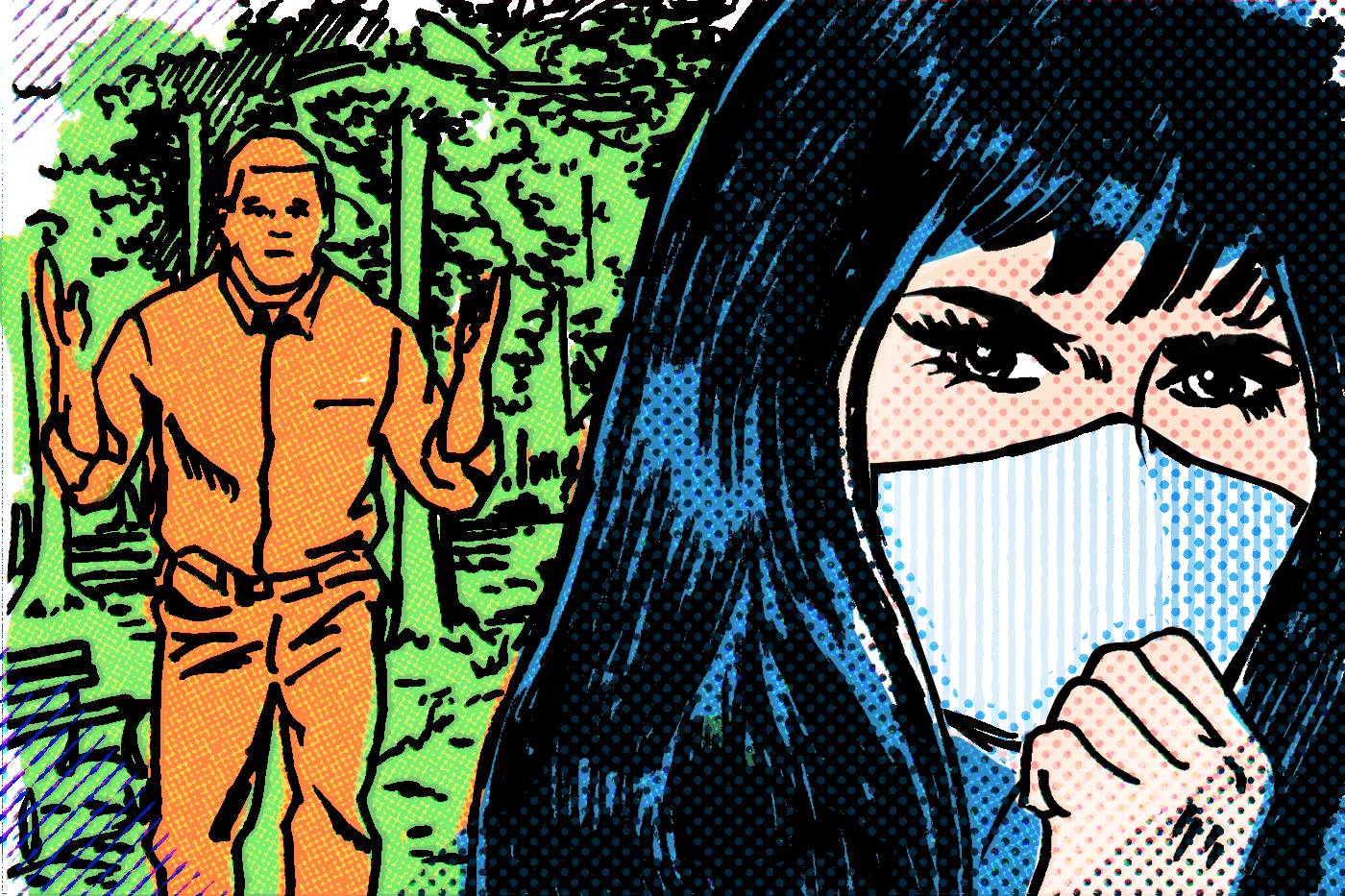
On the eve
of yet another round of rule changes and legislation to bring in new nationwide
restrictions, it is time for a statement of the obvious. The mandating of face
masks in public places has been a complete failure as an attempt to prevent a
second wave of Coronavirus infections across Europe. The question remains as to
why masks have become such a shibboleth for so many people; so politically
symbolic and socially divisive.
I, like the
majority of the population have gone along with the requirements as they have
evolved over the last few months; from first having to mask-up on public
transport, then in shops, and finally the somewhat absurd ritual of wearing
them when standing up in a restaurant or pub between my table, the door and the
toilet. But let me be clear, I have gone along with this not because I thought
that I was contributing to the general “fight against the virus” or that I
believed mass mask wearing would prevent a second wave of infections. I did
this principally to avoid confrontation, to avoid explaining myself and being
treated like a leper. I prefer a quiet life moving across the city rather than
having to fight my way from East to West with my face uncovered. I have my
suspicion that many other people are similarly motivated.
The mass
psychology of mask wearing is something that will furnish many a thesis in the
years to come. “But the science shows” … enough! There is no more science in
the wearing of masks than when your grandmother told you to cover your mouth
when coughing. The difference is that until now no one proposed making her advice
the subject of legislation which could lead to financially ruinous fines or
incarceration. Many things can be speculated about the mass wearing of masks
and we should remember that until the beginning of the summer the general tilt
of that speculation was towards the “don’t know” or “probably won't make much
difference” camp. Indeed the World Health Organisation has never claimed that
masks in themselves have a role in significantly reducing infection rates when
mandated for the general population, nor as yet has there been evidence to the
contrary. This was good honest advice and after all, what exactly would such
evidence look like and where would it come from?
The basic
proposition that a covering over one’s face reduces the spread of infectious
agents into the surrounding air is obvious and clearly doesn't need any major
research studies to demonstrate. As I said, even your grandmother knew this.
The problem is that there is so little data and practically no way of modelling
the effects of masked vs mask-less approaches in different settings during a
pandemic situation. One of the reasons for this, as should be plain from the
ever changing pronouncements on rates of infection, is that the hot spots are
constantly changing. One week it’s transmission in the home between households,
the next it’s between groups of friends in pubs, then it’s students in halls of
residence. None of these pronouncements, backed up by data which is at best
opaque and at worst dubious, is able to tie in how mandated mask wearing has
succeeded or failed in each case.
To put it
bluntly the entire discourse around masks is hyperbolic, and while “common
sense” tells us - just like your grandmother used to - COVER YOUR MOUTH!, the
reality is that it has made no demonstrable impact in preventing the virus
getting out of control across Europe once again. And we should remember that
many countries introduced mask wearing in public places earlier than the UK. It
didn’t save them, it isn’t saving us. You might well object and claim that “if
it weren’t for the masks our infection rate would be even higher!” That may be
true, but it’s only speculation, and we’re being “led by the science” yeah? The
bottom line is that the basic claim that mass mask wearing would control the
infection rate and help prevent another national lockdown has proved to be
false. And yet the discourse around masks, on TV, radio and on the street would
have you believe that they are still the only thing between us and total
oblivion. How did we get to this point?
In the face
of such a counterintuitive response there is only one conclusion; masks have
become a collective comfort blanket.
This
shouldn’t surprise anyone that was paying attention to the rhetoric around
masks back when their introduction was mandated at the beginning of the summer.
In his speech of the 5th of June World health Organisation director
general Dr Tedros Ghebreyesus summarised the issue in these five points:
-People can
potentially infect themselves if they use contaminated hands to adjust a mask,
or to repeatedly take it off and put it on, without cleaning hands in between.
-Masks can also
create a false sense of security, leading people to neglect measures such as
hand hygiene and physical distancing.
-I cannot say this clearly enough: masks alone will
not protect you from COVID-19.
-Masks are not a replacement for physical
distancing, hand hygiene and other public health measures.
-Masks are only of benefit as part of a
comprehensive approach in the fight against COVID-19.
As the
summer sneaked in and lockdown measures were relaxed there was a general push
across Europe and America to get people back to work and the economy up and
running again. Both these aims required that people return to workplaces, use
public transport and visit restaurant and hospitality businesses. Here we
should absolutely note the second of the Director General’s points, that masks
can create a false sense of security. A sense of security? False, perhaps,
but from the perspective of politicians wanting to get the economy up and
running, absolutely desirable. During the summer we were bombarded with
positive rhetoric about “Covid security”, all the while playing up the role of
masks in both “keeping you safe” - still in contradiction to the WHO
advice - and preventing another lockdown. Could it be that this rhetoric which
has metastasised into yet another front in the Culture War was cynically
deployed as part of a strategy of providing false security and getting the
economy up and running again?
A second
related effect of the obsession with face masks is that it conveniently
deflects criticism of the government’s handling of the pandemic onto “selfish
anti-maskers”, or “Covid deniers”. We find ourselves projecting all our anger
and fears onto that stranger huddled in the corner of the train carriage,
furtively pulling down his mask below his nose. All the tens of thousands of
deaths and disruption to our daily lives is suddenly heaped upon his shoulders,
and we sit fuming hoping that the weight will crush him to a bloody puddle
before our eyes. Nothing is more useful to an incompetent government than a
public ready to scapegoat anyone but it for the situation we find ourselves in.
I’m not
proposing mass disobedience to the mask regulations. I have my justification
for complying and in many instances there is little enforcement anyway. Masks,
and the pathological rhetoric around them are irritating and a pointless locus
for staging a protest. By blaming each other for non-compliance and wanting to
“kill my grandparents” we avoid the real battleground which is the accelerating
destruction of democratic life and its replacement with a totalitarian digital
dystopia which every day is tightening its grip. The question that few are seriously posing is what kind of world do you wish to survive into? Moving “beyond the mask” means
(metaphorically at least) casting off the comfort blanket and looking reality
in the face.
I have an ambivalent
relationship with the Southbank centre, which functions a little like the other
side of a Yin and Yang relationship with Cafe Oto. In comparison with the cosy
familiarity of Oto, the Royal Festival Hall, Queen Elizabeth Hall and
surrounding panoply of chain shops, bars and restaurants can seem paradigmatic
of corporate saturated arts entertainment. I don't think this is an inaccurate
description, but never-the-less I've undoubtedly had some of my most cherished
live music experiences at the Southbank going back over 15 years. Also, as an
aside, my university graduation ceremony was held at the Royal Festival Hall in
2003.
One of my
earliest memories there was being blown away by a long weekend of performances
of the music of Iannis Xenakis - hardcore modernist and erstwhile Greek
resistance fighter (against the British I might add) - in 2004. A lightshow accompanied
the electro-acoustic dissonances of his long-form tape piece La Legende d'eer, and I witnessed the
most physical piano playing I've ever seen for Eonta; an example of the composer's "stochastic" music,
with a score incorporating mathematical probabilities worked out by an IBM 7090
computer. In my mid-20s that stretch
of the Thames was practically a second home and I'd spend sometimes two days a
week roaming between London Bridge and Ralph Downes'
post-war Brutalist edifices at the Southbank centre.
It was a
more chilled out place back then, a place you could linger with a book and a
coffee. Since the refurbishment project in the mid 2000s the area around the
RFH has gradually seen the introduction of more chain restaurants, bars and faceless
entertainment tat. A near permanent "street food" market is installed
along the river promenade and wherever you look there are a dozen ways to be
relieved of your cash. The area is now what they call a
"destination". So much, so London.
The question
I ponder is whether I would have been able to see such a mind blowing event as Karlheinz
Stockhausen's opera Donnerstag aus licht,
which I did in May last year, if it weren't for all the money undoubtedly
generated by the "destination" industry. Who knows, but it's
difficult to hold a grudge when you're treated to a such a feast of drama,
humour, cosmic energy and maniacal genius. The opera is just one out of seven
parts that make up the German composer's vast Licht cycle, each
corresponding to a day of the week and which loosely explore the history of
humanity as a cosmic saga. Mostly though Donnerstag
(Thursday) is an autobiographical piece of almost unfathomable egoism which
casts the composer himself as a semi divine figure on a quest to redeem the
world through music.
Named as
Michael in the libretto, the composer is shown at three stages of life, from
his childhood in the 1930s, during which time his mother is committed to an
asylum and later murdered by the Nazi's; through his formative years as an
aspiring composer and "world traveller" in Reise um die Erde, though to a redemptive final act in which threefold
Michael - seemingly evoking the archangel of that name - does battle with
Lucifer, variously appearing as a sort of goblin, a dragon, and a tap dancing
trombonist. The last of these three is forced to the floor by the sound of Michael's
trumpet and plays the rest of his part from a prostrate position. All of this
could come across as a little vaudeville, and there were some genuinely funny
moments, but the overall feeling was one of uncommon dramatic and musical
force.
This was
especially so in the stunning last act where a lightshow involving lasers and
giant mystical symbols projected round the hall combined with a fivefold choir
distributed above the main stage. The orchestra too was similarly split-up
around the performance space. Together this arrangement perfectly showcased
Stockhausen's theories of musical spacial dynamics, rhythm and timbre, as Maxime
Pascal conducted the choral and orchestral parts into waves of sound, which
from the centre of the hall appeared to sweep across the space, combine,
articulate and disarticulate in the most mind boggling ways. As I walked out,
euphoric, into the warm Spring air, surrounded by tourists and Saturday night
revellers, I thought of the strange duality of venues like the Southbank
centre, where almost transcendent works of art can be situated within a general
atmosphere of stultifying banality and mass consumerism. For how long this
tension can continue is anyone's guess.
I should
caveat that comment by noting that in few weeks later in July I saw a showcase
of the small, independent label Village Green at the Queen Elizabeth Hall (the
RFH's little sister venue) which despite being on a much lower budget managed
to put on a memorable night of electronically inflected modern classical music.
Ben Chatwin's set, drawing on his two albums from 2018, was a masterclass in integrating
live electronics with classical instrumentation. The composer/musician
orchestrated things from behind his large modular synthesizer in duet with a
single cellist seated centre stage. The perfectly pitched dramatic and filmic
soundscapes, in combination with a tasteful light show accompaniment brought to
mind the best of Hans Zimmer or the late Jóhann Jóhannsson. Despite this
seemingly stripped down arrangement the music easily filled out the Purcell
concert space.Much appreciation went to
the efficient air conditioning system at the venue, which did fine work on what
was the hottest day of the year.
Since I'm
covering the better known and funded of London's arts venues I should give a
mention to the Barbican centre which I would contend in general has a broader
and more radical program of performances compared to the Southbank, and 2019
was no exception. All but one of my four visits were in the last three months
of the year and took in Alessandro Cortini and Suzanne Ciani's trippy modular
synthesizer music as well as elegiac piano improvisation from Nik Bärtsch. The Bärtsch
show, part of the London Jazz festival and titled When the Clouds Clear, was
a collaboration with artist Sophie Clements, who created a very Zen performance
space within the Barbican's main hall, requiring the Swiss pianist to cross a
small bridge across a pool of water to reach his piano stool.
I'd seen Bärtsch
at the Barbican some years before fronting his "Zen funk" band Ronin; all complex polyrhythms and nods
towards playful Reichian minimalism. Here, alone at the keys, a more expansive,
less formally constrained pianist emerged. As a shaft of light projected from
above passed slowly across the water surrounding the piano, Bärtsch is leaning
inside the instrument, scraping, tapping and plucking at the wires. Passages of
free improvisation like this break out into slowly developing rhythmic
excursions, vaguely following the images projected behind him. A drifting
melodic improvisation accompanies scenes of endless sunlit seas, which as the
weather turns stormy transform into a maelstrom of repeated percussive strikes
on the keys. These shifts from melodic to atonal and rhythmic playing were
particularly affective, never more so as the storm clouds cleared and the light
shining down upon Bärtsch's watery performance space was mirrored by an equally
bright shift in tone colour and accent.
There was an
undoubted romance to some of these scenes of nautical and environmental strife,
and Bärtsch's response to them; as if the studied and metaphysically restrained
form of his other groups had to be resolutely left behind and something of the
human in raw confrontation with nature made to appear. I'd taken the risk of
bringing a new partner to the show, perhaps half-knowingly as a test. Though
not a regular concert goer or aficionado of the byways of jazz and classical
music, she was moved by the uncommon mix of pathos and brute nature that was brought
into conjunction during that all too brief hour.
The other
performance of note, bringing together two brilliant black multidisciplinary
artists and electronic musicians was Moor Mother (Camae Ayewa), who headlined a
show accompanied by the London contemporary orchestra and supported by fellow
traveller Klein. The former brought to the Barbican's Milton Court Concert Hall
an eerie visual and sonic incantation titled The Great Bailout (a reference to compensation paid to slave
owners) which the venue described as a free verse poem that acts as a
non-linear word map about colonialism, slavery and commerce in Great Britain
and the commonwealth. Backed by a giant LED light union jack and flanked by an heterodox
ensemble of percussion, strings, and piano, Ayewa riffs on the words to the
English national anthem, which in her hands becomes a post-apocalyptic funeral
dirge in remembrance of the victims of British and European colonialism in
African and the Caribbean. "Has the Queen been saved? Have her plantations
been saved?" she intones as short bursts of martial drums cut across
string glissandi.
This was my
second encounter of the year with the London Contemporary Orchestra, after a
baffling experience in May watching Robert Ames conducting an interpretation of
Stockhausen's Welt-Parlament with
contributions from avant-techno explorer Actress and his AI project Young
Paint. The AI's contribution, apart from fidgeting on a screen to the right of
the stage, was little more than firing off the occasional random spoken phrase
based on Stockhausen's admitted quite barmy score which uses a choir to stage
an imaginary world parliament debating the nature of love (always with the big
ideas that man). Young Paint continues the trend of artificial intelligence appearing
either terrifying or shit; there appears to be no middle ground. The players
performing with Moor Mother raised themselves to the task of improvising around
her jittery electronics and powerful poetry, with only the occasional shoehorning
of an ascending piano scale sounding a touch out of place amid Ayewa's
smouldering and primarily atonal sturm
and drang.
Larger
concert halls such as these carry with them the risk of audience disengagement.
That you are often at a considerable distance from the performers can lead to
torpor or estrangement; the mind can wander, and not every audio/visual show
can adequately fill such spaces as they have at the Barbican and Southbank.
There was something a little forlorn about Alessandro Cortini behind his little
table at the centre of that huge stage, hands busy with Buchla synthesizer and
sundry audio processing devices. Conversely the small venue or club space
remains the heartland of live electronics. There's some music that just doesn't
feel right experienced sitting down in the comfy seats. There were no such
thing in April last year at Aures, a relatively new space built into an arch
buried below Waterloo station next to the famous "Banksy tunnel".
What took the Royal Festival hall a hundred musicians and an extensive audio/visual
set-up, required just a sound system, a smoke machine and some blue UV lights
for Roly Porter.
Porter is an
interesting guy whose music came out of the aggressively highbrow post-dubstep
of Vex'd in the mid-2000s. Over several albums - mostly released on Subtext
Recordings - Porter has patented a lead-heavy form of bass centred
electro-acoustic music, something like Xenakis might have made if he'd been brought
up on Jungle rather than serialism. The comparison isn't entirely fatuous, both
composers have a penchant for grand themes; in 2013 Porter released an album
titled Life cycle of a Massive Star, attempting
to soundtrack just that, and his latest is inspired by Neolithic burial sites
and features vocalists specialising in early Medieval music. The performance I
saw was of material drawn from Third Law,
his 2016 album on Tri Angle records, which seemed to function almost as a
work-out for the venue's immersive 360o sound system.
Roly Porter at Aures
Earlier we'd
been treated to Vaporwave outlier Bruised Skies frying our brains with bass
heavy drone music which was like being inside the biggest church organ on earth
while a giant played all the pipes at once. Porter's music had more light and
shade, well it had different shades anyway. Passages of rolling industrial
noise open out into processed choral and ambient electronic sound. There are
hints of the sharper edges of Musique Concrete and electro-acoustic music;
strings rise up out of the seething mass of low end reverberations only to be
crushed by an incoming wave of metallic rhythm. With all the smoke, blue light
and pummelling audio tectonics you'd be forgiven for believing yourself part of
some military backed psychological experiment in sensory overload.
Round the
corner is another small alternative venue to the Southbank, where no such brute
displays of multi-sensory muscle are on show. Iklectic is part of a community
space which includes an urban farm, a theatre and a couple of tech start-ups.
Essentially a reclaimed shed, in April I saw Dave Knight and Steven Thrower's
post-industrial psych outfit Unicazurn put on a suitably trippy performance of
boiled electronics and saxophone improvisation. Thrower spent a number of years
as a member of Coil, perhaps the most celebrated and cultishly adored of the
2nd wave of industrial acts. Their quasi-mystical and often quite subversive
music drew heavily on the English esoteric tradition from Aleister Crowley to
William Blake. It was a nice coincidence that opposite Iklectic is Centaur
Street which has been decked out in mosaics replicating some of Blake's images
from works like The Marriage of Heaven
and Hell and Europe: A Prophecy.
The street
is located near to the former site of The Hercules buildings (nice for the
modern street to continue the theme of mythical figures), where Blake and his
wife Catherine lived from 1790 to 1800. I can in some tangential way thank
Blake for introducing me to Coil in the late 90s after discovering Norwegian
avant-black metal band Ulver's album Themes
from William Blake's The Marriage of Heaven and Hell. The Scandinavian
group were Coil fanboys, drawing similar inspiration from the English poet and
engraver as a symbol for an alternative notion of England to that which
developed out of the Industrial Revolution and Victorian age. It's a
countercultural aesthetic that remains very close to my heart.
Reclaimed
spaces like Iklectic are very much in vogue, often following in the wake of
gentrification. It's unsurprising then that East London has more than it's fair
share, repurposing the area's manufacturing and industrial heritage as a playground
for Home Counties parvenus, whose taste for all things twee and
"local" disguises an aggressive tendency towards exclusion. Next time
a white middle class person heralding from Oxfordshire tells you how "up
and coming" Leyton or Forest Gate have become, ask yourself 'who is it
that is being moved on to make this happen?' This is the dark side of all this
chirpy hipster fun and games I've been describing. Iain Sinclair calls London
the captured city; captured that is not by this or that corporation or shadowy
group, but by the forces of finance, of"development"
itself. Never did so plain a word harbour such significant consequences for
those subjected to its irresistible advance.
Few boroughs
have experienced more of this than Hackney. The Pickle factory, close to the
Bethnal Green gas holders, is another reclaimed space now operating as part of
a multipurpose arts/entertainment/commerce venture, which in addition to the
ubiquitous cafe also includes corporate events space and a creative co-working
space for enterprising gig economy types. Demand for the latter seems likely to
suffer post-covid (the new PC). In late June I experienced a lovely evening of
immersive ambient music headlined by Rod Modell's Deepchord and The Chi Factory
(Hanyo van Oosterom) all whilst reclining on pillows distributed around the
stage. All these kinds of places are rustic and basic in what they offer; a
pop-up bar, little by way of seating, but also the chance to get up close and
personal with the artists; that's the sell, that's why I go.
A mile north
as the crow flies from the Pickle Factory is the rechristened Victorian public
house The Glove That Fits. Another new venture of the last three years, turning
what must have been a humdrum boozer into yet another edgy arts venue. Truth be
told the sound system is great and the atmosphere in the dank basement (dank in
the conventional way) is a tight, improbably shaped space to experience more of
the Capital's cutting edge electronic music. I was there to see a fairly unique
line-up of "post vaporwave" artists associated in one way or another
with the Dream Catalogue label, fronted by alternative scouse rapper and enfant
terrible of the "Dreampunk" scene David Russo (otherwise known as
HKE, Air Japan, DARKPYRAMID, Martin Smith, Future City Love Stories, Henry
Moonchild and at least two dozen other monikers).
For an
ostensibly internet based music scene the turnout wasn't bad. The music, which takes
influences from pathos soaked variants on ambient techno, to trap, dubstep and even
Kpop, wasn't bad either and had the crowd of mostly lone hoodie wearing white
males dancing along. You couldn't imagine a gig like this happening in any
other part of the UK. For better or worse London, and the East End in
particular has become a global Mecca for the cutting edge of electronic music,
second only perhaps to Berlin.
Practically
all the experiences and anecdotes above involve significant proximity to other
gig goers. That's part of the fun. A sparsely populated gig is rarely a good
one and at least part of the joy of live music is experiencing italongside other people as enraptured with it
as you are. As long as coronavirus legislation is active then the kinds of
intimate venues described above will remain closed. After all, intimacy itself
has more or less been banned. Music venues as sites of mingling, where
individuals and bodies loosen their boundaries, allowing something of the other
to enter are thus under serious threat. Modern power has an innate fear of the
kinds of scenes one witnesses at a rave,rock concert or intimate live performance. From a certain perspective
those bodies tightly packed-in, losing themselves in the sights and sounds of
the show, are analogous to political protests, the gathered multitude. These
are events of noise, crowds, and a certain release, if only temporary from our
lives of possessive individualism.
The doors of
music venues across London and indeed Europe have been closed for half a year.
The larger ones, the Barbicans and Southbanks and Royal Albert Halls of this
world may well have the resources and cash reserves to survive, though almost certainly
not without shedding a large number of the their staff; a process which is well
underway across the arts sector. Smaller venues like those I've described above
may very well not survive at all. Many are run on a shoe string, leveraging the
good will of volunteers while building links with their local community.
While the
government has prioritised getting shops, pubs and restaurants back open, next
to nothing has been done to safeguard the arts sector, least of all proposing
some way music venues and theatres can reopen their doors. With no end in
sight, and indeed a second wave of the pandemic seemingly on the way, the
prospects looks bleak. Live music in London is a shining beacon in what can otherwise
be a very alienating and unfriendly place. More than that it's an activity that
can break down the doors of perception, allowing an escape from the everyday
and opening people up to new sensations beyond what is spoon fed to us by the
culture industry.That culture industry
- the counterpart to the world of finance and "development" - would not
mourn the loss of London's small independent venues. Unless the tide turns and
the arts sector is either supported or allowed to reopen then we may emerge
with a very different and lamentable live arts landscape.
... the
corporate muzak echoing through socially distanced covid-secure bars drowns out
the sound of silence from London's once vibrant live music scene ...
Of all the
things which vanished beneath the influx of Coronavirus in March, live music is
the one I miss most of all. In the warmer months I can do without the stuffy
interiors of London's pubs, to say nothing of their elevated prices and near
ubiquitous bad taste in piped music.In
the 90s and early 2000s London was awash with what used to be called
"stand-up drinking" bars. An apt description for bare rooms blasting
out bottom drawer House and Garage as a soundtrack to high speed alcopop and
cheap lager abuse.
The premise was simple and still holds true, that if you deprive
the punter of their capacity for discourse - principally somewhere to sit and
the ability to converse with others without spittling directly into their ears
- then they tend to fall back onto swigging whatever beverage they happen to be
holding. This greatly increases both the house's revenue and work for the door
staff and local constabulary. Those days are largely gone from the London area,
but the tendency for pubs and bars to pump out garbage from their licensed
speaker systems has sadly remained. Hence my frustration at the prospect of yet
more months deprived of London's live music scene.
London's Astoria just prior to demolition
The shutdown
came at a time when I was spending more of my unlaboured hours at London's
music venues than ever before, with 2019 having been an especially memorable
year for shows. Many of the city's larger and medium sized venues have gone the
way of the dodo over the last 20 years, with rapacious developers, Crossrail
and general mismanagement being the main causes. Of particular regret was the
loss of the Astoria on the Charing Cross Road where I enjoyed many a sweaty
night during the late 90s and early 2000s, watching bands like Pitchshifter,
Katatonia and emo-cybergoth darlings VNV Nation. I'd never really enjoyed arena
gigs, the sound always being such a disappointment. Repurposed warehouses like
the thankfully demolished Docklands Arena and the O2 Arena (housed in Tony
Blair's Great White Elephant the Millennium Dome) are little more than airy
placeholders around which cluster the usual dour set of main-street eateries
and overpriced corporate booze vendors.
It was only
last year that I had my first experience of the latter as a venue for live
music, having never before had occasion to fork out the entry price for an
uncomfortable seat up in the Gods of the O2. Massive Attack's reprise of their truly
classic album Mezzanine was what had me trekking round Greenwich Peninsular that
mild February evening, past the concrete factory and recycling centre. And then,
emerging out of the gloom, in the midst of all that dust and grime is a driving
range, floodlights glaring out across the Thames towards Canary Wharf. Coming
across its high boundary fence rising into the dark winter sky was most
disorientating. This is an area which
symbolises the piecemeal way much of the East of London has been developed over
the last few decades. During the 19th and much of the 20th century it was home
to the Capital's heavy industry, including an asbestos plant and Europe's
largest gas works.
The O2 Arena
The opening of the Blackwall tunnel in 1897 connected the by
then heavily contaminated soil of Bugsby's marshes with the docks on the north
side of the Thames. Even with the arrival of the London Underground in 1999 it
still has the feel of an isolated place to me, somewhere you put things out of
way. Massive Attack's set, 150 yards ahead and below my position was a fug of
incomprehensible bass and juddering percussion. All the finely crafted dynamics
of their dark dub-rock masterpiece were lost in the acoustic illiteracy of that
giant tent. Thankfully
the shear sonic force needed to fill such large spaces naturally excluded a lot
of the music I was getting into in my 20s. By my 30s I naturally tended towards
the city's numerous intimate venues.
2019 had started
auspiciously with a week-long festival at Cafe Oto dedicated to the music of the
late French composer and electronic music pioneer Luc Ferrari. I've written
about him before where I
talked about his capacity to craft sensual- dare
I say sexy - tape compositions, brimming with desire. The four shows I attended
in the second week in February took in every facet of Ferrari's oeuvre, from
his "anecdotal" tape compositions,scored and improvised instrumental works and some of the wilder examples
of his musical imagination. Now, Cafe Oto is one of those places that gets
under your skin. It was opened in 2008 by Hamish Dunbar and his partner
Keiko Yamamoto and has since then forged a deserved reputation as London's
premier venue for experimental and improvised music.
I first started going
around 2011, though I have no memory of what I saw on that occasion. What
sticks in my mind from that evening was the shock at having boarded a London
Overground train at Richmond to step out 45 minutes later at Dalston Kingsland
into what looked like another city. This was prior to the shockwave of
gentrification emanating from Hoxton and Shoreditch reaching that far up the
A10. Whatever it was I saw that evening was the first of countless gigs I've
attended at this most cherished of venues. Last year was a record at seventeen
visits.
As the name
indicates, Oto is a cafe during the day, a single low ceilinged room with no
obvious stage, peppered with a few small marble-topped tables and distinctly
uncomfortable wooden chairs. At one end is the bar and at the other the sound
system, rigged up upon a gantry, hanging from the ceiling, speakers pointing
out in three directions above an otherwise unremarkable area of concrete floor.
At night the place is transformed. The little tables and chairs are arranged
around the ostensible performance area, which can be anywhere in the room, not
just between the speakers. Recently they've taken a leaf out of the Boiler
Room's book and started having the more dance orientated acts perform at a
table in the centre of the space, allowing the audience to surround them. Hiro
Kone's set which I saw in November was run this way.
Jenny Hval at Cafe Oto 2015 (picture - tim@encosion.com)
The first night
of the Ferrari festival I witnessed had French turntable wizard ErikM deconstructing
the late composer's concrete sound archive with help from Scanner (Robin
Rimbaud) and Thurston Moore; yes that Thurston Moore, who is apparently a
denizen of Stoke Newington and makes the occasional appearance at Oto. He was
around all week, owing to his involvement with a large compendium of Ferrari's
scores and writing that was being published to coincide with the festival. Based
on the recordings I'd heard I'd not expected ErikM's set to be quite so
physical. He positively wrestled with his equipment, hurling out jagged
fragments of sound like shrapnel. A looped phrase in French is sundered by a
distorted slam like a boot on a metal panel. Pieces of incidental field
recordings, animals, the rustling of leaves, morsels of glossolalia like half
remembered thoughts ricochet between the speakers. Where Scanner chose to frame
this hailstorm of sound against a gossamer of ambience, Moore amped it up
further, intervening with waves of distortion from his electric guitar.
By far the
most unusual and memorable of the four nights I spent that week amid the
candlelight and craft beer of Cafe Oto was the third where I saw Aine O'Dwyer
& Graham Lambkin perform one of Ferrari's most mysterious compositions, Unheimlich Schon (1971). The subtitle to
this work - or is it in fact the score? - asks "how does a young woman breath when her mind is elsewhere?"
There must have been something in the water in Paris that year as in 1971
Ferrari also completed Pornologos (of
indeterminate duration, for private individuals or groups) for which he
produced a score which he admitted was "almost unattainable". He also
began work on one of his masterpieces, Danses
Organiques (1971-1973) a remarkable expression of erotic power borne
through the medium of tape manipulations, which follows two women - as the
composer reveals in his notes - who meet for the first time and make love.
Something of this erotic tension and mad attempt to fill the often sterile
medium of concrete music with desire was present in the performance that night
at Cafe Oto.
The
realisation of the score of Unheimlich
Schon is on the surface remarkably simple. It involves only microphones and
a means of generating feedback on the signals they generate. The 1971 recording
of the piece released in 1993 by the Metamkine label in France featured a
single female voice repeating the title, her voice subjected to the most subtle
of electronic manipulations and beneath which - sometimes around or above which
- comes the breath which bears the erotic charge. This charge became a
explosion in ultra slow motion in the hands of Aine O'Dwyer & Graham
Lambkin, who, taking the basic premise, twist and turn this most pared back of performances
into a tense shadow play of bodily and linguistic intensities. The key to the
realisation was the use the duo made of mobile phones, which connected to each
other allowed cunning use of feedback as the phone speakers were moved around
the microphones, and when brought into proximity with each other.
Luc Ferrari with his wife Brunhild
A delicate
physical balance was on show where the repeated phrase of the title was joined
by the question "how does a young woman breath when her mind is elsewhere?" This "elsewhere"
was the unnameable void around which the two performers circled, entwining
themselves and their equipment into an uncannily beautiful (which is a literal
translation of the title) and perfectly poised display of erotic tension, which
could actually be heard in the building of layers of controlled feedback
between the human voice and its technological mediation. We, the audience sat
in silence, voyeurs, captivated by this spectacle taking place a few feet in
front of us. This is the magic of live music when experienced at a venue like
Cafe Oto, where the intimate proximity between performers and audience can give
rise to profound moments when the gap between the two seems to blur.
Dalson has
no shortage of independent venues. During the year I visited two others within
a few hundred meters of Cafe Oto, different in their own ways but similarly
catering for more off the beaten track musical experiences. Evolutionary Arts
Hackney (EartH) opened a couple of years ago, taking over the derelict site of
the Hackney Savoy Cinema; a sumptuous venue that includes two performance spaces and a
kitchen. It was in May that I visited for the first time, passing up through
the renovated, modern and rather spartan dining area before emerging out into
what was formerly the large cinema auditorium. From the street you'd have no
idea that such a gem of a place existed, as the bulk of the building lies
behind a discrete entrance on Stoke Newington road flanked by Turkish
restaurants and a barber shop.
Little has been done to bring it into the 21st
century aside from making the space safe. The splendid sense of dilapidation,
with bare masonry, peeling paintwork and decayed art deco fixtures is
wonderfully atmospheric.The former
cinema is mostly all standing now, though on this occasion a few rows of chairs
had been set up precariously along the front two wooden terraces; a concession
to the more relaxed and cerebral atmosphere anticipated for the night's
performers, The Necks. If Dalston were to have an in-house jazz band then it
would be Australia's The Necks. The trio's regular residencies at Cafe Oto have
become the stuff of legend;a perfect
place to showcase their unique blend of improvisation. Always oversubscribed a
move to the larger auditorium up the street made sense. Ostensibly a classic
jazz trio of Lloyd Swanson on double bass, Chris Abrahams on piano and Tony
Buck on drums, their live and recorded output belies any preconception about
what such trios should sound like. Each "song" ranges from twenty
minutes to over an hour, often building up from quietly probing melodic lines
from Abrahams piano or plucked strings from Swanson's bass. They've been
variously described as ambient jazz, drone jazz or minimal electro-acoustic
jazz. So there's jazz there, that we can be sure of.
The Necks taking the applause
Whether or not they agree
beforehand some direction for their live performances the result is always a
unique and powerful expression of three musicians entirely in tune with each
other. Long passages of raga like melodies can be followed by wild percussive
interludes, droning improvisations with Abrahams scraping the strings of the
piano, or Swanson firmly redirecting the piece with carefully placed interventions
with his bass. All of this somehow comes back round to finish, often where they
started, with those beautiful phrases from the piano. The acoustics at EartH
were divine, and in the decayed splendour of the art deco cinema a different
concept of time seemed at work. Moments were stretched or compressed according
to the logic of The Necks. A single bass note could last an age, only to be
followed by passages so full of musical life that you'd be convinced you were
experiencing them at high speed. The distinctly unmodernised interior of EartH only
added to the sense of being somewhere else, somewhere better.
A little
further East from Cafe Oto, along Dalston Lane and you'll find a very different
type of venue. SET Dalston is part of a multifaceted arts and community
organisation with sites around the city. Visually it resembles a converted cafe
or small restaurant with a performance space to one side. The roster of events
is resolutely DIY with nights dedicated to poetry, modern folk, free
improvisation and electronic experimentation, often featuring local artists. In
October myself and a friend - admittedly "three sheets to the winds" enjoyed
the wild sounds of the Chinabot label; a pioneering imprint, who in their own
words are attempting to change the dialogue surrounding Asian music. Their
roster includes artists based in Thailand, South Korea, India, and China itself,
as well as a "digital diaspora community" based in Western countries,
combining the sounds of traditional Asian music with European experimental
styles.
Ohyung
My memory of
the night is a little hazy but the standout act for me was New York based
Ohyung who performed an energetic set of noisy trap and synthesizer variants
held together by witty socially conscious rapping, often touching on themes of
racial injustice and the historical experience of the Asian diaspora in the
United States. His track Park Slope
is a case in point, with the repeated refrain of "Park Slope moms got
black babysitters. Park Slope moms got yellow babysitters", highlighting
the cosseted life and double standards of the liberal middle class in one of Brooklyn's
most hipster districts. Playing to the crowd he called out for suggestions for
a similarly 'BoBo' neighbourhood in London. He seemed surprised that most
thought Dalston itself most fit the mould, but he happily swapped out the
lyrics as my friend and I listened from a sofa in a darkened corner, close to where
an upright piano had been stored out of sight beneath a black sheet. At some
point during his set I began accompanying Ohyung with a few hammered low notes
from out of the dark. The craft beer flows in these places.
I'd
originally been turned onto Chinabot after researching around the work of Lawrence
Lek, the filmmaker and multimedia artist whose remarkable Geomancer film I'd
seen at the Bomb Factory near Archway earlier in the year. It's symbolic of
London's dynamic underground arts scene that Lek later turned up at Cafe Oto
playing guitar and electronics while operating his "open-world" game
2065, as it was projected onto the back wall of the performance space. The
concept on the "game," like much of Lek's oeuvre, draws on themes
around big-data, algorithms, and artificial intelligence to imagine a world
where digital technologies have eliminated work, leaving people free to play
video games all day. His films are startling CGI generated worlds which combine
the artist's formal education in architecture with a gamers sensibility for
space and possibility; all bound up with a vaguely apocalyptic and dystopian atmosphere.
The night's performance included a walk through a virtual reality Dalston,
complete with Cafe Oto rendered as a post Brexit war torn landscape. In
November I saw Lek pull a similar trick at Somerset house using the room's
neoclassical features as a canvas to mash together footage of Extinction
Rebellion's London actions with his futuristic post-work urban environments.
There seemed to be an implied criticism of UK arts institutions for their close
financial relationships with major fossil fuel companies such as Shell, who under
pressure from activists had earlier in the year ended their relationship with
the Southbank Centre. The British Museum and Tate Galleries have come under
similar pressure in relation to some of their major sponsors.