"The
face is the only location of community, the only possible city". (Giorgio
Agamben - Means Without End pg91)
1) The contemporary life of the subject
is marked by two differing realms of experience. The first is a corporeal
experience of comings and goings, of physical exchanges and mundane
transactions; the ticket barrier that opens when I present my card on the way
to work; the hurried rush along underground tunnels; lunch in a sterile office
or noisy local eatery; small talk with colleagues, a visit to the supermarket,
a quick evening drink, etc. The other realm which we no longer consider as
separate from the first takes place in virtual space, on the internet, via my
tablet or smart phone. Here too there is exchange, "sharing",
information flows and playfulness. There is also increasingly a lot of anger,
and to the extent that this virtual world now penetrates the formerly
"real" world so totally and is seemingly so unavoidable, this
inchoate anger now haunts our otherwise mundane corporeal experiences. And yet in
practice our day to day shunting between home and work or college seems
relatively untouched by this online violence as if we were in the midst of some
secret civil war that polite society was reticent to discuss.
Fundamentally
what is at stake in this split and this upsurge of angst online are the related
concepts of identity and personhood and consequently of community itself. In
concert with developments in communicative technologies recent decades have
witnessed a semantic slippage from the person or personality to identity and
the means to represent it. This slippage has gone so far as to more or less
erase the person from political discourse. Whereas we have today all manner of identity politics notions of the public person
or of personality are siphoned off into other fields such as psychology or
cultural studies. The explosion in social media in the last ten years has
pushed this general trend to near completion. The other essential concept in
this cluster is recognition which for reasons that I hope will become clear does
maintain a healthy life both online and in identity politics.

Giorgio
Agamben dedicated a recent essay to this subject under the title of Identity without the Person which seeks
to draw out the consequences of an age when our public persona is increasingly reduced to mere biological datum and
digital recognition. Agamben points out that the Latin persona originally meant mask and derived from the ancestors mask
of wax that hung in the atrium of patrician families homes in Rome, marking an
individual's belonging to a gens but
also coming to represent an individual's public 'personality' or political
standing as a free man in general. Thus as Agamben summarises, the struggle for
recognition is the struggle for a mask (Agamben 2009 pg46). More important for
our purposes is the link Agamben emphasises between a person's "mask"
and their formation as an ethical being. For the mask is accordingly something
we take up, we put on, and thus we cannot be reduced to. It's a role we have an
obligation to play and to play well, but we can never and never should try to
identify with our mask, to reduce ourselves purely to its representation. This crucial
tension between individual and mask is according to the Italian philosopher the
subject of Roman art which depicts an actor gazing at their mask as if in
dialogue with it. Immediately we might think of modern masks like those we
produce online, on Facebook deploying multiple profile pictures and snappy
status updates, holiday photographs and videos of our favourite music artists.
Indeed Mark Zuckerberg has made billions off the human need for a mask. But does life online maintain that critical
reflective aspect that Agamben believes is key for ethical life? Or is it not
the case that in the modern era under pressure from a consumer capitalism that
admonishes us to "be the best version of yourself" in a spirit of
permanent entrepreneurialism this constitutive gap between man and mask
has all but collapsed. What are the consequences of this?
2) Despite endless scandals involving
mass theft of personal data and the revelations of state surveillance that have
come out due to the bravery of whistleblowers like Edward Snowdon, the
historical links between the public online "profile" and techniques
for cataloguing, categorising, and identifying criminals (or "persons of
interest" in the language of the securicrats) is generally not recognised.
In fact the profile picture itself nestled in the top corner of our social
media page is an almost direct appropriation of the mug-shot that was fixed to
the top of so called "Bertillon cards", the ID system developed in
the late 19th century for cataloguing repeat offenders in Paris by Alphonse
Bertillon. The cards also contained anthropometric measurements, a forerunner of
biometric passports and were christened portrait
parle, a speaking portrait which is a pretty good description of today's
social media profiles. The difference being that the latter are constantly updated.
Indeed
citizens of developed economies have become so habituated to forms of identity
checking, data gathering, surveillance and the like which have developed out of
police techniques that the shared affinity between these procedures and our
voluntary uploading of personal information is seemingly obscured. Just as we
are monitored in the world to an ever greater extent and our corporeal
existence is recorded and measured to an ever more precise degree so has the
public online profile taken on ever greater importance in the life of citizens.
Agamben recognises this trend and its correlation with the general state of
depoliticisation in developed economies: "At the moment when individuals
are nailed down to a purely biological and asocial identity they are also
promised the ability to assume all the masks and all the second and third lives
possible on the internet, none of which can ever really belong to them"
(Agamben 2009 pg53). What we seem to be witnessing here is a strange correlate
to what Michel Foucault famously termed Biopolitics; the reduction of the
political life of citizens to the management of mere biological life. As the
public person has increasingly been reduced to the level of a biological body,
forcibly ejected from the city square (now privatised), so has social media
taken on its role as a substitute demos, a demos however made up of atomised
sovereign identities without any real political power and maintaining only a
semblance of community. It should not be surprising then that in complete
agreement with Agamben's distinction, online there is certainly a politics of
identity but neither persons nor rarely any ethics.
In order to
properly grasp the significance for Agamben of this 'identity without the
person' and this contemporary split
between the biological identity and the fictive online identity it's worth
going back to a dense text which he authored in 1996 on the subject of
"The Face" which seems to foreshadow where contemporary communicative
technologies were headed.
"The fact that politics constitutes itself as
an autonomous sphere goes hand in hand with the separation of the face in the
world of spectacle - a world in which human communication is being separated
from itself. Exposition thus transforms itself into a value that is accumulated
in images and in the media, while a new class of bureaucrats jealously watches
over its management" (Agamben 1996 pg95).
Much of this
almost prophetic passage chimes with our contemporary experience of modern
communication and social media. On the one hand there is a huge accumulation of
images drawn in from everyday life and available for adoption and circulation.
On the other hand this infinite multiplicity of images dwells alongside an ever
greater demand for concision, soundbite, simplification and dissemination, as
well as massive infiltration by forces determined to control the flow of
information, directing or distorting it for political or commercial ends. In
the so called "post truth age" as our sources for information get
mediated to an ever greater degree, divested of any decisive authority,
reproduced and recontextualised online, the ground for certainty on any issue
whatsoever becomes shaky. Indeed one near ubiquitous view on social media is
that you can't trust the media! And yet the very ground upon which this
scepticism takes place - which might otherwise lead a way to truth - is the
walled garden of social media itself which not only has no need to distinguish
between true and false but in fact feeds off the demand for ever more sharing
of images and information that this uncertainty creates.
We might
then want to add a second aspect to that loss of personal ethical principles
Agamben diagnoses as a result of modern "personless" identity. If my
reduction to a set of biological facts is an identity I can form no
relationship with, then all that I am left with which to identify is just those
fleeting ephemeral images online that I upload and share, data which
immediately becomes the property of social media corporations as well as
material for others to appropriate and disseminate. Indeed my relationship with
others becomes almost exclusively one of faceless appropriation and
dissemination. Perhaps then we should not be surprised at all that fearful
possessiveness of opinions, all that stubbornness and lack of openness that
turns so quickly to abuse and threats online. In the public square I am a body
to be managed or a consumer or passenger to get through the door; online I have
a profile, I have likes and dislikes, interests to be shared, I can represent
"the best", "the truest" version of myself before it
inevitably dissolves into the network. Thus I will guard it zealously.
We can see
something of a dialogue in Agamben's reflections on the person and the face
with Martin Heidegger's well known critique of technology which is undergirded
by the centrality afforded to language. For Heidegger the essence of modern
technology is that it reveals nature as a "standing-reserve" to be
used or used up according to the demands of developed economies. This "en-framing"
(Ge-stell) he claims occurs to the
detriment of other ways of seeing and revealing that are more poetic, more
artistic and seemingly less alienating. Heidegger was principally talking about
large scale industrial and military technologies; the hydroelectric plant on
the Rhine, a radar station. Agamben however - in an admittedly more Marxian
vein - recognises that it is not only productive and military technologies that
can have this alienating effect but communicative ones too. Thus we should
understand that capitalism (or whatever other name we might want to give to the
process dominating world history today) not only was directed to the
expropriation of productive activity, but was also and above all directed to
the alienation of language itself, of the communicative nature of human beings
(Agamben 1996 pg96).

To put this
in Heidegger's terms we could say that modern communicative technologies enframe
day to day human experience as standing-reserve to be accumulated, circulated
and converted into revenue via the media, social or otherwise. Just as I am
forced to sell my labour in order to live, similarly I am ever more required to
feed data into the 'Great Memory' so as to secure even a semblance of identity,
and as such my experience of reality is increasingly mediated through the photo
lens and the screen. The end result of this for both thinkers is much the same.
For Heidegger the illusion that technology gives to us of the world means that
no-where does man today any longer encounter himself (Heidegger 1993 pg332).
And for Agamben developing the argument from the essay in 1996 to the one on
identity without the person thirteen years later, it is this mysterious
experience of "the Face" beyond any identity that we might
appropriate, which is closed off to us. Putting it in characteristically
hyperbolic terms; "the face, truth, and exposition are today the objects
of a global civil war, whose battlefield is social life in its entirety, whose
storm troopers are the media, whose victims are all the peoples of the
earth" (Agamben 1996 pg95). What justifies this broad and dark
proclamation?
3) One should not take these reflections
as a call for some kind of reductive return to "real life" and real
community. Nor am I suggesting we should be taking a "moral stand"
against the alienation of social life in the hope that would be sufficient to break
the spell. I am after all also a user of social media and like most people feel
the itchy pull of the smart phone in my pocket. We cannot unlearn what we have
learnt. So if there is to be a way out of this it cannot be backwards to an idyllic
former life but only forward to a new use for technology and a new experience
of community. But what might going beyond the split between the biopolitical
body and the multiplicity of illusory masks be like? And what is this
mysterious figure of the face which Agamben believes lurks behind every
representation?
I don't want
to embark on a detailed exposition of what I think may be at stake in the idea
of the face as it appears regularly in Agamben's work, not least as I don't
feel entirely qualified to do so. However what does seem clear is that what
Agamben calls the face is an experience of another person as a singularity beyond
all particular characteristics and qualities (being tall, being black, being
gay, etc), beyond that is all forms of representation. That is not to say
however that these qualities are simply ignored as in liberal "difference
blindness". As such the face is not something that transcends the visage:
it is the exposition of the visage in all its nudity, it is a victory over
character - it is word (Agamben 1996 pg97). And later in the essay of 2009 the
face is that simple figure of the human being that we must search for as a way
out of both the world of the biometric facies
and the online world of infinitely appropriable masks (Agamben 2009 pg54). In
another iteration Colby Dickinson in a recent collection of essays on Agamben's
work links the face to a process of self-citation (another good description of
life on Facebook) that can give life to the fractured human self and which can
provide the much sought-after sense of 'transcendence-in-immanence' that
religions have subsequently distorted and monopolized (Dickinson and Kotsko
2015 pg82). This self-citation would not however be the sort of citation we
perform online; building our profiles up from status updates, quotes and images
borrowed from the news media and long dead authorities. That form of citation is
little more than an extreme form of representation where I alienate myself into
borrowed images, glib phrases, and descriptions of my day to day life. A
citation that "heals the fracture" between the biopolitical body and
the potentiality I am as a "speaking being" can thus only be a form
of direct presentation which as Dickinson's quote above suggests bares no
little relation to notions of mystical communion.
For our
purposes then what an encounter with the face appears to be (as Dicksinson and
Kotsko have also noted) is something akin to the idea of face in the work of
Emmanuel Levinas where it constitutes the supreme call to ethics from the
exposure of the Other. We might also think of the experience of love where what
is loved is not this or that set of qualities or characteristics (which are of
course acknowledged but also acknowledged as changeable within the life of a
person) but rather the singular individual beyond any representation. So the
answer to the often asked question "why do you love me?" can only be "because
you are loveable!" None of this however really seems to help us get an
understanding of the political implications of this experience of the face. To
try and bring things back to something like an idea of political community I
want to briefly draw attention to one other of Agamben's recent essays that
does address the political implications of this "mystical communion"
of singularities in a more direct way.
Let us first
note that when talking about practical resistance to the control of appearances
we are first and foremost talking about the State and media apparatus that is
today more than ever founded upon such control. In Leviathan and Behemoth (Agamben 2015), Agamben's inventive analysis of the frontispiece to Thomas Hobbes'
Leviathan, he once again emphasises
this constitutive split between bodily biopolitical life, and the life of the
people which can only be represented by the State. In Hobbes' well know
political ontology the multitude of disunited individuals in the state of
nature mutually agree to give up their rights to the sovereign so that "he
may use the strength and means of them all, as he shall think expedient, for
their peace and common defence" (Hobbes, 1996 pg114). What Agamben
observes in the frontispiece is that the city which the figure of Leviathan looms
over is completely devoid of inhabitants except for a few guards outside the
castle and two figures outside the church on the right hand side which are
identified as plague doctors (I'm less than convinced on this point). The
people however have been transferred into the body of Leviathan which we can
see as the crowd of heads all facing up towards the face of the giant figure.
The crucial movement
we are encouraged to see here is not the one from warring individuals to
body-politic under the sovereign (as the traditional reading goes) but rather one
that goes from a disunited multitude (in the state of nature) to a dissolved
multitude (in the body of the Leviathan). The body of the people it seems
cannot itself subsist outside of its dissolved representation in the State. Or
as Agamben puts it: "the people - the body political - exists only
instantaneously at the point in which it appoints 'one Man, or assembly of men,
to beare their person' (Hobbes 1996 pg120).; but this point coincides with its
vanishing into a 'dissolved multitude'. The body political is thus an
impossible concept, which lives only in the tension between the multitude and
the populus-rex: it is always already
in the act of dissolving itself in the constitution of the sovereign; the
latter, on the other hand, is only an 'Artificiall person (Hobbes 1996 pg111),
whose unity is the effect of an optical contraption or a mask (Agamben 2015
pg35).
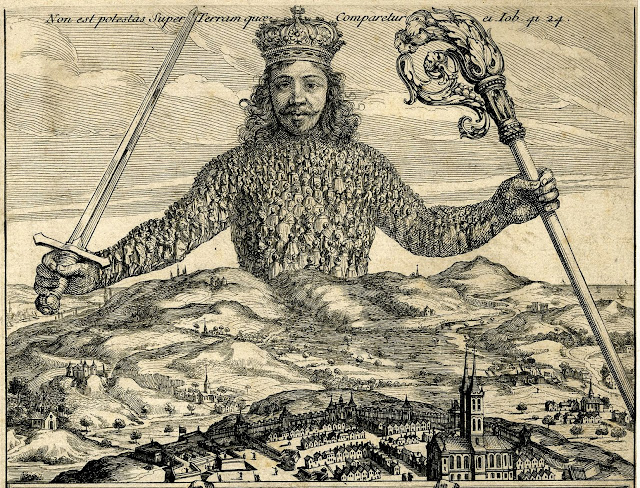
So on the
one hand we have the body of the people which does not exists aside from its
fictive representation by the sovereign, and on the other hand we have the
actually existing bodies of the individuals who make up the multitude of
citizens which are absent from the city aside from the guards and doctors
signifying their reduction to mere biological existence, security and health.
It should be clear now that the arguments Agamben is making here differ from
those on the person and the face only by a matter of scale. We should thus equate
the mask of the sovereign with our fictive online identities, and the guards
and doctors which haunt the city with our experience of depoliticised corporeal
life in modern democracies. The authentic figure of politics that encompasses
both the disalienated individual and the absent body politic goes by the name
of "face".
This is
obviously something of a cursory description of what is a more complex
exposition on the supposedly eschatological aspects to Hobbes' political
philosophy, but nevertheless we should now have a glimpse of what Agamben
believes is at stake in this striving towards a pure 'presentation' of the face
beyond all representation. If the logic behind this split in human subjectivity
is not just a recent phenomena but rather the hidden core of the political history
of the West (as he claims) then any struggle against the forces of representation
is ultimately a struggle against the State with all its media apparatus in tow.
Or to put it in the somewhat mystical language it seems hard to avoid: the attempt
to generalise the experience of love - that pure experience of singularity - to
a whole community necessarily puts the representational logic of the State at
risk. The risk is that the people may discover their own body as a community founded
not by a gathering together of some particular traits (being English, being
white, being Christian, etc) but by the simple gathering together of "whatever
singularity". This is what Agamben has termed 'The Coming Community' and
it is from his text of that name that he issues a warning on the potential danger
of such a gathering: "Whatever singularity, which wants to appropriate
belonging itself, its own being-in-language, and thus rejects all identity and
every condition of belonging, is the principle enemy of the State. Wherever
singularities peacefully demonstrate their being in common there will be a
Tiananmen, and, sooner or later, the tanks will appear" (Agamben 1993
pg87).
Despite the
dangers and the still somewhat mystical nature of these claims, modern life
testifies to the necessity of re-thinking community beyond our structures of representation.
Whether it is Tiananmen or Tahrir, Zuccotti park or Trafalgar Square, this is
the open in which human beings can take hold of their appearance as
being-manifest, it is as such the only possible city.
References:
Agamben,Giorgio
- 1993 - The Coming Community (University of Minnesota Press, Minnesota)
Agamben,Giorgio
- 1996 - Means Without End: Notes on Politics (University of Minnesota Press,
Minnesota)
Agamben,Giorgio
- 2009 - Nudities (Stanford University Press, Stanford)
Agamben,Giorgio
- 2015 - Stasis: Civil War as a Political Paradigm (Edinburgh University Press,
Edinburgh)
Dickinson,Colby
& Kotsko,Adam - 2015 - Agamben's Coming Philosophy: Finding a New use for
Theology (Rowman & Littlefield International, London)
Heidegger,Martin
- 1993 - Basic Writings (Routledge, London)
Hobbes,Thomas
- 1996 - Leviathan (Oxford University Press, Oxford)


