2022
Introduction
This is the last of the redux series
where I'm republishing material from the defunct Spectre-Online website. This
was a somewhat ambitious essay from autumn 2015 which attempts to argue a
heterodox position on the influence of theology for modern jurisprudence and
political categories more generally. As a piece of political-theology it's
heavily influenced by my reading of Harold J Berman's two volume Law and Revolution, as well Giorgio
Agamben's work on so-called economic -theology found in his Kingdom and the Glory.
There's a degree of naiveté shown
here in my ignorance of the "dark side" of the process whereby the
Medieval Catholic Church became a centralised transnational bureaucratic power,
and how the birth of scholasticism was integral to that process. An excellent
counterpart - or counterhistory even - can be found in R.I. Moore's The War on Heresy, which documents -
from the ground up - the role that nascent Catholic legal science had in
building the case for the Albigensian crusade.
Scholasticism gave a fixed and
uncomprehendingly bureaucratic zeal to the clerics charged with prosecuting the
war on heresy in the Languedoc and wider region of what is now South Western
France. All too often the spectre of a "Manichean", or otherwise
dualist Gnostic heresy was the convenient shorthand to gloss local disputes or
reform activity which ran against the grain of the Church's attempt to
centralise and systematise the faith. The invention of the heretic, with an almost
standardised set of beliefs and posing an existential threat to the unity of
the faith, emerged in the Paris schools of the twelfth century, coeval to the
birth of scholastic rationality and the newly confident Church's drive to
reform the secular world. Ranged alongside a French monarchy looking for
excuses for expansion, the end result was a military campaign, unprecedented in
its brutality, which historians now frequently refer to as genocide.
The second obvious naiveté in this
text stems from it being written prior to the populist wave of 2016. While the
displacement of the Church's claims to universality onto modern transnational
institutions like the EU, IMF, World Bank, etc, is plain to see, my lament for
the loss of a counterbalance to contest the Globalist (for that is what I'm
talking about avant la lettre) pretentions
of international finance proved to be premature. I read in those paragraphs a
desire for a new movement, not a new Church, and certainly not what we got; a
ragtag association of conspiracy theorists, 4Chan shit-posters, Boris Johnson
and Donald Trump. I'm being unkind, and the past seven years (only seven!)
cannot be reduced to any one tectonic shift around worn-out political
categories (least of all Left and Right). That's why the study of
political-theology is so fruitful in destabilising our preconceived notions of
how social and political life are put together. Now, the so-called Culture War
really does look like the return of the wars of religion or the prelude to a
crusade. As it was in the Middle Ages the battle lines are frequently being drawn
between the rooted, parochial folk inhabiting the material world, and that
assertive class of transnational administrator whose reified conception of how
the world works depends for its stability on the ever present threat of the
heretic.
2015 text
"God is himself law; therefore
law is dear to him" Sachsenspiegel (Saxon
Law) of Eike von Repgau, Early 13th Century
Of all the grand narratives
supposedly put to the sword during the era of post-modernity secularisation
seems peculiarly resistant. While we are familiar with critiques of Western
progress, cultural superiority and ethics, the narrative that would have us believe
we in the West live in predominantly irreligious societies, and thus have
passed through some process by the name of secularisation remains common
wisdom. This idea is implicit in the way we see ourselves and how we frame our
dealings with other cultures, and has become increasing acute in the post 9/11
world where the complexity of the global situation and the West's part in the
multiplying fields of conflict are reduced to simple binary oppositions. David Cameron provided a paradigm example of
this kind of simplification in a recent speech on the ideology of Islamic
State:
"It (ISIS) says religious
doctrine trumps the rule of law and Caliphate trumps nation state and it
justifies violence in asserting itself and achieving its aims. The question is:
How do people arrive at this worldview?” (1)
One might critique this
simplification by replacing the words religious doctrine with economic
necessity or globalisation and Caliphate with American/Western hegemony. But
this reversal - while having some truth to it - would gloss over what I think
is the more important opposition Cameron sets up, which is the one between
religious doctrine and the Rule of Law. Here the Prime Minister is drawing directly
on a common assumption of secularisation, and from a particularly Protestant context,
which draws a fundamental separation between human and divine law. This is one
of the key assumptions of secularisation theory, that it involves purifying the
legislative and governmental functions of the State from any kind of religious
influence. That we in the UK live in such a state despite bishops sitting in
the house of lords, an established church, and a sovereign who is also head of
that church, is taken for granted.
But what precisely secularisation
consists in, and where and when did it occur, is still a vexed question, the
answers to which very often fall back on the sort of grand narrative type of
historiography that we are meant to have left behind. The answers may vary but
inevitably they include many of the most recognisable events in Western historiography;
the renaissance, the reformation, the scientific revolution, the enlightenment,
the French revolution, the industrial revolution, etc. Here we are confronted
with a process supposedly ending in the present and yet seemingly without an
origin. I would argue that this thing we call secularisation is a far more
complex idea than it is generally taken to be and that an on-going critique of
our assumptions regarding religion and the West is vital to understanding the current
predicament we face in politics and culture. With such a vast topic a detailed treatment
isn't feasible here. Instead it might be worth taking a historical perspective
on the supposedly common sense opposition between religion and the Rule of Law.
A Note on the "New
Atheists"
As is well known the question over
religion's place in society and international affairs has been constantly
raised over the last fifteen years or so, given impetus by 9/11 and the war on
terror. There has been no more prominent voice during this period than the so
called New Atheists with Richard Dawkins and the late Christopher Hitchens being
their most visible public figures. Their "debates" and public actions
have more often than not focussed on opposing religion to their own brand of
secular, empirical and scientific world view. As such they tend to spend most
of their time debunking bible stories and criticising the irrational belief in
higher beings rather than enquiring into the sociological and philosophical intersection
between religion and modernity. They assume a break, so to speak, between the
two and so their actions display an almost incredulous attitude towards those
who haven't got the message yet.
This analytic/empirical attachment to
the God question has skewed public discourse on religion to the detriment of
other approaches which might yield a less partisan, less triumphantly
antagonistic form of enquiry. One obvious source of that antagonism is the presupposed
association of secularism with rational government and democracy, and thus their
opponents with religious dogma, fanaticism and authoritarianism. Cameron's
quote above fits squarely within this form of thought. To get beyond this
antagonistic staging of debate around religion it is vital to turn away from
the limited questioning around the existence of God and instead enquire into
the history and operation of religion as a form of social ordering centred
around the sacred. To do this broadens the enquiry to take account of the
intersections between the history of philosophy, science, and most critically,
the development and formation of Western legal and governmental systems. In
doing this however, in particular to put the role of science into question, is
a step too far for the New Atheists and their analytic empirical commitments.
To borrow a distinction from Ian
Paisley, the activity of the New Atheists in public is in fact not to debate but to dispute religion. Their aim is to displace it from public discourse
and to install their own version of secular empirical rationality as "established". Thus they hope to remove
the need to debate it in the future. In this sense it is broadly correct to
describe the kind of militant atheism practiced by Dawkins et al as a kind of
secular religion, construed as a form of totalised social ordering and
fundamental set of principles beyond question.
Western legal rationality and the Canon
Law: The Papal Revolution
To begin to critique the accepted narrative on
secularisation we need to go further back than the well known events listed
above. Back further than the reformation and renaissance, back to the very
heart of Medieval Europe. At the end of the eleventh century Europe experienced
what some scholars have described as the first of the great revolutions; the so
called Gregorian or Papal revolution. To summarise, it involved a declaration
of independence by the Papacy from the control of Kings, lords and the Emperor
within the multitude of Germanic proto states that made up the bulk of central
and Western Europe at that time. But the infamous Dictatus papae of Pope Gregory VII was more than just a
declaration of independence. Among its 27 statements it asserted for the first
time the unity of the Church as a transnational body with the Pope as its
supreme head; that the Pope may appoint or transfer bishops as he sees fit, and
only he may depose them; and of particular importance was the statement that
only the Pope can approve laws for the church. This was a new and powerful
declaration of the dualism of secular (meaning temporal or earthly) and
ecclesiastical powers and jurisdictions which came to be known as the Two
Swords theory.
In the period after the disintegration of the Western Roman state and prior
to the eleventh century these powers tended to be tied together in the concept
of sacred Kingship where the ruler was not simply an enforcer of the peace but
the spiritual head of the community; God's vicar entitled to dispose of
ecclesiastics as he saw fit and intervene in church policy and governance
within his respective territory. The freedom of the church from secular control
and the declaration of the Pope's supremacy over spiritual matters began the
process of eroding this notion of Kingship. The King was to be a layman whose
role increasingly came to be seen as keeper of the peace and law-maker within
the jurisdiction of temporal affairs only. However, as is well known, the Dictatus
papae also made the radical claim that the Pope could himself depose Kings
and Emperors, in accordance with the theory the ecclesiastical sword was
ultimately superior to the temporal sword. This shouldn't obscure the fact
however that the first tentative moves towards the separation of Church and State
were made by the church itself, and it had to fight hard to assert this
independence with the so-called Investiture controversy and the martyrdom of
Thomas Becket being two significant flashpoints.
But the Church's declaration of political separation was only one part
of the revolutionary changes that took place in the eleventh and twelfth
centuries. More important for the emergence of the idea of the Rule of Law was
the concurrent development
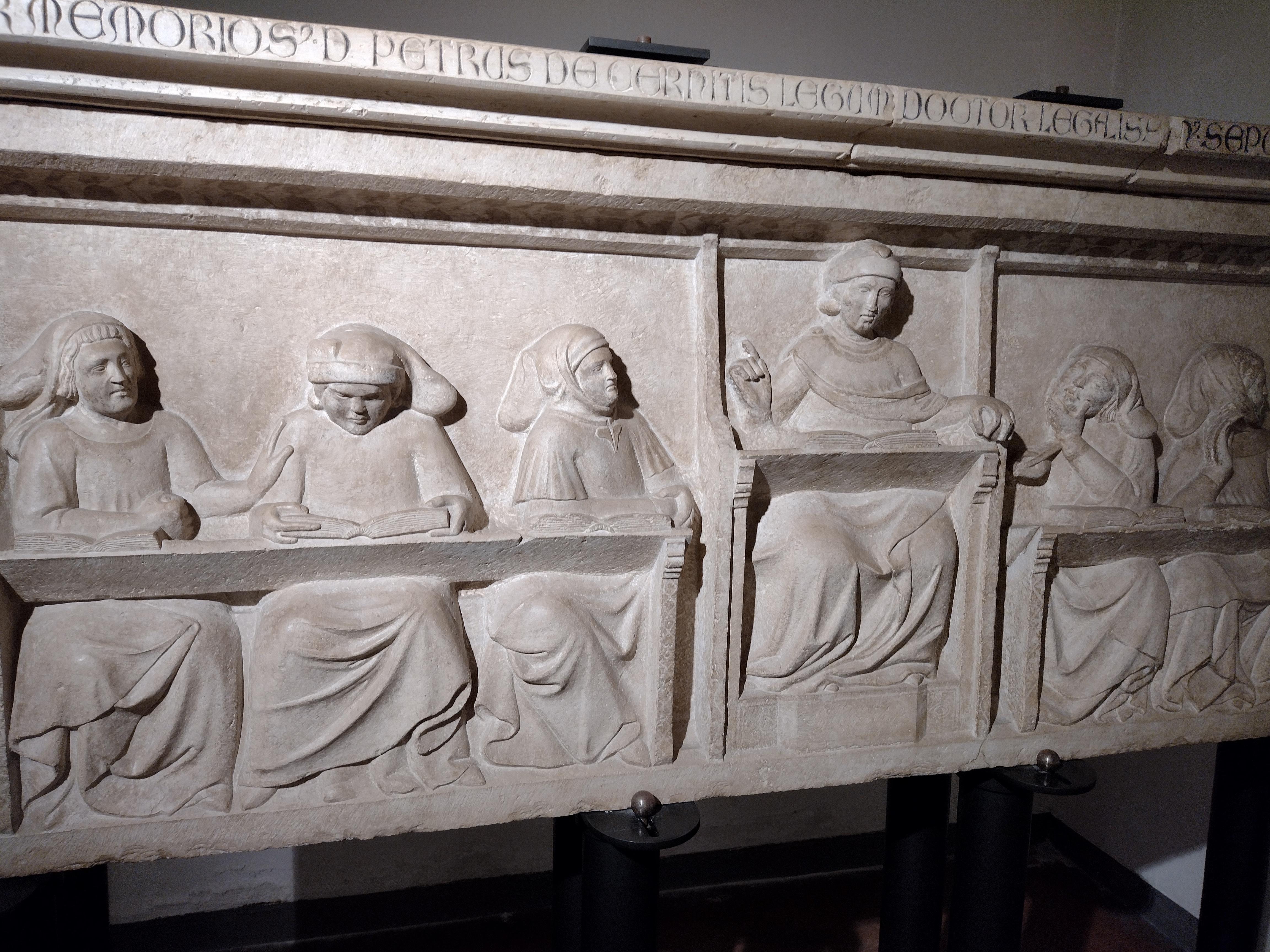
and systemisation of the Canon law inspired by the newly rediscovered Roman Law
books of Justinian. Scholars such as those at the recently founded law school
at Bologna began examining the legal doctrines of the church in light of Justinian's
texts which they took to be a complete and ideal legal system, a ratio scripta endowed with near biblical
authority. To do this they employed the method of analysis and synthesis
developed by Saint Anselm, Peter Abelard and others known to us as
Scholasticism. Since they assumed that the edicts and responsa of the Roman Law were true and just they could in effect
be treated as first principles. But since both the Roman Law, and the writings
and Canons of the Church contained gaps and contradictions, a process of
dialectical reasoning had to be employed to smooth out the different legal
norms contained within; abstracting, classifying and synthesizing conflicts.
Legal historian Harold J Berman has
argued that this movement represented not only the emergence of modern
rationalised legal science but of the
modern scientific method more generally. The glossators of Roman law and the
Canon lawyers worked by formulating hypotheses that could serve as a basis for
ordering phenomena (in this case legal phenomena) in the world of time that
could yield probabilities and predictions rather than certitudes and
necessities. Their approach moved dialectically by establishing general legal
principles and then relating them back to particulars in predictions (2).
Certainly this wasn't the sort of exact empirical science favoured by Dawkins
but it did have an experimental side insofar as the developing system was
tested in practice in the ecclesiastical courts and in the conflict between
overlapping legal jurisdictions throughout Europe. The apogee of this work came
in the mid twelfth century with Gratian's decretum,
a collection of church Canons which formed the basis of Canon law until the
20th century. It is thus not an exaggeration to describe the Canon law that
emerged from the Papal revolution as the first recognisably Modern legal system
complete with a professional body of lawyers and a student body to study and
develop it. But more than this it coincided with the independence of the church
from secular control and its rise as a form of transnational state in its own
right. This new state with its officials and sovereign (Pope) was to be a state
based on law, a Rechtsstaat which in
practice placed considerable limitation on the power of the Pope up to the
point of theorising conditions where he should be deposed.
As the legal system of the church
developed so too did its legal practices, which in turn influenced the legal
practices of the hitherto unsystematic and arbitrary forms prevalent in the
Germanic kingdoms. Trial by compurgation (oath helping), ordeal or battle were
rejected and superseded by the investigative or inquisitorial procedure which
emphasised the establishment of the facts. To be sure the Catholic inquisition
would later come to be associated with the worst of the Medieval church, but in
the twelfth century these new procedures constituted a dramatic shift towards a
more rational, logical and more distinctively modern jurisprudence where the
direct intervention of God was ruled out. The Canonists and Glossators of the
Roman law took up an agonistic relationship to the secular laws of the various
Germanic and Frankish kingdoms, both supporting and challenging them, giving
rise to many basic legal concepts we still carry with us today. Indeed the
principles of reason and conscience were proclaimed by the ecclesiastical
jurists as weapons against the formalism and magic of Germanic law (3). This
relationship hinged upon the freedom of the Church and the fact that the
boundaries between temporal and ecclesiastical power which inaugurated the
Papal revolution were constantly being contested.
What we tend to think of as the
religiosity of the Medieval Canon law and its conflict with secular state
affairs was in fact always already a process of secularisation. The Glossators
and Canonists endowed the Roman Corpus
Juris, as it was known, with a sacred quality comparable to the Bible
itself. They took it in effect as a total system developed over centuries that
not only reflected the best that mankind's reason could produce, but also
represented a common law of all peoples under God. This universalism and the Church's
newly acquired mission to reform the secular world was a defining shift in the
minds of Medieval people in comparison to previous centuries where the earthly
realm was seen as little more but one of chaos and decay; a world sliding away
into dust before the coming of The Kingdom of God which the Church was to
patiently await. The period of the Papal revolution however saw a massive shift
in Medieval European society. The invasions from the North, South and East of
Europe finally came to an end, populations rose and thousands of new towns were
founded along with increases in trade and artisanal production. Amid these
changes the church declared its unity and independence and its mission to
reform the secular world; a mission in which Law came to play a defining role. This
shift in legal ideology might be summarised as the move from a chaotic
irredeemable law of an irredeemable world to a systematic legal rationality
that could aim to approximate divine justice itself and in doing so reform that
world.

From the Two Swords to the global oikonomia
The above summary is obviously brief
and simplifies considerably what was a complex and multi-facetted era in
European history. It should however suffice to demonstrate that Cameron's
assertion of the opposition between religion and the Rule of Law is wholly
misplaced and in fact the Medieval church was instrumental in desacralizing
Kingship and bringing to a closure the era of Germanic folk-law which reigned
in Europe after the fall of the Roman state. We owe to the Papal revolution of
the eleventh and twelve centuries and to the philosophers, theologians and
jurists of that time the modern notion of a rational, logical, law governed
world, one capable of embodying an ideal of Justice and ultimately the Rule of
Law itself.
It should be noted that subsequently during
the Reformation, and English and French revolutions it was the jurisdiction of
the ecclesiastical courts that was primarily attacked and only secondarily,
over time, the content or procedure of the law itself. In England after Henry
VIII broke from Rome the authority of the Pope was taken up by the monarch who
not only maintained but even extended the jurisdiction of the ecclesiastical
courts. It wasn't until the 19th century that the jurisdiction of church courts
in England was thoroughly curtailed and the secular legal system took up what
Michel Foucault has called its "pastoral power". In the modern era it
is the secular powers that have assumed the task of judging and shaping the
soul of Man. It is only in the 20th
century that the idea developed initially by the Canon lawyers, that the law
should represent something universal for all peoples, something that embodies
higher values beyond mere contingent political interest, has faded from view.
More to the point the church's role in championing such a position and
challenging the secular power to meet that obligation has almost entirely
evaporated (although Pope Francis seems at times to hint at a revival of this
tradition). It is Berman's thesis that this eclipse of universality constitutes
the great crisis in law today. Without a common consciousness that the law
should embody universal values about ends and purposes of society people lose
respect for it and more often it becomes what Karl Marx and Max Weber believed
it was; merely an instrument for the prevailing power.
I am more of the view that what has
occurred over the last century or so is not the eclipse of universality but
rather its displacement into a new field, namely economy. The IMF, World Bank,
and other transnational financial institutions have issued their own Bull of unam sanctam and hold sway over the
governments of nation states to a degree the Pope could never had imagined. For
us unlike the peoples of Medieval Europe there is no Two Swords theory that
would have the secular and spiritual authority vying for position, criticising
and constraining each other's power. Nor does the universal law of the market
admit of any other values aside from profit and competitive positioning. The
nature and actuality of justice is no-longer contested as a political concern
and is increasingly identified under neoliberal economisation with market
outcomes. The American political philosopher Wendy Brown's recent analysis of
the "revolution of neoliberalism" claims that under such conditions
what disappears is precisely this capacity to limit, this platform for
critique, and this source of radical democratic inspiration (4). Since the
transnational apparatus for global finance holds both swords they can influence
the laws and economies of sovereign states (need I mention Greece, Chile, South
Korea) while judging the soul of human life according to the logic of homo economicus.
It is the radical thesis of Italian
philosopher Giorgio Agamben that the paradigm for modern globalised economy was
gestated in the Western church's theories of the divine economy and
Providential government of creation (5). Just as the Medieval church came to
see Law as a way of reforming the world and directing moral conduct towards a state
mirroring that of the divine Kingdom, the modern era uses it - and governance
more generally - as a way of reforming national economies and directing individual
economic conduct towards market norms. The supposedly natural and immutable
form of marketized world governance is however a Providence divested of its
messianic fulfilment, and as such is a potentially eternal government of the world without the possibility of an eschaton.
This dark
thesis suggests a controversial way of looking at secularisation. According to
this view secularisation is not a concept operating within historical processes
but rather a "signature" which continually marks history, showing
where the forms, modes and underlying metaphysical assumptions have shifted
from the field of religion to those of politics and economics. While this is by
no means uncontested ground we should perhaps be open to the possibility that our contemporary era is
more marked by the ideas and signatures of theology than we are led to believe.
References.
1 - Cameron warns of
'quietly condoning' IS ideology (BBC News, 19 June 2015, http://www.bbc.co.uk/news/uk-33192306)
2 - Berman,Harold
J - Law and Revolution: The Formation of the Western Legal Tradition ( Harvard
University Press, 1983) - pg151
3 - Berman,Harold J - Law and Revolution: The
Formation of the Western Legal Tradition ( Harvard University Press, 1983) pg251
4 - Brown,Wendy - Undoing the Demos:
Neoliberalism's Stealth Revolution (Zone books, 2015)
5 - Agamben, Giorgio - The Kingdom
and the Glory (Stanford University Press, 2011)