Showing posts with label History. Show all posts

Tuesday, 15 November 2022

Reframing the Present: Secularisation and the Rule of Law - 2022 Redux


            2022 Introduction

This is the last of the redux series where I'm republishing material from the defunct Spectre-Online website. This was a somewhat ambitious essay from autumn 2015 which attempts to argue a heterodox position on the influence of theology for modern jurisprudence and political categories more generally. As a piece of political-theology it's heavily influenced by my reading of Harold J Berman's two volume Law and Revolution, as well Giorgio Agamben's work on so-called economic -theology found in his Kingdom and the Glory.

There's a degree of naiveté shown here in my ignorance of the "dark side" of the process whereby the Medieval Catholic Church became a centralised transnational bureaucratic power, and how the birth of scholasticism was integral to that process. An excellent counterpart - or counterhistory even - can be found in R.I. Moore's The War on Heresy, which documents - from the ground up - the role that nascent Catholic legal science had in building the case for the Albigensian crusade.

Scholasticism gave a fixed and uncomprehendingly bureaucratic zeal to the clerics charged with prosecuting the war on heresy in the Languedoc and wider region of what is now South Western France. All too often the spectre of a "Manichean", or otherwise dualist Gnostic heresy was the convenient shorthand to gloss local disputes or reform activity which ran against the grain of the Church's attempt to centralise and systematise the faith. The invention of the heretic, with an almost standardised set of beliefs and posing an existential threat to the unity of the faith, emerged in the Paris schools of the twelfth century, coeval to the birth of scholastic rationality and the newly confident Church's drive to reform the secular world. Ranged alongside a French monarchy looking for excuses for expansion, the end result was a military campaign, unprecedented in its brutality, which historians now frequently refer to as genocide.

The second obvious naiveté in this text stems from it being written prior to the populist wave of 2016. While the displacement of the Church's claims to universality onto modern transnational institutions like the EU, IMF, World Bank, etc, is plain to see, my lament for the loss of a counterbalance to contest the Globalist (for that is what I'm talking about avant la lettre) pretentions of international finance proved to be premature. I read in those paragraphs a desire for a new movement, not a new Church, and certainly not what we got; a ragtag association of conspiracy theorists, 4Chan shit-posters, Boris Johnson and Donald Trump. I'm being unkind, and the past seven years (only seven!) cannot be reduced to any one tectonic shift around worn-out political categories (least of all Left and Right). That's why the study of political-theology is so fruitful in destabilising our preconceived notions of how social and political life are put together. Now, the so-called Culture War really does look like the return of the wars of religion or the prelude to a crusade. As it was in the Middle Ages the battle lines are frequently being drawn between the rooted, parochial folk inhabiting the material world, and that assertive class of transnational administrator whose reified conception of how the world works depends for its stability on the ever present threat of the heretic.  


2015 text

"God is himself law; therefore law is dear to him" Sachsenspiegel (Saxon Law) of Eike von Repgau, Early 13th Century


Of all the grand narratives supposedly put to the sword during the era of post-modernity secularisation seems peculiarly resistant. While we are familiar with critiques of Western progress, cultural superiority and ethics, the narrative that would have us believe we in the West live in predominantly irreligious societies, and thus have passed through some process by the name of secularisation remains common wisdom. This idea is implicit in the way we see ourselves and how we frame our dealings with other cultures, and has become increasing acute in the post 9/11 world where the complexity of the global situation and the West's part in the multiplying fields of conflict are reduced to simple binary oppositions.  David Cameron provided a paradigm example of this kind of simplification in a recent speech on the ideology of Islamic State:

"It (ISIS) says religious doctrine trumps the rule of law and Caliphate trumps nation state and it justifies violence in asserting itself and achieving its aims. The question is: How do people arrive at this worldview? (1)

One might critique this simplification by replacing the words religious doctrine with economic necessity or globalisation and Caliphate with American/Western hegemony. But this reversal - while having some truth to it - would gloss over what I think is the more important opposition Cameron sets up, which is the one between religious doctrine and the Rule of Law. Here the Prime Minister is drawing directly on a common assumption of secularisation, and from a particularly Protestant context, which draws a fundamental separation between human and divine law. This is one of the key assumptions of secularisation theory, that it involves purifying the legislative and governmental functions of the State from any kind of religious influence. That we in the UK live in such a state despite bishops sitting in the house of lords, an established church, and a sovereign who is also head of that church, is taken for granted. 

But what precisely secularisation consists in, and where and when did it occur, is still a vexed question, the answers to which very often fall back on the sort of grand narrative type of historiography that we are meant to have left behind. The answers may vary but inevitably they include many of the most recognisable events in Western historiography; the renaissance, the reformation, the scientific revolution, the enlightenment, the French revolution, the industrial revolution, etc. Here we are confronted with a process supposedly ending in the present and yet seemingly without an origin. I would argue that this thing we call secularisation is a far more complex idea than it is generally taken to be and that an on-going critique of our assumptions regarding religion and the West is vital to understanding the current predicament we face in politics and culture. With such a vast topic a detailed treatment isn't feasible here. Instead it might be worth taking a historical perspective on the supposedly common sense opposition between religion and the Rule of Law.


A Note on the "New Atheists"

As is well known the question over religion's place in society and international affairs has been constantly raised over the last fifteen years or so, given impetus by 9/11 and the war on terror. There has been no more prominent voice during this period than the so called New Atheists with Richard Dawkins and the late Christopher Hitchens being their most visible public figures. Their "debates" and public actions have more often than not focussed on opposing religion to their own brand of secular, empirical and scientific world view. As such they tend to spend most of their time debunking bible stories and criticising the irrational belief in higher beings rather than enquiring into the sociological and philosophical intersection between religion and modernity. They assume a break, so to speak, between the two and so their actions display an almost incredulous attitude towards those who haven't got the message yet.

This analytic/empirical attachment to the God question has skewed public discourse on religion to the detriment of other approaches which might yield a less partisan, less triumphantly antagonistic form of enquiry. One obvious source of that antagonism is the presupposed association of secularism with rational government and democracy, and thus their opponents with religious dogma, fanaticism and authoritarianism. Cameron's quote above fits squarely within this form of thought. To get beyond this antagonistic staging of debate around religion it is vital to turn away from the limited questioning around the existence of God and instead enquire into the history and operation of religion as a form of social ordering centred around the sacred. To do this broadens the enquiry to take account of the intersections between the history of philosophy, science, and most critically, the development and formation of Western legal and governmental systems. In doing this however, in particular to put the role of science into question, is a step too far for the New Atheists and their analytic empirical commitments.

To borrow a distinction from Ian Paisley, the activity of the New Atheists in public is in fact not to debate but to dispute religion. Their aim is to displace it from public discourse and to install their own version of secular empirical rationality as  "established". Thus they hope to remove the need to debate it in the future. In this sense it is broadly correct to describe the kind of militant atheism practiced by Dawkins et al as a kind of secular religion, construed as a form of totalised social ordering and fundamental set of principles beyond question.


Western legal rationality and the Canon Law: The Papal Revolution

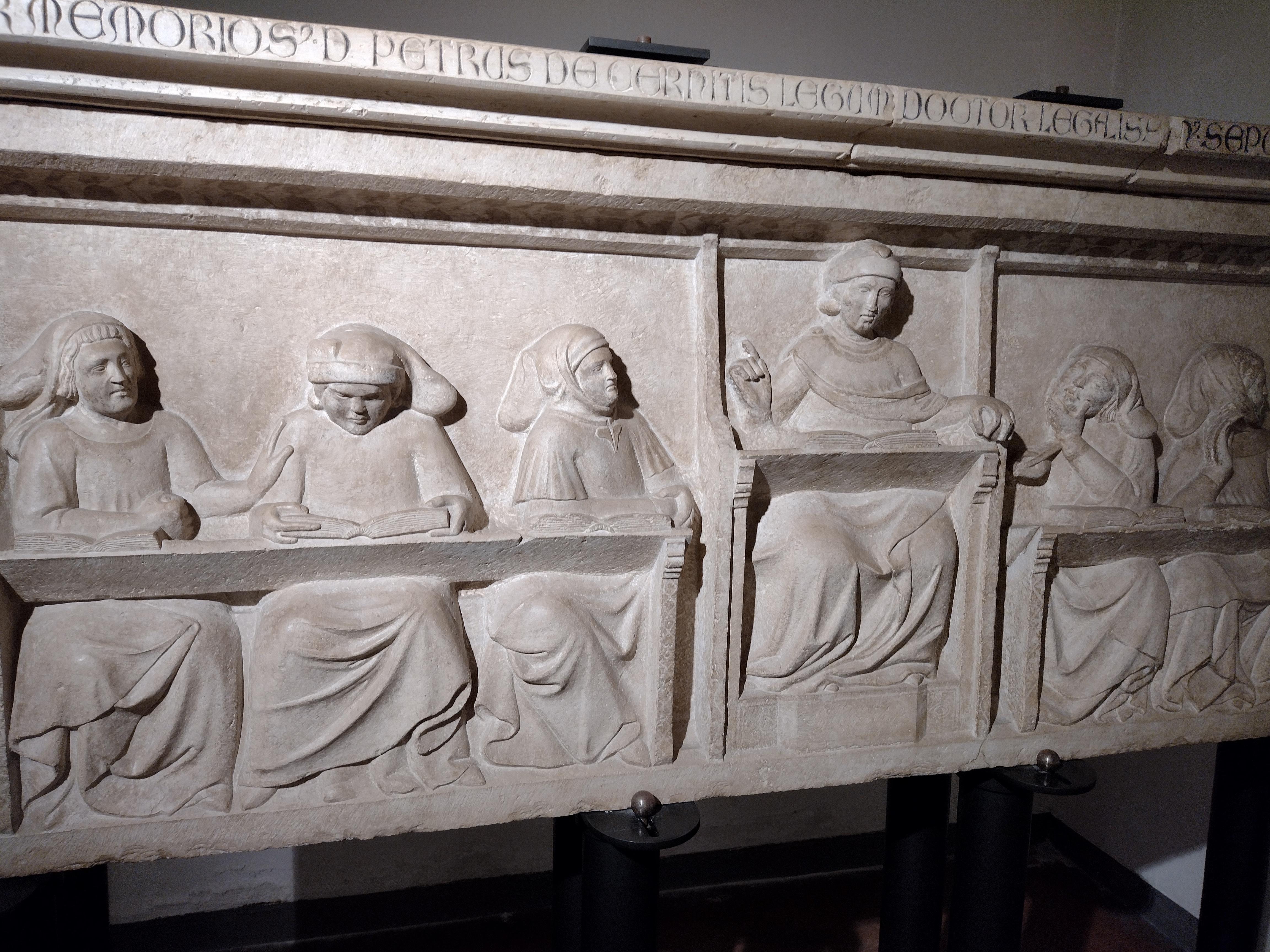
To begin to  critique the accepted narrative on secularisation we need to go further back than the well known events listed above. Back further than the reformation and renaissance, back to the very heart of Medieval Europe. At the end of the eleventh century Europe experienced what some scholars have described as the first of the great revolutions; the so called Gregorian or Papal revolution. To summarise, it involved a declaration of independence by the Papacy from the control of Kings, lords and the Emperor within the multitude of Germanic proto states that made up the bulk of central and Western Europe at that time. But the infamous Dictatus papae of Pope Gregory VII was more than just a declaration of independence. Among its 27 statements it asserted for the first time the unity of the Church as a transnational body with the Pope as its supreme head; that the Pope may appoint or transfer bishops as he sees fit, and only he may depose them; and of particular importance was the statement that only the Pope can approve laws for the church. This was a new and powerful declaration of the dualism of secular (meaning temporal or earthly) and ecclesiastical powers and jurisdictions which came to be known as the Two Swords theory.

In the period after the disintegration of the Western Roman state and prior to the eleventh century these powers tended to be tied together in the concept of sacred Kingship where the ruler was not simply an enforcer of the peace but the spiritual head of the community; God's vicar entitled to dispose of ecclesiastics as he saw fit and intervene in church policy and governance within his respective territory. The freedom of the church from secular control and the declaration of the Pope's supremacy over spiritual matters began the process of eroding this notion of Kingship. The King was to be a layman whose role increasingly came to be seen as keeper of the peace and law-maker within the jurisdiction of temporal affairs only. However, as is well known, the Dictatus papae also made the radical claim that the Pope could himself depose Kings and Emperors, in accordance with the theory the ecclesiastical sword was ultimately superior to the temporal sword. This shouldn't obscure the fact however that the first tentative moves towards the separation of Church and State were made by the church itself, and it had to fight hard to assert this independence with the so-called Investiture controversy and the martyrdom of Thomas Becket being two significant flashpoints.

But the Church's declaration of political separation was only one part of the revolutionary changes that took place in the eleventh and twelfth centuries. More important for the emergence of the idea of the Rule of Law was the concurrent development and systemisation of the Canon law inspired by the newly rediscovered Roman Law books of Justinian. Scholars such as those at the recently founded law school at Bologna began examining the legal doctrines of the church in light of Justinian's texts which they took to be a complete and ideal legal system, a ratio scripta endowed with near biblical authority. To do this they employed the method of analysis and synthesis developed by Saint Anselm, Peter Abelard and others known to us as Scholasticism. Since they assumed that the edicts and responsa of the Roman Law were true and just they could in effect be treated as first principles. But since both the Roman Law, and the writings and Canons of the Church contained gaps and contradictions, a process of dialectical reasoning had to be employed to smooth out the different legal norms contained within; abstracting, classifying and synthesizing conflicts.

Legal historian Harold J Berman has argued that this movement represented not only the emergence of modern rationalised legal science but of the modern scientific method more generally. The glossators of Roman law and the Canon lawyers worked by formulating hypotheses that could serve as a basis for ordering phenomena (in this case legal phenomena) in the world of time that could yield probabilities and predictions rather than certitudes and necessities. Their approach moved dialectically by establishing general legal principles and then relating them back to particulars in predictions (2). Certainly this wasn't the sort of exact empirical science favoured by Dawkins but it did have an experimental side insofar as the developing system was tested in practice in the ecclesiastical courts and in the conflict between overlapping legal jurisdictions throughout Europe. The apogee of this work came in the mid twelfth century with Gratian's decretum, a collection of church Canons which formed the basis of Canon law until the 20th century. It is thus not an exaggeration to describe the Canon law that emerged from the Papal revolution as the first recognisably Modern legal system complete with a professional body of lawyers and a student body to study and develop it. But more than this it coincided with the independence of the church from secular control and its rise as a form of transnational state in its own right. This new state with its officials and sovereign (Pope) was to be a state based on law, a Rechtsstaat which in practice placed considerable limitation on the power of the Pope up to the point of theorising conditions where he should be deposed.  

As the legal system of the church developed so too did its legal practices, which in turn influenced the legal practices of the hitherto unsystematic and arbitrary forms prevalent in the Germanic kingdoms. Trial by compurgation (oath helping), ordeal or battle were rejected and superseded by the investigative or inquisitorial procedure which emphasised the establishment of the facts. To be sure the Catholic inquisition would later come to be associated with the worst of the Medieval church, but in the twelfth century these new procedures constituted a dramatic shift towards a more rational, logical and more distinctively modern jurisprudence where the direct intervention of God was ruled out. The Canonists and Glossators of the Roman law took up an agonistic relationship to the secular laws of the various Germanic and Frankish kingdoms, both supporting and challenging them, giving rise to many basic legal concepts we still carry with us today. Indeed the principles of reason and conscience were proclaimed by the ecclesiastical jurists as weapons against the formalism and magic of Germanic law (3). This relationship hinged upon the freedom of the Church and the fact that the boundaries between temporal and ecclesiastical power which inaugurated the Papal revolution were constantly being contested.

What we tend to think of as the religiosity of the Medieval Canon law and its conflict with secular state affairs was in fact always already a process of secularisation. The Glossators and Canonists endowed the Roman Corpus Juris, as it was known, with a sacred quality comparable to the Bible itself. They took it in effect as a total system developed over centuries that not only reflected the best that mankind's reason could produce, but also represented a common law of all peoples under God. This universalism and the Church's newly acquired mission to reform the secular world was a defining shift in the minds of Medieval people in comparison to previous centuries where the earthly realm was seen as little more but one of chaos and decay; a world sliding away into dust before the coming of The Kingdom of God which the Church was to patiently await. The period of the Papal revolution however saw a massive shift in Medieval European society. The invasions from the North, South and East of Europe finally came to an end, populations rose and thousands of new towns were founded along with increases in trade and artisanal production. Amid these changes the church declared its unity and independence and its mission to reform the secular world; a mission in which Law came to play a defining role. This shift in legal ideology might be summarised as the move from a chaotic irredeemable law of an irredeemable world to a systematic legal rationality that could aim to approximate divine justice itself and in doing so reform that world.


From the Two Swords to the global oikonomia

The above summary is obviously brief and simplifies considerably what was a complex and multi-facetted era in European history. It should however suffice to demonstrate that Cameron's assertion of the opposition between religion and the Rule of Law is wholly misplaced and in fact the Medieval church was instrumental in desacralizing Kingship and bringing to a closure the era of Germanic folk-law which reigned in Europe after the fall of the Roman state. We owe to the Papal revolution of the eleventh and twelve centuries and to the philosophers, theologians and jurists of that time the modern notion of a rational, logical, law governed world, one capable of embodying an ideal of Justice and ultimately the Rule of Law itself.

It should be noted that subsequently during the Reformation, and English and French revolutions it was the jurisdiction of the ecclesiastical courts that was primarily attacked and only secondarily, over time, the content or procedure of the law itself. In England after Henry VIII broke from Rome the authority of the Pope was taken up by the monarch who not only maintained but even extended the jurisdiction of the ecclesiastical courts. It wasn't until the 19th century that the jurisdiction of church courts in England was thoroughly curtailed and the secular legal system took up what Michel Foucault has called its "pastoral power". In the modern era it is the secular powers that have assumed the task of judging and shaping the soul of Man.  It is only in the 20th century that the idea developed initially by the Canon lawyers, that the law should represent something universal for all peoples, something that embodies higher values beyond mere contingent political interest, has faded from view. More to the point the church's role in championing such a position and challenging the secular power to meet that obligation has almost entirely evaporated (although Pope Francis seems at times to hint at a revival of this tradition). It is Berman's thesis that this eclipse of universality constitutes the great crisis in law today. Without a common consciousness that the law should embody universal values about ends and purposes of society people lose respect for it and more often it becomes what Karl Marx and Max Weber believed it was; merely an instrument for the prevailing power.

I am more of the view that what has occurred over the last century or so is not the eclipse of universality but rather its displacement into a new field, namely economy. The IMF, World Bank, and other transnational financial institutions have issued their own Bull of unam sanctam and hold sway over the governments of nation states to a degree the Pope could never had imagined. For us unlike the peoples of Medieval Europe there is no Two Swords theory that would have the secular and spiritual authority vying for position, criticising and constraining each other's power. Nor does the universal law of the market admit of any other values aside from profit and competitive positioning. The nature and actuality of justice is no-longer contested as a political concern and is increasingly identified under neoliberal economisation with market outcomes. The American political philosopher Wendy Brown's recent analysis of the "revolution of neoliberalism" claims that under such conditions what disappears is precisely this capacity to limit, this platform for critique, and this source of radical democratic inspiration (4). Since the transnational apparatus for global finance holds both swords they can influence the laws and economies of sovereign states (need I mention Greece, Chile, South Korea) while judging the soul of human life according to the logic of homo economicus.

It is the radical thesis of Italian philosopher Giorgio Agamben that the paradigm for modern globalised economy was gestated in the Western church's theories of the divine economy and Providential government of creation (5). Just as the Medieval church came to see Law as a way of reforming the world and directing moral conduct towards a state mirroring that of the divine Kingdom, the modern era uses it - and governance more generally - as a way of reforming national economies and directing individual economic conduct towards market norms. The supposedly natural and immutable form of marketized world governance is however a Providence divested of its messianic fulfilment, and as such is a potentially eternal government of the world without the possibility of an eschaton.  

This dark thesis suggests a controversial way of looking at secularisation. According to this view secularisation is not a concept operating within historical processes but rather a "signature" which continually marks history, showing where the forms, modes and underlying metaphysical assumptions have shifted from the field of religion to those of politics and economics. While this is by no means uncontested ground we should perhaps be open to the possibility that our contemporary era is more marked by the ideas and signatures of theology than we are led to believe.


References.

1 - Cameron warns of 'quietly condoning' IS ideology (BBC News, 19 June 2015, http://www.bbc.co.uk/news/uk-33192306)

2 - Berman,Harold J - Law and Revolution: The Formation of the Western Legal Tradition ( Harvard University Press, 1983) - pg151

3 - Berman,Harold J - Law and Revolution: The Formation of the Western Legal Tradition ( Harvard University Press, 1983) pg251

4 - Brown,Wendy - Undoing the Demos: Neoliberalism's Stealth Revolution (Zone books, 2015)

5 - Agamben, Giorgio - The Kingdom and the Glory (Stanford University Press, 2011)

Monday, 22 August 2022

The Weinstein and Westminster Scandals Should Make us Reflect on the Connection Between Power and Sexual Violence (2022 Redux)


2022 Introduction:

Not the snappiest of titles. This is the third in a series of "redux" posts republishing material which originally appeared on the Spectre-Online zine. This one from 2017 responds to the series of sexual abuse scandals, which in that darkest of years were seemingly ever-present in the news. What this essay argues for is a sort of political ontology of abuse, which tracks mass instances of sexual violence to institutional and cultural arrangements where relations of domination are prevalent. I begin with the news stories around Harvey Weinstein and other recent sexual abuse scandals before jumping to the historical example of slavery and the long shadow that institution casts over our understanding of domination and systemic violence. Then, in a form of argument one could call the Great in the Small I try to show how our commonplace thinking  about slavery (and by implication freedom too) masks what would be a more profound understanding of how power and domination function in the era of global governance.

Giorgio Agamben's writing on the significance of economy (the Oikos or household government) becoming the principle form of Western power, guides much of this analysis, as does my reading of nominally less radical thinkers like Philip Pettit and Quentin Skinner. The latter's concept of Neo-Roman freedom (or freedom as non-domination), which builds from an analysis of liberty and slavery in the ancient world, is I think a very useful one. At the time I was reading their work alongside the later Foucault, with all its fascinating takes on the government of self and others in Greco-Roman culture. But alongside the minutiae of Greek political education or Roman household management I was also - and still am - trying to think about these problems of social and political ontology from the perspective of globalised humanity.

The term one-world governance (not government!) is one I began using around this time. There is something of the provocation in it, insofar as it bears more than a passing resemblance to a common trope in conspiracy theories. The point of using it is to make a claim for a kind of negative universality, where the pure relation of domination (between parent and child) is potentially generalised by the total depoliticisation and economisation of humanity. That's the apocalyptic bit. What we are increasingly witnessing now as that system of governance  continues its collapse, is the full actualisation of the global civil war which has been gnawing at the margins of our world for decades. What will become of the eternal problem of domination and violence in human life when the institutions of the West ,which have now lost all legitimacy, collapse into the void which they have created?


(2017 text)

1). What started in October with the rapid fall of a once untouchable movie mogul has grown in the intervening weeks into a full blown crisis for institutions across Britain and the US. The British Prime minister has had to hastily convene cross party meetings and cobble together a semblance of an HR system at Westminster after a series of accusations against MPs and ministers from both sides of the house. Her defence secretary has had to resign after revelations of inappropriate advances toward journalists and lewd comments to one of his own female MPs. Her first secretary of state is also under investigation. While in the US, allegations against Harvey Weinstein ranging from aggressive propositioning to rape continue to accumulate.

The actress and producer Brit Marling wrote a powerful account in The Atlantic of her experiences with the mogul: "I, too, sat in that chair paralyzed by mounting fear when he suggested we shower together. What could I do? How not to offend this man, this gatekeeper, who could anoint or destroy me"? The scandal across the pond has now claimed the career of Kevin Spacey and has expanded to encompass predictable questioning over the peculiarities of the film industry; its glamour, its shallowness, its obsession with young female flesh, often paired with less than youthful male co-stars. The same form of questioning was heard after the abuse perpetrated by Jimmy Savile was exposed in the UK, and has often been raised regarding the abuse carried out by religious institutions and care homes like Haut de la Garenne.

Given the breadth of institutions involved,  terms like sleaze or sex scandals that have in the past been used to refer to such revelations hardly seem appropriate. It's also worth remembering that this is only the latest salvo in the now permanent crisis of British institutions embroiled in accusations of systematic sexual abuse and cover-ups. The expression 'Sexual Abuse Scandal 'might as well be built in as an autofill for newspaper headline writers. And yet despite the near ubiquity of abuse revelations on the contemporary social landscape little is done to try and draw the commonalities together. We walk dumbfounded from one crisis another, each time raising up the same sense of shock and surprise. Perhaps the subject is just too large, and the issue of sexual violence too ingrained in the dark corners of human societies to be worth treating at a general level.

Certainly it seems that way in the case of the UK government's unwieldy public enquiry into historic sexual abuse allegations, which has had a turnover of leadership comparable to many Premier League football clubs. Framed in the way it has been, there is something almost inevitably self-defeating about its scope. How can an enquiry, which in its range and manpower becomes an institution in its own right, be able to investigate, appraise and recommend remedy for abuses committed in seemingly every type of institution in the land? Since the scandals in Westminster and Hollywood have predominantly involved the abuse of adult women the focus has understandably been on the issue of sexism and misogyny; just as in the case of Savile and child abuse in the Church the focus has been on paedophilia. I wonder though if there's not a more general way of capturing an important aspect of all these cases from Weinstein to Westminster, from the Catholic Church to care homes. Why not talk about relations of domination and their direct link with sexual abuse?

2). Our understanding of domination is strongly conditioned by the historical legacy of slavery. A dominated person is someone in chains, forced to work under threat of death. Their status is that of property, owned by a master and disposed of as they see fit. Slavery is also a complex institution requiring the collaboration and complicity of wide sections of the society in which it exists. Its eventual abolition across much of the developed world in the 18th and 19th centuries was due to multiple factors, only a few of which involved what we might now call "changes in attitudes". Since we tend to associate relations of domination with historical slavery and its outward appearance it has taken a long time for the issue of modern slavery to be taken seriously. Only in 2015 did the UK bring in the Modern Slavery Act which while being a step in the right direction of recognising modern relations of domination, in practice merely reiterates the common understanding of domination as "servitude and forced labour". It does little to break down precisely what constitutes a basic condition of servitude.  I'm bringing up slavery as it represents the most extreme example of a relation of domination. However unless we have an account of precisely what a relation of domination actually is in itself we won't be able to recognise less extreme forms, which I suggest are much more prevalent.

The Canadian philosopher Philip Pettit, drawing on the ancient (specifically Roman) understanding of domination cited three criteria for a person to be in such a relation. A person dominates another if:

-They have the capacity to interfere.

-On an arbitrary basis.

-In certain choices that the other is in a position to make.


This is a useful albeit somewhat formal definition, not least as it doesn't depend on the slave/freeman distinction. It also emphasises that it is the capacity to interfere, not actually occurring interference that is the dominating condition. By this account a person could be in a relation of domination relative to one person or group but not to another, and perhaps only within a particular field of choices. Think about Weinstein and Brit Marling again. As an aspiring actress and screenwriter her field of possibility crossed over with his field of influence. Relative to her he was "...this gatekeeper, who could anoint or destroy me". The language here is not an accident. The power to anoint or destroy, to bind or loose, is symbolic of power at its most dominating. Think too about the power Jimmy Savile held over the children he abused and to an extent over the staff at the BBC, who, relative to him - the big star - were mere flunkies.

Another element of dominating relations which Pettit discusses is the absence of contestation. Put broadly, contestation is the ability of a person to find redress for an abuse, either through the courts, or through extra-legal means such as disciplinary proceedings or even local forms of community or family resolution. The capacity for contestation is a brake on the ability of the master to do what he wants with impunity (his arbitrium in the Latin understanding). Absence of contestation is a major contributing factor to the ability of a person to interfere with another on an arbitrary basis. There is after all nothing to stop them. Even in the presence of nominal procedures for redress, the ability of a person to challenge abusive behaviour can be thwarted by prejudice, the reluctance of others to assist owing to the influence of the perpetrator, or structural reasons which shield powerful people from the consequences of their actions.

These facts serve to remind us that relations of domination do not exist in isolation. Like the historical institution of slavery they require the active collaboration and complicity of a host of others. Think about how many people turned a blind eye to the behaviour of Weinstein. Think about the cover-ups and the advice given to women not to pursue complaints against high value stars and officials, or of the care home staff and police who refused to the believe the testimony of victims. And think also of the capacity rich and powerful people have to pay off complainants, to keep their abuse out of the public domain. Where money and influence are involved the network of power extends to the potential legal repercussions against those who speak out. And in a world where the media walk in step with politicians and the superrich, the threat of having one's life torn apart by their attack dogs is all too real.

There are often too many parties interested in seeing the structures of power which allow sexual abuse to remain undisturbed. For instance, to question how Savile was able to operate with impunity is to question the nature of celebrity and the role a monolithic institution like the BBC or Fox News (which has also been mired in scandal) has in raising them up. To question the power of politicians to abuse their staff similarly puts the whole form of parliamentary power under the microscope. At least it should, if the journalists involved were not also polluted by the same toxic material. A few individuals might quickly be made example of, if only to appease the sense of outrage and give the establishment time to reorientate itself; to put in more procedures and ensure the machine keeps on turning. Risk management, not justice, is the order of the day.

          3). The Romans had two ways of conceiving relations of domination. Where the power in question related to public power, such as the State or its institutions, they used the term Imperium, from which we receive the words empire and emperor. Where the power in question was private such as the family, or in the modern world a private corporation, the term used would be dominium, which relates to the domus, the home and consequently to notions of household management and property. It is the latter term from which we get our modern lexical understanding of slavery as related to private ownership and property rights more generally. This is not the place to elaborate on the complex genealogy of these concepts and how they have impacted on modern Law and our experience of power in social life. What seems clear, however, is that in the contemporary era the distinction between private and public power seems less and less tenable. The state and the non-state are no longer divided down lines which would be recognisable even to people living a century ago. The influence of transnational forms of governance such as the EU, IMF, the World Bank and huge communications and media corporations like Google, Facebook and News International threatens the centrality of the nation state as the key operator in political life.

           Another problem is that liberalism has tended to focus on the threat of state interference (imperium) at the expense of seeing how private domination, particularly that of large corporations has grown exponentially in the post-war era, given impetus by the developments in communications technologies and the internet. The global dominance of economy in human affairs means that one single form of governance, originating in notions of household management (combining the Roman domus with the Greek oikos) now holds sway. No longer does the State attempt to hold back the violence of the market, and no longer is private economy a bulwark against interference by the State. Under global capitalism State and market, public and private, operate as two elements of the same power. More and more of us today are subject to dominating relations produced by this total global economy, which sees everything and everyone in terms of measurable, calculable units.


Slavery, the most extreme form of domination has since the beginning been associated with sexual violence. It flows directly from the status of a person as the property of another to be enjoyed as they see fit. Sexual violence was routinely deployed against slaves of both sexes by colonialists in the Caribbean and slave owners in the United States. In the ancient world the master's sexual use of his slaves was a natural consequence of their thing-like status. Where restrictions on the sexual abuse of dominated persons have historically existed they have tended to take the form of appeals to the moral character of the master rather than the humanity of the victim. Codes of chivalry, notions of nobility or virtu, religious commitments and other such regimes have often been the sole restraint to unfettered rapine in peacetime as much as war.

In the Oneirocritica of Artemidorus, a compendium of dream interpretations written in the 2nd and 3rd centuries AD, it is considered a positive portent if the master dreams of sexually using his slaves, since it shows him deriving satisfaction from his property. Wherever relations of domination exist we find sexual violence, not because the absence of restraint allows pre-existing violent desires to go unchecked, but because such relations in themselves produce that violence. In a condition of domination my will is absent, completely or partially consumed by the other. What I want or don't want is irrelevant.  As Brit Marling wrote: "Consent is a function of power. You have to have a modicum of power to give it". Dominating power by contrast, whether by an individual, a bureaucracy or a State, is ultimately domination over the ability to refuse, to say no. Under domination one cannot refuse to comply. And under such conditions my body and person are available for use by the one who wields power.

                It's clear that the position of Brit Marling and of Westminster staffers, or even the victims of Savile was not that of slaves, but they were within relations of domination to varying degrees; limited, but enough to allow abuse to occur under certain circumstances. If this is the case we should then acknowledge that domination exists on a spectrum that correlates with an increased risk of abuse.  The thing-like quality of a person tracks with perfect symmetry this spectrum of relations of domination. The more dominated a person is - the more thing-like they become - the more their body is rendered as something for the master to take pleasure from as they desire. Sexual possession of the dominated body is not a pathology external to power, it is its most visceral sign. In an era when the household, the domus, the oikos, has become the model for globalised humanity, it is worth remembering that it is in the house that we find the most common and most acute relation of domination; that between parent and child. And it is also worthwhile remembering that of all human institutions it is within the household that most sexual violence takes place. Only in a return to politics, in opposition to globally triumphant neoliberalism, might humanity start to take the problem of domination in wider society seriously again; to see in every accumulation of power the real possibility of violence and to cut it off at the root, before the victims pile up.

Tuesday, 14 June 2022

Desiring and Acting Differently: A Sketch Towards a Critique of Consent (Redux)


2022 Introductory note: This overly long and convoluted essay was originally published in 2016 on a different platform, which is sadly no longer online. I think it’s worth republishing here as my opinions have not changed much in the interim. Two things do come to mind as I’m reading this back.

1 – The almost feverish manner in which I repeatedly try to reassure the reader that I take consent seriously, and that the occasion of my critique isn’t some awful prelude to a full-on exultation of manosphere values. It’s amusing to see these little summaries at the end of each section, which I’ve put into italics, as if I’m saying to the reader ‘No matter if you skimmed the rest, at least concentrate on this!’, all of them couched in defensive terms, “it is important to be very clear”, “Let me emphasise again that in no way…”, etc. There was a lot of pick-up-artist, manosphere attention on consent at the time and to not be enthusiastic for Leftist consent discourse was to risk being lumped in with some very unsavoury individuals.

2 – Quite soon after I wrote this it dawned on me that the ridiculously convoluted route I’ve taken here to make what were at the time a series of unfashionable arguments could be summed up quite straightforwardly with the following: Consent does not turn violence into non-violence, it merely turns it into legal violence. I should caveat this by drawing attention to the very timely We Can’t Consent to This campaign which has done much to push back against the defence of “consensual violence” in cases where women have suffered serious injury or been killed at the hands of men. Nevertheless, the fact that such a campaign group needs to exist proves my basic point.

 That I made such effort to construct a series of arguments - some more plausible than others – reflects my inability at the time to take what would have been the short route, straight through values. For if violence is the actual matter at hand, then all that is needed is to point out the empty formal quality of consent as it is used in the contemporary legal/social context, and demand an ethic of substantial values set against the normalisation of violence. This, of course, is the illiberal path, but it is the one that was quite obviously signposted, which is borne out by the fact that in turning away from that path I was driven to take these colourful extended detours through everything from speech-act theory to Medieval law.  

I think section 5, which revolves around Jennifer Doyle’s book Campus Sex, Campus Security, has some of the strongest material, not least as little did I know that in thinking about risk management and the bolstering of State paternalistic authority I was sketching what would become the central mode of power during the pandemic. It is a short step from risk management around sexual freedom to risk management around freedom in toto. This passage, which quotes Doyle, is especially suggestive:

  The appearance of consent classes as well as safe spaces is "shaped by the affective economy of a security culture in which a sense of injury and exposure revolves around sexual possibility - a possibility with the organizing force of a black hole" (Doyle 2015 pg28). This discourse of protection Doyle claims not only re-enforces but actually produces the subjectivities it claims to protect. Ultimately it constitutes a particularly insidious apparatus for normalising and inscribing both the essential fragility of the student-subject and the policing power of the university in its Neoliberal phase. Within these regimes of risk management sex appears as a thing, as a dangerous property possessed by "sexual sovereigns" that someone else might try to take away, or that we may misuse, and which we demand the state and university protect.

Risk management is in the second rank – behind Decline – as an interpretive key for the present. As for understanding the metastasis of authoritarian yearning among the administrative classes, it is indispensable.


2016 Text

1.

As I write, the verdict in the retrial of footballer Ched Evans has just recently been announced. The verdict itself is a shock but what is even more disheartening are the facts of the trial; that the complainant's personal sexual history was used against her after the judge made a rare exception to allow it as evidence, and that the family and partner of Evans was known to have offered a cash reward for information leading to his acquittal. The repercussions of this verdict and the precedent that the judge's exception may set will undoubtedly be felt for years to come and is a huge blow for women who seek to bring their attackers to justice. Once again bringing prejudice to bear against the sexual history of women who report rape has become a legitimate line of defence. To put it simply, this trial in the way it was allowed to be conducted has made women less safe and men more secure in their ability to rape without fear of conviction.

Currently then a critique of the use of consent as an effective concept within the discourse of rape prevention seems inopportune. Shouldn't we be defending the sanctity of the notion of consent, since it was precisely the autonomy of the victim and her right to deny consent that was being undermined in the Evans retrial? On the other hand, the trial also demonstrates the fragility of consent as a legal principle which enables us to identify harm in sexual matters. Given the right conditions, the right amount of prejudice, enough money, and a legal system that still fails women time after time, a person's right to give or deny consent can be overthrown. 

It is for this reason that a critique of consent - and in the case of this article - of the development of so called 'sexual consent classes' in universities, is worthwhile. It is meant to be a sketch so my lines of argumentation are multiple but do not reach the depth that they would deserve in a fuller exposition. Also, given the climate, it will unavoidably appear as a provocation. What I wish to argue is that the concept of consent is inadequate due to its being imported from the legal discourse of property and contract and that as such it imprints a highly abstract and alienating form onto sexual relations that erodes the aspects of mutuality and reciprocal gift-giving which are at the heart of all worthwhile human intimacy.

2a.

"Not everyone has the privilege to feel enthusiastic about sexual consent but that doesn't necessarily mean that they lack the freedom and capacity to make that choice..." (NUS Women, I Heart Consent Workshop Guide 2015) - Link no longer available

Sexual consent classes are a phenomenon that began in universities in the United States, but have over the last two or three years become increasingly prevalent in the UK. Their implementation has been spearheaded by the NUS as one approach to tackling the high rates of reported sexual harassment on university campuses. Depending on the source those rates range from one in five to over 50% of female students experiencing some kind of sexual harassment or assault while at university in the UK. The NUS conceive of consent classes as part of the standard induction package all new students should receive along with more general health and safety material, and information about IT and library recourses. This mirrors the reception of such measures in the US where they have been integrated into universities as part of their obligations under Title IX of the US Higher Education Act. Title IX is an amendment that covers safeguarding and how universities deal with accusations of discrimination and assault. To this end the UK NUS have produced a standardised guide for those organising consent classes.

Their introduction has not gone unnoticed and there have been several stories picked up by the mainstream media over the last two rounds of admissions. Last year we had George Lawlor at Warwick (http://www.bbc.co.uk/news/blogs-trending-34615631) who took offense at having attend the classes. He argued a common criticism of the classes that they imply all men are potentially rapists: "It's just that I feel if you need to be taught what consent is and what consent isn't, then you don't have respect for other human beings." This year as more student unions around the country introduced the classes there were even minor protests and walk-outs such as at York where third-year accounting student Ben Froughi encouraged a boycott arguing that the classes encouraged men and women to identify with the respective roles of potential victim and rapist. Interestingly the irked accountant also took issue with the implied contractual form of sexual bargaining: "There is no correct way to negotiate getting someone into bed with you. In suggesting that there is, consent talks encourage women to interpret sexual experiences that have not been preceded by a lengthy, formal, and sober contractual discussion as rape".

Despite increasing numbers of universities hosting such classes there is scant data either here or in the US, where they have run for many years, that the classes are effective in reducing the incidence of sexual assault. In fact, judging by the stats put out by the NUS, the reported rates seem to be increasing; although like such data produced by the police and government, this is often explained away by putting any increase down to the willingness of victims to come forward, and thus something in part to be celebrated. However, this is also an admission that there is no reliable data pertaining to the reality of the situation on the ground, or as yet any empirical means to assess the impact of the classes. Like those mysterious proclamations on the invisible war put out by security services we can well imagine NUS officers proudly counting up the number of potential rapists neutralised by their programs of prevention and countermeasures. It is important however to be very clear; my argument is not that the problem of sexual assault at Britain’s universities is trivial or overstated, nor is it that these techniques of management could never be effective (although as yet there is no evidence that they are). My claim is that their potential effectiveness carries with it a problematic discourse which undermines the good intentions from within.

2b.

The starting point for the NUS guide is the definition of consent from current UK legislation. In England and Wales a person consents if they agree "by choice, and has the freedom and capacity to make that choice". And in the Scottish sexual offenses act of 2009 consent is defined simply as "free agreement". Both these definitions are highly abstract renderings of basic principles from contract law emphasising notions of free agreement and the absence of force and fraud. Immediately in its legal form sexual relations are taken in part to be an instance of the exchange of goods or services involving the free contracting of the parties involved. 

Consent classes, the principal subjects of which are rape and rape culture, begin by reproducing this juridical and legalistic framework of sex crime legislation, as well as the vagueness of some clauses within those definitions. The classes tend however to expand on the legal definition to include examples of additional clauses while maintaining the contractual style already inherent in the legal definition. For instance, the NUS consent workshop guide includes “active, on-going conversation, and retractable” as attributes of consent while including “assumed, and previous consent” as examples of what genuine consent is not. Taken in isolation and as general pointers towards avoiding harm none of these examples is especially vexatious, although in practice some may be difficult to implement. Taken together they flesh out the vagueness of the current UK definition of sexual consent into a more concrete contractual form.

One of the difficulties both in the UK and US legal definition is that it admits the possibility of non-verbal consent, though the US code excludes that as a possibility in cases resulting from the use of force, threat of force, or placing another person in fear. Although the NUS consent class guide does not state consent should be explicit and verbal, the additional glosses on the UK and US legislation (especially that consent should never be assumed) and the overall contractual framework make the implication clear. Transparency and predictability of outcomes are key.

The clearest indicator of the abstract contractual nature of consent being put forward in the NUS guide is that it is explicitly separated from any notion of enthusiasm or enjoyment; surely the prime reason all things considered for having sex besides purely reproductive motivations. For the authors of the guide, consent functions seemingly as a purely formalistic concept within an exchange between two parties. The guide even goes so far as to describe enthusiastic consent (which we might translate as anticipating the possibility of actually enjoying the act) as a "privilege" and draws comparisons with the exchange between sex workers and their clients. This is a particularly striking comparison considering the continued "workerisation of sex" that I have drawn attention to elsewhere. 

In that case, guided by Neoliberal notions of entrepreneurship and human/erotic capital, advocates from the sex industry have argued against distinguishing sex-work from work in general, using a similar set of conceptual tools around consent and personal bargaining that they argue would reduce the dangers to sex-workers and combat prejudice. Paul Mason has argued in his book Post-Capitalism that this reflects a trend of contemporary Neoliberalism to capture "externalities"; aspects of our social lives that do not obviously conform to market or value generating transactions. (2022 note: In the wake of the pandemic this distinction has now almost entirely collapsed)

The direction this is heading in seems clear; human sexual relations are just like any other form of exchange within the economy. The fact that money may not actually change hands does not mean sexual exchange should be excluded from regimes of management where pleasure is rarely a significant factor. Ultimately sex is just another instance of one party wishing to obtain goods or services from another, fitting squarely within prevailing legal discourses of property and contract. Lovers become contracted partners in an amorous exchange and the estrangement of immanent human relations into the legal/juridical framework is further normalised. As so often in the most developed societies, security and risk management are the banners under which we are rapidly burying all possibility of a joyful form-of-life. Consent classes are potentially then a correlate to the reimagining of sex-work through the logic of work, contract, and entrepreneurship. And as such the sex-worker becomes the vector through which all sexual relations are being reconfigured along economic lines.

The consent classes, which would presumably be appropriate for anyone, are in fact part of a package from the US which includes the notions of “safe-spaces” and “trigger warnings” (both present in the NUS literature) which opponents argue have together contributed to infantilising an entire generation of students across the pond and is threatening to make relations between young people just as miserable and estranged over here. There has also been criticism of the use of safe spaces by some universities and interest groups to shut down legitimate criticism of Israel on the grounds that Jewish students felt threatened. This is however another issue entirely. Let me emphasise again that in no way am I suggesting that consent is an irrelevance for sexual relations (quite the opposite) or that one should casually reject the discourse around consent purely on the basis that it brings with it unforeseen consequences or types of language. Nevertheless, it is all too often forgotten that life and Law are fundamentally distinct realms and the assumption that the former might be contained and safeguarded by the later is a mistake that Western society in the modern period never ceases to repeat.

3.

"Our suggestion is that the presuppositions introduced by the pornographic conversations persist in the conversations with real women" (Langton 2009 pg187)

Consent, when referring to a verbal or other sign form of agreement is an example of a type of speech act called performative. Performatives are not like regular descriptive speech that report something about the world; the cat is on the mat, etc. Performatives do not merely describe a state of affairs but actually bring that state of affairs into being through their saying. When someone says "I promise" those words are not representing a promise but constitute the promise itself. Performatives do what they say. Similarly, J.L. Austin who first developed speech act theory in the 1960s uses the example of an umpire in tennis who when shouting "out" constitutes the ball 'as' out within the context of the game regardless of whether it actually was or not. Saying so 'makes it so'. This reality constituting aspect of performatives is central to American philosopher Judith Butler's queer theory and the possibility she sees of undermining prevalent norms of gender and sexuality; notably through the use of Drag.

Consent classes are not the first example of performatives being brought into issues around rape and sexual violence. Second wave feminists in the 1970s and 80s found Austin's work on performatives invaluable in building their case against pornography on the grounds that it depicted women in ways that caused "illocutionary disablement" of women in general. In short, the argument goes that the depiction of women in pornography as enjoying domination, as always available, as always saying yes - and critically when they do say no not really meaning it - meant that a women's capacity outside of pornography to refuse sex (refusal is also a performative) was negatively affected. Just as was the case during the Ched Evans retrial, consent is for all intents and purposes assumed. 

As Catherine MacKinnon put it in an influential essay: “pornography brings its conditions of production to the consumer, … establishing what woman are said to exist as, are seen as, are treated as, constructing the social reality of what a women is and can be in terms of what can be done to her, and what a man is in terms of doing it”(MacKinnon 1993 pg25). Pornography is said to make comparable pronouncements on the status of women as an umpire in tennis calling the ball out or a jury ruling a defendant guilty. As such it does not simply describe a state of affairs but continually constitutes and re-enforces that state of affairs.

Saying no is a refusal and like utterances of consent are speech acts that aim at a particular effect and are as such dependent on factors Austin called felicity conditions. These are particular conventions and references that allow a performative to actually have the effect it is intended to have, such as promising, accepting, etc. If, however, the one whom the refusal is directed to believes that women enjoy being coerced into sex, that for a woman to drink and enjoy herself is itself an invitation for sex, and that even when they say no they sometimes mean yes, the act of refusal can fail to count as an effective speech act. The felicity condition whereby the speaker’s refusal is taken to reflect genuine intention is absent or disputed, as such it fails to count as an effective illocution. Between the speakers, as Jennifer Hornsby has argued, there is a lack of reciprocity (Hornsby in Dwyer 1995 pg224).    

Although much of what MacKinnon and others argued about pornography at this time has been challenged, not least on the claim that it has a so-called power of 'divine performatives' that can socially construct women unchallenged, there was a sophistication to their critique that brought in ideas of how the wider discourse on sex within a society impacted an individual's sexual relations at a fundamental level. Consent classes however appear something of a step back from this insofar as they take the concept of consent in a more or less uncritical way, as if it were not also dependent on particular conventions and subject to the vagaries and dominant interests within the wider discursive environment in which it is used. 

Although these classes do address the influence of rape culture (a term retained from MacKinnon's era) it could well be argued that the claims made about refusal by second wave feminists apply equally to consent and that wider societal and ideological factors have a part to play in how such speech acts function and the sort of social relations they entail. The question we need to then ask is what are the felicity conditions that make consent intelligible in its contemporary form? I have already drawn attention to the legal economic influence which brings sexual consent into the realm of contract and exchange, but what about other historical sources?

4.

"When the ethical - and not simply cognitive - connection that unites words, things, and human actions is broken, this in fact promotes a spectacular and unprecedented proliferation of vain words on the one hand and, on the other, of legislative apparatuses that seek obstinately to legislate on every aspect of that life on which they seem no longer to have any hold" (Agamben 2011 pg70-71)

The etymology of consent leads back to the Latin consentio/consentire; literally to ‘feel-together’ or to be of the same mind. For the ancient Romans however the word never had the status of a technicus terminus in legal or economic writing and is instead found across the literature in numerous contexts evoking the sense of being of common mind or shared sentiment. The development of consent as a concept in modern legal discourse and the caveat in the NUS literature excluding enthusiastic consent makes clear however that sentiment or mutual feeling are not significant factors in its contemporary use. The sex worker does not feel the same about the act as the client. It should not surprise us that the etymological shift towards an increasingly abstract form of agreement took place during the 13th century when so much of the basic framework of modern systems of Law were being worked out across Europe.

In English law it makes a prominent appearance near the end of that century in the Statutes of Westminster where for the first time the notion of sexual consent is developed independently of whether a girl (such laws dealt solely with girls) were married. In Roman and Cannon law a girl's perceived capacity to consent was tied entirely to the age of womanhood and marriage. Consenting to marriage necessarily implied consent to sex and the two were more or less indexed to the onset of puberty and as such the physical capacity to bear children. As Victoria Bates writes recently "Consent in itself was not the focus of these laws, in which a man’s right to take a girl’s chastity – ideally, but not necessarily, with her consent – came with marriage". The marriage agreement was taken to give the husband a right in the use of the wife's body, ostensibly for child rearing; a perspective on the institution of marriage that lived on well into the 20th century.  

Bates also draws attention to the 1885 Criminal Law Amendment Act which gave us our modern two tier system of consent laws which set the felony age at 13 and misdemeanour age at 16. What is essential for our discussion is how the setting of the two ages reflected concerns about unruly sexual desire in young girls. "Before full maturity – physical and mental – girls were thought to need protection not only from men, but also from their own new and disorderly sexual feelings. This question of ‘capacity’ was a double-edged one: it complemented a child protection agenda, but also supported those who feared that girls (especially working-class girls) would ‘fall’ early and should not be given the opportunity to do so. 

This balance between protection and control ran throughout much Victorian legislation" (Ibid). In effect the raising of the age of consent to 16 reflected as much a desire to control young women as to protect children. I don't believe it is too much to suggest that today's discourse of consent as it plays out in the courts and social media and in particular how a woman's clothing, her choice to drink, her choice of company and lifestyle retain the signature of this desire to control and condemn female sexuality.   

Leading into modernity there have then been two distinct but interrelated discourses on consent which now find themselves united in the contemporary concept. On the one hand a notion tied to the institutions of marriage, childbirth and ethico/religious obligations; on the other an increasingly general and abstract notion tied to the development of the law of property and contract, and of the human being as an economic subject. It is clear that many aspects of the first discourse continue to influence the moral landscape around consent, with women bearing most of the negative consequences. 

It is also clear however that with the detraditionalisation of established sources of ethical norms, such as the church, the family and the local community, that it is the economic discourse of consent which now holds sway over the field. More broadly, as the aspect of reciprocal feeling inherent in the ancient usage has receded, the concept of consent has increasingly come to be associated with individuals embroiled in some form of negotiation. Its fate is like many other concepts in the Western metaphysical tradition; its character as an emblem of singular being-together, of common life, is hollowed out, abstracted and finally marooned as a mere statement representing the ascent of an individual to a matter present-at-hand.

5.

"Making oneself vulnerable: Is that not what we do in friendship, and in desire?" (Doyle pg49)

The continued failure of the judiciary to properly protect women, instead perpetuating prejudice; and the proliferation of discourses collapsing the distinction between sex and other forms of economic activity are not phenomena opposed to each other. Both rely on the efficacy of the performative ‘consent’ as a means to constitute harmless relations or identify harmful ones. As such consent relies on certain conditions of intelligibility, which Austin called felicity conditions, in order to function. These include the distribution of roles, responsibilities and rights, and obligations drawn from prevailing social relations. Or as Italian philosopher Maurizio Lazzarato put it in a recent critique of the emancipatory potential of speech act theory: "Just as the performative codifies enunciations, utterances, and their effects, it also institutionalises speakers and listeners, their respective roles and ranks, and the public space of their acts. The "subjects" that emerge here take no risks and do not engage themselves "personally""(Lazzarato pg174).

As we have seen, the discourse of sexual consent is inseparable from its history as a means of managing female sexuality either in association with marriage and child rearing or the supposed dangers of precocious and disorderly female desire. Consent more generally is also inseparable from its development as a key concept in the history of property and contract law, and in the present era the generalisation of those discourses as models for all human activity as life continues to be marketized. It is for these reasons that I argue that making consent the foundational concept of any discourse dealing with sex will not help produce healthy, flourishing relations between people, nor ultimately prevent harm.

The situation in the courts and the continued prevalence of prejudice against women remain a salient example of how this historical baggage combined with legal exactitude are ensuring the failure to prevent or even identify that harm. Victoria Bates' reflections on the 19th century consent laws and their ambivalent motivation similarly allow us to understand this strange dual view of women as simultaneously 'at risk' and 'a risk'.

Returning to the situation in the universities Jennifer Doyle's recent book Campus Sex Campus Security (Doyle 2016) describes how concerns around sexual harassment have articulated with the university security apparatus in the US. Doyle claims that outmoded paternalistic myths about female vulnerability have been generalised in the contemporary era and are now captured within the ubiquitous discourse of risk management. The appearance of consent classes as well as safe spaces is "shaped by the affective economy of a security culture in which a sense of injury and exposure revolves around sexual possibility - a possibility with the organizing force of a black hole" (Doyle 2015 pg28). This discourse of protection Doyle claims not only re-enforces but actually produces the subjectivities it claims to protect. Ultimately it constitutes a particularly insidious apparatus for normalising and inscribing both the essential fragility of the student-subject and the policing power of the university in its Neoliberal phase. 

Within these regimes of risk management sex appears as a thing, as a dangerous property possessed by "sexual sovereigns" that someone else might try to take away, or that we may misuse, and which we demand the state and university protect. Just as pre-nuptial agreements were meant to protect the property of the rich in acrimonious divorce settlements, and modern sugar daddy agencies seek to formalise that type of relationship outside of marriage, here the juridical framework of contract is again called upon to smooth over precarious interpersonal relations, which in an atmosphere of cultural anomie and litigious anxiety, increasingly lack any other grounding. The historical unfolding of contract and consent, while always carrying with it the mark of freedom and individualism, has also - and always been - a way for life to be captured in Law.

6.

"We must think that what exists is far from filling all possible spaces. To make a truly unavoidable challenge of the question: What can be played?" (Foucault 1997 pg140)

This is meant to be a sketch for a critique, and I make no claim to any magic bullet for the problems of sexual violence and how Western societies are addressing them. However, to bring this to some sort of conclusion it may be worth reflecting on one kind of utterance that Lazzarato opposes to the performative. Michel Foucault's late work included extended reflections on the ancient Greek practice of parrhesia, a word with no direct translation but which is to do with truth telling or true speech. This is however not the kind of speech that merely describes a state of affairs. 

As Foucault put it in almost tautological fashion: "parrhesia involves the way in which by asserting the truth, and in the very act of this assertion, one constitutes oneself as the person who tells the truth, who has told the truth, and who recognises oneself in and as the person who has told the truth" (Foucault 2011 pg68). In such speech it is the speakers themselves who appear rather than in the case of performatives like consent, where what appears is merely the matter present at hand. The latter case brings in nothing that is not already decided upon or pre-assigned to accepted roles and responsibilities, of what can and cannot be said. Whereas in parrhesia it is the speaker’s freedom that appears and their courage.

In his writing on this "courage of truth" Foucault describes different situations where parrhesia is in play, several of which are political in nature such as Pericles speech to the Athenians during the Peloponnesian war. Indeed, at times it is as if for the French philosopher the function of parrhesia takes on a significance for the wellbeing of a political community that surpasses even that argued by Cicero for classical rhetoric. For our purposes, on the interpersonal level it is also crucial to emphasise that this openness in truth is a deeply ethical one that always demands a reciprocal openness on the part of the other which Foucault describes as the "parrhesiastic pact". This is especially the case as the question of the free and moral subject comes back to the question of the true discourse in which this moral subject constitutes itself, and the question of the relation of power in which this subject is formed(Foucault 2011 pg68). What is crucial to this argument is that for Foucault this kind of truth telling is the highest exercise of freedom, albeit a dangerous one.

Dangerous perhaps because unlike with performatives parrhesia does not produce a codified effect, rather it opens up an unspecified risk (Foucault 2011 pg62). As such it is entirely opposed to the contractual logic animating the contemporary discourse of consent with its emphasis on predetermined, predictable outcomes and risk management. Parrhesia as an eruption of truth means that the situation between the partners is open, no longer predictable and that consequences cannot be known in advance. A declaration of love or desire always carries with it great risk for both parties. 

However, clarity is essential here; parrhesia is not opposed to consent. On the contrary, at the very fundamental level (the level of not forcing people to do things they do not wish to) consent is presupposed by parrhesia. Within a parrhesiastic situation the will to dominate the other must be entirely absent for the play of risk and openness to function, and it is only through such an interplay that a break with the predictable, with the closed and cold logic of sexual exchange can be made, that love and sex might reach the level of an event.

This is admittedly a somewhat vague and certainly more difficult form of relationship to think compared to the familiarity of legal terms that increasing guide our public and personal lives. I hold however that it and other similar notions constitute a far better starting point for ethical sexual relationships than the limited and tainted discourse of consent. If there is any desire left in this world to resist the transformation of all social life into market transactions; any desire to resist human intimacy being subsumed under economic categories; or any imagination left to conceive of a break with the conditions of the past, then it will involve re-thinking sexual relations and sex education along these kind of lines.

References

Agamben,Giorgio 2011 - The Sacrament of Language (Cambridge, Polity Press)

Doyle,Jennifer  2015 - Campus Sex, Campus Security (Semiotext, California)

Dwyer, Susan (Ed.) 1995 - The Problem of Pornography (Belmont, Calif.:Wadsworth Publishing Company)

Foucault, Michel 1997 Ethics:Essential Works of Foucault 1954-1984 Vol 1 (London Penguin Books)

Foucault,Michel 2011 - The Government of Self and Others (New York, Palgrave Macmillan)

Langton, Rae - Sexual Solipsism (2009) (Oxford University Press, London)

MacKinnon, Catharine 1993 - Only Words (Cambridge, Mass: Harvard University Press)

Lazzarato,Maurizio - Signs and Machines: Capitalism and Production of Subjectvity 2014 (Semiotext, California)