Showing posts with label Grenfell. Show all posts

Sunday, 17 July 2022

A Month That Changed the Country? Grenfell Tower Could be a Watershed (2022 Redux)


2022 Introductory note:

This is another piece of previously published work which originally appeared on the now defunct Spectrum Online political zine. This one was a reaction to the Grenfell fire of June 2017 and was written in one sitting. I recall I was hot and pissed off. I'd walked to the river at Richmond and sat people-watching while drinking beer. The fire had occurred two or three days earlier and was the latest horror in what seemed like a Spring of endless darkness. I felt despondent and decided the choice was between diving into the next bottle or heading home and putting it down in black and white; I chose the latter.

 My exposition here, which rereading I can appreciate for its vitriol, nevertheless was floated on a still latent notion of possible redemptive change. In this resides my naivety. I write here as if in intimate acquaintance with rock bottom, and yet the following four years would cast this series of security and social disasters in an almost nostalgic light. We had yet to face the interminable months of Brexit wars and my optimism for the Corbyn project - at this point at its zenith owing to the 2017 election result - would be slowly eviscerated by a combination of friendly fire and one of the most relentless media/establishment onslaughts Britain has ever witnessed. I have a bad habit, common I imagine amongst those with past involvement with the far Left, of reading too much into popular reaction in the immediate aftermath of a significant event.

 It did seem in that week that something had snapped in the country; that the loss of Theresa May's Parliamentary majority, and the apparent endorsement of Corbyn's Labour, opened up a glimpse of a future (outside the EU) which wouldn't be a deregulated Gammonist tax haven with flag-shagging as its national sport. The Grenfell fire and the national outrage it evoked looked like it could be the last straw. It wasn't to be. After two years of cold civil war over the meaning of Brexit the nation was exhausted. I know I was. The slogan "Get Brexit Done" and Boris Johnson's matey mop-top grimace looked to a significant proportion of former Labour voters in the North of England like a bankable punt to get Britain back on the rails. Now BoJo is going and I could write a similar piece about the sickness and degeneracy of his Premiership. That imaginary epitaph, which I did write for his predecessor would however not contain the outrage mixed with messianic optimism which I display here. Still too Liberal. Still not looking reality in the face. That will come with the Pandemic. 

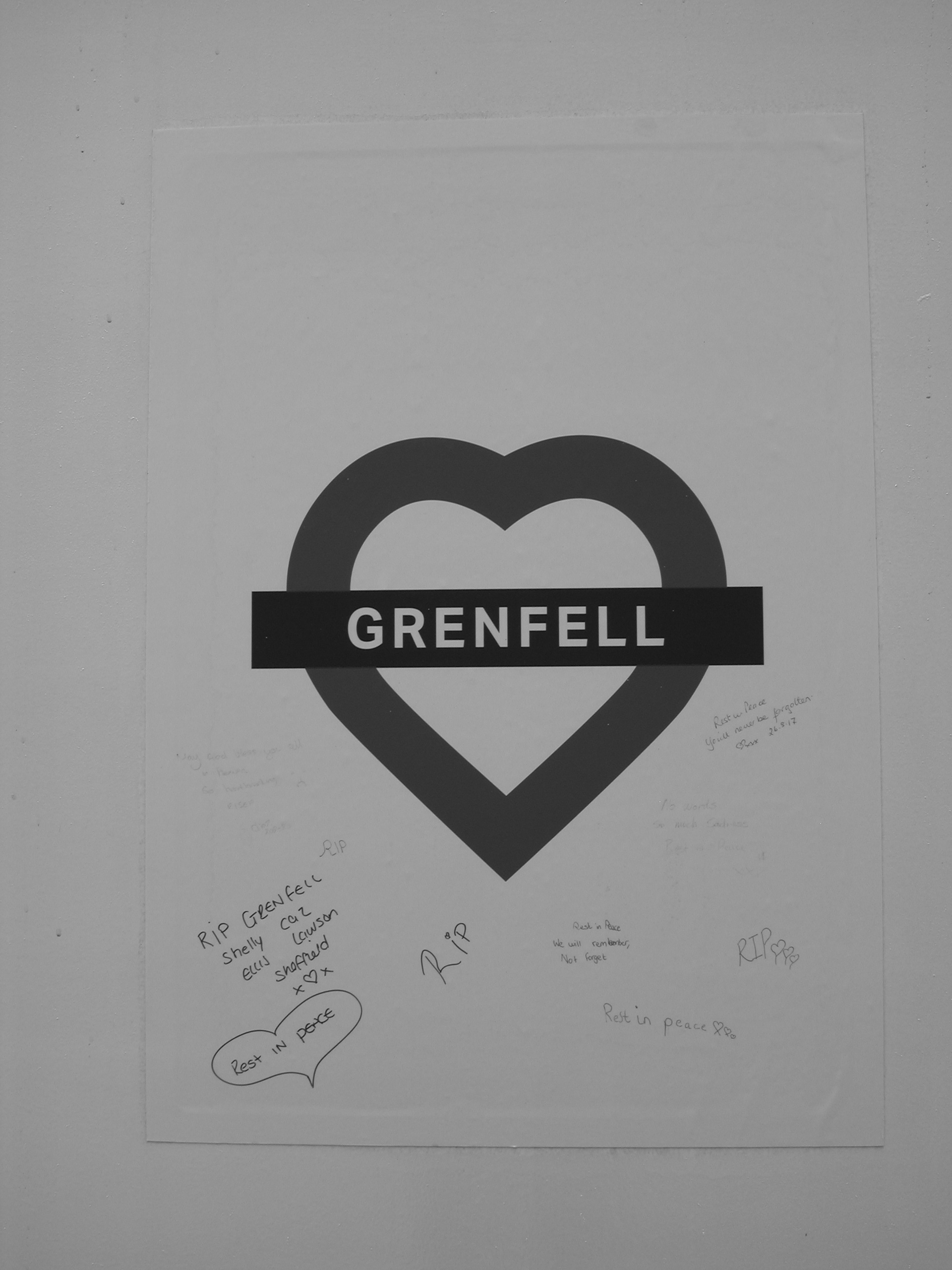
The photographs were taken during my 2 x 10mile walks around Kensington and Chelsea in August 2017 to collect sound and image material for a "sound portrait" of the borough. Three months after the fire the tributes were still there.


2017 text

It seems fitting right now that a new series of Twins Peaks is appearing on our screens. David Lynch's most well known production about a small town in the North of the United States, traumatised by the slow revealing of its dark underbelly could be a metaphor for Britain in2017. The original series began with the murder of a local homecoming queen; an act which on the surface appears totally out of place amid the scenes of bucolic small town life; a darkness that could only have been visited upon the community from outside. Eventually the surface is broken to reveal that what appeared wholesome, functional and everyday was built upon layers of corruption, violence and lies. The darkness which seemed to have come from outside is discovered to be rooted at the very foundations of the town itself. In the last few weeks something similar may be happening in Britain.

Two terrorist attacks, one surprise election result and one horrific tower block fire have left Theresa May's beleaguered premiership teetering on the brink. More important than that; more important for the possibility of lasting radical change, is the feeling, palpable in the country, that some hitherto unknown darkness, which the powers that be have spent the best part of two decades telling us was outside, out there" trying to destroy our way of life", is in fact right here. It runs through everything, from the transformation of London into a vast foreign investment portfolio, to the filthy money and weapons moving back and forth from Western governments to the Middle East, from the cuts to public services and the doctrine of austerity, to the acts of mass murder in Manchester and London, and of course this week in one of the richest places on earth, the abandonment of the country's poor to death by fire in their own homes.

It started after the Manchester Arena bombing when the role of the intelligence services and Theresa May's Home Office in maintaining an extreme anti-Gaddafi faction (The Libyan Islamic Fighting Group) was revealed, and that the then home secretary had allowed bomber Salman Abedi to travel age 16 to fight in Libya and to return unhindered. (). Only a few weeks prior she was seen virtually kissing the hands of Saudi King Salman bin Abdulaziz Al Saud while agreeing a multi-billion pound weapons deal with the Wahhabist state that is currently using those weapons and others supplied by the US to pulverise parts of Yemen back into the Middle Ages, creating the world's most serious food crisis, which the UN has described as a "man-man humanitarian catastrophe". Those weapons she told Parliament back in September 2016 were important to "keep people on Britain's streets safe".

The polls were already closing as we entered June. The Prime Minister's robotic and evasive non-performances could scarcely be defended by her own party, while Jeremy Corbyn was seen addressing thronging crowds wherever he went and seemed at ease among ordinary people drawn to his program of an end to austerity and renewed investment in public services. An arrogant and skeletal manifesto followed from the Tories which few cabinet ministers had even seen before being asked to defend. May's bunker mentality extended to her own party. Like the aging Emperor Claudius she relied on a few personal advisors for her connection to the real world. When called out on the blatant U-turn over the so-called dementia tax she steadfastly denied anything had happened. Like her speech in front of Downing St the day after the election, she seemed to occupy a different logical space to the rest of mankind. Strong and stable - the mantra with which she called the election, began to look at best deluded, if not mildly deranged.

Then on June 2nd, six days before the polls opened, another atrocity. The van and knife attack at London Bridge instead of playing into the government's rhetoric on security and stability seemed to have the opposite effect. Labour grabbed the initiative, focusing the public debate on cuts to police numbers during Theresa May's time at the Home Office. And again there were noises on the periphery about the State's role in doing deals with countries known to finance terror organisations. In the same week Donald Trump heralded the isolation of Qatar by its neighbours for just this reason and then sold $12bn of weapons to them. In an irony that few noticed, the Shard of Glass, a vast middle finger of capitalist domination that looms over the once Dickensian area around London Bridge, is majority owned by the Qatari state and was constructed as part of a large project of "regeneration" which saw many old established businesses forced out by compulsory purchase orders and soaring rents.

The election result, despite leaving the Conservatives as the largest party felt like a renewal; a vindication of ideas and a form of politics that many thought had been lost to cynicism, Neoliberal individualism and more recently the fallout from Brexit. Instead Labour's leader stands tall at the head of a movement which since the election result has swelled the ranks of his party beyond 800,000. Rather than Brexit, immigration, stability or even security, the public discourse was dominated by the issues of austerity, cuts to public services and a genuine feeling - for the first time in decade - of a real choice at the ballot box. The Prime Minister was visibly crestfallen , reduced to repeating the same broken phrases from the campaign, before submitting hers and her government's future to the creationists, anti-abortionists and religious zealots of the Democratic Unionist Party. Now Grenfell Tower has happened.


I switched on the radio as I do every day on my 5am drive to work and for the third time in as many weeks I immediately gauged that sombre professional BBC tone that is their hallmark at times of tragedy. This, at the end of weeks of shocks and reversals seems to bring everything together into one brutally tragic denouement. The poorest people in the richest borough in the country, suffocated and burnt to death in their homes after being threatened with legal action for publically raising fire safety concerns. An unaccountable quango inflicting "beautification" upon their building for the benefit of the surrounding rich; work that seems likely to be the cause of this unprecedented fire.

The terrible sight of the tower engulfed in flame and the harrowing stories of those within are mirrored by the unrestrained anger of the survivors and general public. For the first time in my memory such an event was covered immediately from the perspective of politics, class and inequality. Despite that, animosity from the residents towards the media is clear, with even the doting Jon Snow of Channel 4 News getting a hard time on the ground. Again and again the same grievances are heard in interviews; cuts, gentrification, abandonment, inequality and stigmatisation by the media.

The image of Theresa May at her private audience with a select few senior fire and police officers may be defining for her. Watching the coverage you become aware that separations so many of us are used to taking for granted are collapsing. The sort of scenes of anguish we're used to seeing in Alepo or Bangladesh, here in one of the richest places on earth. The sort of testimony of trauma we're used to hearing translated. Weeping women pace the streets carrying pictures of loved ones missing in the inferno. In the era of Globalisation, argued Michael Hardt and Antonio Negri in their book Empire, there is no longer any geographical separation between first and third worlds, they exist together side by side. The greatest poverty amid the greatest riches, the greatest suffering amid the greatest prosperity. People made homeless by the fire and their supporters have stormed the offices of Kensington and Chelsea council, demanding help and justice.

Something has been emerging over the last month, confirmed by the electoral slap delivered to Theresa May's Conservative and Unionist Party and their arrogance in expecting a fearful, compliant electorate to hand them a landslide. People aren't buying it anymore, and there is a sense that the repeated blows of tragedy during this time of political choice has had the effect of focussing attention on the state of Britain like never before. But more than that, what may be coming to consciousness for the first time in British society is the connection between things; the common substance linking all these events. Let us call the devil by its name: The Market. Not the market as talked about by the classical economists of the 18th and 19th century, not even the free market talked about in relation to exiting the EU. This is the Market not as something that exists, but as an idea, something transcendent and ineffable against which everything else is evaluated. This is the Market as first cause and first principle from which all human conduct should be measured. Indeed, from the idea of Market comes a whole anthropology of what the human being is and what a human society should look like. Not the political animal of Aristole but homo economicus. Not the community of equals striving to build the Just City but a network of freely contracting individuals, rationally calculating according to their own self-interest.

It is from commitment to this idea of the Market that successive governments have sold off Britain's public services, attempting as much as possible to make Britain mimic that idea. It is from the idea of the Market that Britain takes money from corrupt undemocratic regimes like Saudi Arabia and Qatar in exchange for weapons, despite their known involvement in the funding and dissemination of Islamist extremism. It is from the idea of the Market that police numbers are cut making it harder to detect and prevent that same terrorist extremism. It is from the idea of the Market that council housing is sold off or run down to make way for lucrative private developments that (in London in particular) are beyond the reach of those on ordinary wages. And it is from that same idea of the Market that so much of this new private housing stock is sold to foreign investors and left empty while homelessness spirals and the poorest have to live in dangerous, decrepit rented accommodation. Finally it is from the idea of the Market that the welfare state should be transformed (where it is not destroyed)in concert with profit seeking private companies into a apparatus for coercing people into the appropriate market behaviour, which equates to a life of precarious living, "bullshit jobs" (to borrow David Graeber's phrase) and permanent uncertainty.

At every level from major corporations and transnational organisations like the IMF, World Bank and the EU, to national governments and on down to local councils, the same idea, the same first principle of governance is applied and used to guide decisions and orientate human action. This is the almost metaphysical thread that runs through globalisation. It is only in the Neoliberal era, when the State was weaponised against Welfare and the unions, and the separation between public and private, State and free enterprise has all but collapsed, that the idea of the Market was able to become the totalising global principle it now is.

There is no single name for what I'm describing. Globalisation has been the common term but I prefer to use the expression One-World Governance. Everywhere it is transforming human life, bringing inequality, breaking up communities and breaking down forms of solidarity that don't adhere to the idea of the Market. This is the form-of-life, hierarchically ordered that today holds sway across the world. Until recently the violence that this system brings with it has been mostly kept at the periphery. Since the global crash in 2007 that separation too has now collapsed. Whether it is life permanently under the threat of terrorism, or amid the tragedy and ruins of Grenfell Tower, life under One-World Governance is a unfolding catastrophe. Change is undoubtedly in the air and the centre ground has all but vanished. Sides are being taken, battle lines drawn. Even if the tragedies of the last month do lead to lasting change it will take a shift of global proportions to redirect humanity from the course it is currently on.  


Friday, 31 August 2018

In the Shadow of Grenfell: Notes on an On-going Procrastination


For a year now I’ve been sitting on a set of field recordings which I made in August of 2017 around the London borough of Kensington and Chelsea. The project they were destined for was conceived as a response to the Grenfell fire which had taken place two months earlier. The idea I had was to produce a "sound portrait" which would highlight the range of different environments and economic conditions in the borough, which is often thought of as simply a rich and prosperous place, filled with museums, giant Georgian and Victorian terraces and trendy shops. In fact, Kensington and Chelsea while containing some of the richest people and most expensive property in Europe also has some of the most deprived wards in the UK. This disparity became a rallying point in the aftermath of the tragedy and continues to influence the terms in which it is framed.

That this project has barely got off the ground is a matter of some regret, as the one-year anniversary of the fire came and went. Although I still intend to develop the recordings, the project has thrown up some interesting issues with the nature of such endeavours and the difficulties both of making distinct recordings in an urban environment and of the notion of a sound portrait itself. Also, as time has passed the feeling I had of a need to do something in response to what occurred has given way to reflection. I’ve increasingly questioned my aims and whether the project was capable of living up to my intentions, which were to make some kind of contribution to the artistic and literary responses to the tragedy. Nevertheless, I have nearly five hours of recorded material which is sitting waiting to be worked on.
On two days in August 2017 I walked pre-planned routes of ten miles snaking through the borough from one corner to another. The routes were designed to present opportunities for recording what I hoped would be distinctive or pertinent material. Planning the routes presented the first challenge. Although I was familiar with the geography of the area and had visited many of the sites I intended to record at, I had never walked around the borough to this extent before and several of the locations – notably those around North Kensington, where the tower was located - were unfamiliar. I had to guess where might be a good place for recording and hope that what I found there would generate material sufficient for highlighting the varying character of the borough. In the case of the museum tunnel at South Kensington or beneath the Westway in North Kensington I roughly knew the soundscapes that would be present and kind of environment I’d have the chance of recording. I had also marked out certain parks, estates, and streets where I wished to make recordings, but I didn’t want to make the walks too prescriptive, as if the perfect soundscape was just there waiting to be gathered up.

One of the key principles which I take from the work of Luc Ferrari is that the making of field recordings should be open to an experience of what the Surrealists called “The marvellous”. This is an encounter with something that leaps out of the everyday flux of life, disrupting the normal process of signification and opening up more poetic readings. In Surrealist literature encountering the marvellous is often associated with walking unguided through cities and it was something of this tradition that I wanted to capture in my walks through Kensington and Chelsea. Invoking such a rupture in the day-to-day struck me as essential in order to emphasis the harrowing nature of the fire itself, without having recourse to direct testimony or some ham-fisted attempt to use sound to hint at the horror of being in a burning building. In fact, I wanted that event, and the tower – the shell of which had become an all too familiar sight in the news media – to feature barely at all. This is one reason why I used the working title ‘In the Shadow of Grenfell’ to signal that it was what lay in the locality of the tower rather than the tower itself and its traumatised community that was my subject. This also absolved me from having to confront the horror of that night directly, which I in no way felt capable. Here I must admit the truth of Theodor Adorno's claim that all middle class music is fundamentally ambivalent.

My route on the first day began at the South Western corner of the borough, where the A3220 turns North at Chelsea Embankment, and finished at Kensal Rise beyond the borough’s Northern border. I had the idea of beginning recording at the river, capturing the sounds of boats, the Thames lapping against the stone embankment, cars in the distance. I would then venture into the World’s End Estate hopefully to pick up the soundscape of the local community. In practice the ambient noise of cars passing hurriedly down Chelsea Embankment swamped the mix. The Thames is a surprisingly quiet river at Chelsea where boat traffic is irregular. A small sewerage outflow provided a trickle of watery noise as it dropped into the river but at low tide there was little of the evocative sound of water against stone mixed with urban background noise that I had hoped for.

In the estate I encountered another familiar problem with making recordings of this type. The square around which some of the main residential buildings were organised was nearly deserted apart from a group of men sitting outside a café. One is faced with the desire to get close enough to pick up the murmur of their chat without eavesdropping or disturbing them. Being noticed is always likely to end up ruining a recording as the unwitting passer by attempts to question why you’re wandering around their neighbourhood with a microphone. This happened while I was sitting in the estate and as a result I have a crystal clear recording of a Turkish man and his mates asking me whether I'd like to interview them. Perhaps I should have taken up the offer?

As the day wore on the sound of traffic and of the huge amount of building work going on all around the borough began to grate on me. I started to conceive of a composition made up entirely of industrial sounds emanating from the basements of well-to-do addresses, punctuated by the occasional exclamation in Polish or Hungarian. At Sloan square I offset the roar of Bentleys and Lamborghinis going through the junction with the gushing of Gilbert Ledward’s Venus pouring water from a conch shell into the fountain basin. Walking around the fountain I picked up a few touristic conversations as well as local business people yammering into their phones.

The urge to find quieter locations drew me off the planned route and onto side streets where row after row of elegant red brick apartment buildings sit alongside a series of private garden squares. Many of these hark back to the late 18th century and are accessible only by key holding residents of the multi-million-pound properties which flank them. If one theme of my piece was to be the sense of injustice felt by many at the levels of inequality in the borough then here was one concrete historical precedent. The garden squares of Chelsea, Belgravia and Knightsbridge are some of the few places of solace in an otherwise chaotic, noise polluted area. It's as if the planners of the 18th century had foresight that peace and quiet would be a commodity in modern Britain, so they privatised it in advance. The recordings I made at Cadogan and Lennox gardens, Egerton Crescent and Brompton square are replete with birdsong, crunching leaves underfoot and a sense of auditory breathing room that was impossible to find anywhere else besides the interior of St Luke’s Church Chelsea, where Charles Dickens was married to Catherine Hogarth in 1836.

On the North side of the church is a sports area where at the time of my visit local school children were having a tennis lesson. This provided one of the most distinctive recordings from the day, made all the better as the grounds were situated a good distance from the road. On the South side of the church building the original churchyard was filled with people relaxing in the late summer sun, eating lunch or talking with friends. After a brief recording stop at South Kensington station, braving the columns of school children on their way to the Science and Natural History Museums I finally began moving North up towards Holland Park and beyond it Notting Hill and North Kensington. My route for this first day would take me through the park and up Portland Road which skirted the residential complex where Grenfell tower sat.

I’d thought long and hard about whether to make recordings around the location of the tower itself. The last thing I wanted to do was to appear voyeuristic or to be mawkishly appropriating other people’s grief. And indeed, locals had put up signs around the site asking people not to take photographs. I elected not to make a roving recording around the area, which in truth was remarkably quiet. The one I did make was while sitting outside Kensington leisure centre. It seemed a good place as it was shielded from the wind by the hoardings put up to restrict access to the disaster site and as a result people milling around had to pass close to where I was sitting, affording the opportunity to get some snippets of voice which I was aware I had little of so far. A couple of minutes after switching the recorder on, two young boys came out of the leisure centre and sat next to me on the stone bench. They must only have been around eight or nine years old. They talked absently about the blackened hulk of Grenfell tower which loomed above us; one asking the other how it had happened and reacting incredulously when his friend told him it may have been started by a fridge. "But fridges are cold?!" he replied with impeccable logic. They moved onto other topics, one saying he wanted to be a scientist when he grew up, the other wanted to be Spiderman. It was a serendipitous conversation and the only recording I picked up with a direct reference to the fire.  

In truth, making field recordings with old sub-optimal equipment over a whole day is never ideal, especially when struggling to find subjects that rise out of the fug of background traffic and construction noise. Much of the day had felt like drudgery and I was finding it hard to imagine how I’d produce something distinctive and in the semi-didactic way I’d hoped for with the recordings I’d made so far. What could I add to my itinerary with a degree of sonic seasoning? The Carmelite Monastery to the North or perhaps Wormwood Scrubs to the West? I decided to collect some more obvious signifiers and made a couple of recordings at Latimer Road tube station, capturing both the coming and going of trains and the platform announcements which would serve to anchor the listener to the locality. Then the marvellous arrived beneath the Westway.

The pedestrianised area below the A40 flyover is about as Ballardian a place imaginable. Indeed JG Ballard once said that the raised carriageways at White City and Hammersmith leading out of London inspired many a page from his automobile based stories, not least Concrete Island (1974) which tells the tale of a latter day Robinson Crusoe marooned on hinterland between two dual carriageways. After the fire the area directly beneath the flyover became a make-shift community centre and gallery where locals can come to rest on any number of assorted sofas, meet local activists and community workers and contribute to the growing collection of tributes to the dead, political poetry, murals, and expressions of hope and anger.

This was undoubtedly a place where a great deal of emotion had been invested and where the reality of the fire and by association the raison d'etre for my project was most starkly felt. I spent a few minutes recording the dull rhythm of the cars passing along the concrete overhead, but in fact it was the acoustics below the road that were more interesting. Water dripped from some occluded overflow pipe high up on one of the supporting pillars, the screeching of brakes and trundling of trolleys on nearby Bramley road reverberated delightfully off the 1960s concrete, punctuated by the voices of local kids. There was also a street piano. I'd noticed it as I first passed through, then after making recordings at Latimer road I returned to find an elderly man at the stool with an even more elderly looking women in a wheelchair watching from the side. The piano was woefully out of tune (they were collecting funds to have that fixed) and whatever pub blues the gentleman was trying to conjure from his memory, it came out as a series of broken, tuneless chords. I managed to record a little under four minutes from about ten yards away; a rupture of vaguely melancholic, vaguely comedic quality in what was otherwise a very sad and poignant place.

At the end of day one I nursed a pint at a pub near Kensal Rise station while wiping the accumulated London grime from my face. Although I had accrued some distinctive material the question of the sound portrait and of the approach to composition remained, just as it would do during the following year. There are numerous possible approaches to the sound portrait, just as there are in the painted portrait. Luc Ferrari talks nebulously about music as a zone of frictions; between epochs, sensibilities and histories. In describing his sound portrait of Madrid (L'Escalier Des Aveugles) he emphasises the role of interpreters (typically for him, a series of young women) who enter into a dialogue both with the "portraitist" and the space, from which only material recorded there can be used in the "sketch". This process would be repeated at each location, producing a series of short stories. In truth Ferrari's work never truly approaches what we would consider portraiture in the traditional sense of an attempt to represent a person or place in another medium. In his case autobiography is always central in what he calls the "mike-voice relationship" and even simply with the presence of the author/composer/recordist. It is not for nothing that he termed his most distinctive style utilizing field recordings "anecdotal music".

Of more recent work in this area I've been taken with the collection by Katharina Klement (Peripheries: Sound Portrait Belgrade, 2017) and especially Rafal Kolacki's recordings made at the camp at Calais populated by refugees, known colloquially as the Jungle (Hijra: Noise from the Jungle, 2016). Both these works attempt a more documentary style with the author/recorder fading as much as possible into the background. Kolacki's recordings in the camp capture the variegated sounds of music - some pre-recorded, some played live - reflecting the origins of the inhabitants there. Sudanese and Syrian styles are heard most prominently alongside more domestic concerns and the voices of stressed international aid workers. There is as far as I could tell no collage or attempt at artifice in his work. Klement on the other hand deploys a methodology both in the collecting of her recordings and in their composition. Taking up the theme of peripheries she collected sets of field recordings by walking the city in eight concentric circles, with her apartment at their centre. These were composed as an eight channel mix for eight speakers with a combination of processing and layering which accentuated particular elements, environments or transitions within the places she visited.

My method of walking routes of a set length owes much to her approach but I'm less convinced that the significant intervention of studio techniques and a conscious narrativization was appropriate for my project. What I feared was a loss of the realism I wanted to achieve and with it some honesty. Another significant difference between our methods is that Klement recorded some interviews with people from the city, asking them questions about their experiences of the Belgrade soundscape. This was something I had briefly considered but rejected on the grounds that it would turn me into some kind of quasi-reporter and again would bring me a bit too close to the central trauma of the events of June 14th 2017.

The second day was thankfully cooler than the first and began in the drizzle at Kensal Green Cemetery at the North Western corner of Kensington and Chelsea borough. Nothing hugely exciting was seen or recorded here, though I did get a few moody camera shots juxtaposing crumbling grave sculptures with the gas holders on the horizon. These were added to a collection of photographs I took throughout both walks. With the exception of the cemetery which sits on its Northern bank, the Grand Union Canal marks the boundary between Kensington and the borough of Brent. Long gone are its days of ferrying goods and materials from Northern manufactories into London. The only traffic you're likely to see nowadays are pleasure trippers swigging craft beer out on deck, or that unique breed of London house boat dweller shifting their moorings every two weeks. It's wise to keep one eye on the tow path as these once industrial thoroughfares have given way to cyclists pelting down upon unsuspecting "peds". Despite the cyclists, canals are a refuge wherever they are found. People walk more leisurely, take in the sights either side and life generally seems to move at a slower pace. I walked along the path, past the famous Trellick tower (another Ballardian signifier) before hopping off at the borough's Eastern border with Westminster. The sounds of passing boats and the honking of Canada Geese beneath the road bridges were a welcome addition to my set of recordings, as were tube and intercity trains passing through Westbourne Park station.

Now heading south into Notting Hill the transition in affluence was marked. Portobello road market has long surrendered to the tourist trade and in truth little was open that morning. I really could have done with a good binaural recording set-up as it would have been worth capturing the sounds of the few shopkeepers and tourists doing their thing on either side of the road. Instead I was reduced to poking my microphone cautiously towards areas of activity while pretending to peruse the wares on offer. The second park visit was to the Western edge of Kensington Gardens; home to a notorious family of benefit claimants the Duke and Duchess of Cambridge, known to their friends and Wills and Kate. On this auspicious day the Duchess had made known via her agents in the popular press that she was expecting her third child. This led to a scrum of reporters from those parts of the globe who still cared (mostly North America) to assemble at the gates of Kensington palace and speak reverentially on the subject of morning sickness and speculate on possible names for the expensive Royal sprog.

It was also the twentieth anniversary of the death of Diana Princess of Wales and it seemed many a foreign visitor had come to make pilgrimage and lay cringe worthy messages at the palace gates. One that particularly struck me implored us to remember that just as at Calvary three were crucified, so too on that fateful night beneath the Seine did three lose their lives. The placard included pictures of Diana, Dodi Fayed and their driver Henri Paul, with the princess at the centre of the triumvirate in Christ's place. Such is the madness that the late princess's memory still evokes among some sections of hardcore Royal fetishists. These tributes to the long dead "Queen of Hearts" sat uneasily with those I had seen for the victims of the Grenfell fire the previous day. Would anyone be paying them such honours of memoria mei twenty years from now? The Diana memorial garden (yes there is more!) gave me another vaguely marvellous slice of audio in the form of a giant glockenspiel, which tuneless tinkling, animated by day tripping kids, wafted through the topiary boundary to meet my microphone.

I reflected on how I might complete the day's recordings while sitting by the ornamental pond at the centre of the Victoria and Albert museum, which, since the sun had appeared, was full of children squealing as they skipped through the fountains. I switched on the recorder, but a couple of men loudly talking shop to my right smeared what would otherwise have been a nice soundscape.
I'd given up the ghost regarding the construction noise. Where I came across an interesting timbre of angle grinder or pneumatic drill I took a couple of minutes recording. Nothing else appeared worthwhile between South Kensington and my return to the river. I was at the centre of Chelsea Embankment and now, with the tide fully in I clambered over a barrier onto a steel platform that held a ladder down into the water. Carefully I squatted down and activated my recording device. The Thames below the steel grill of the platform slapped against the stone. But before I could collect all that I wanted a wasp appeared a few centimetres from my nose. Startled I dropped the recorder towards the water, only for it to be saved by the wire connecting my monitoring headphones which miraculously did not come loose and held it in mid-air. Gingerly I hoisted it back up. I took it as a sign to make haste towards home and headed for Chelsea Bridge. Just before crossing I noticed a large stone staircase leading down to the river with easy access and the unmistakeable sound of waves licking against them. Finally I had the recording I had wanted to complete my soundscape; the perfect auditory punctuation nailing the listener to a place and a particular element.


As of writing it's been a year to the day since I completed the second of my walks. As the author Iain Sinclair (who knows a few things about walking in London) might say; such flâneuring about town can - if you're lucky - reveal occulted histories and provide new perspectives on otherwise familiar places. One way this can happen is by observing the transitions between locations; uncovering boundaries that we never knew existed. There may be no walls or guard posts between Portobello road and Latimer road, but they are worlds apart. Separated not just by affluence and social class but by a sense of integratedness with the beast that is boomtown London. Kensington and Chelsea borough is a place of exclusions. The rich behind their security gates and in their private garden squares and the poor, out of sight and out of mind; piled up on top of each other in death-trap buildings; deprived even of a means of escape. None of this happens by accident and it's been happening in London for centuries.

It remains my intention to work on these recordings and to produce something worthwhile. I hope the preceding recollections will function as an aide-memoire both for the compositional process and to recall the great tragedy that inspired them.

Below is a fifteen minutes mix of some of the raw recordings taken over the two days.