There's a
moment during V for Vendetta when the
voiceover tells us ominously that at a certain point in the recent history of
the authoritarian dystopia which the film depicts, "America's War"
reached England. The film was released during the days of the War of Terror and
is saturated with the rhetoric and imagery of that era. Fifteen years on and it
is the American Culture Wars that are threatening to make a wholesale jump over
the Atlantic, and nowhere is this felt more strongly than in the politics of
sex and gender.
One skirmish linked tangentially but significantly to current
struggles over transgender-rights is whether biological sex is binary or exists
as a "spectrum". A relatively
recent article in Scientific American
by their associate graphics editor Amanda Montañez, has even gone so far as to
create a visualisation purporting to show the spectrum of biological sex and
how each position within the spectrum relate to each other during development
from birth, through puberty to adulthood.

The Anglophone
world has seen huge changes over the past half century in the way in which
sexuality and gender are conceived. We're by now familiar with thinking of both
in a variety of different ways, and thankfully long gone are the days when
homosexuals like Alan Turing would be prosecuted and subjected to electric
shock treatment. More recently has been a rise in the prominence of
trans-politics and rights claims being made in order to depathologize and
demedicalize the status of transgendered people and the process of changing a
person's legal gender. In the UK this has risen to public consciousness owing
to proposed changes to the Gender Recognition Act (2004) that would allow a
person to change their legal gender without the need for approval by doctors or
psychiatrists.
The proposals and subsequent public consultation have elicited a
backlash from some women's groups; one of their claims being that so called
"self-ID" would undermine women's spaces by making it too easy for
biological men to change their gender and access them. There are also questions
about the impact of potentially removing the sex based exemptions from the UK Equality
Act which has allowed spaces like women's refuges to deny access to trans-women
and to exclude them from women's sports.
In most
discussions around these issues the biological basis of sex is still thought of
as binary. That being said there is also evidence of a great deal of slippage
and imprecision between notions of biological sex, a person's gender
"identity", and their legal gender. It is occasionally difficult to
establish precisely what is being disputed or the depth and breadth of some of
the claims being made. Beneath the radar however it is clear that the binary
basis of sex has begun to be challenged and several controversial articles in
scientific publications have appeared in recent years. At the core of the
argument is the expanding field of research into so called differences or disorders
of sex development (DSDs) and the status and significance of Intersex people.
To
give some indication of the ground being covered and what "biological
sex" here refers to, here is a concise summary from a review article in
Nature from 2014: "Mammalian sex determination is the unique process
whereby a single organ, the bipotential gonad, undergoes a developmental switch
that promotes its differentiation into either a testis or an ovary. Disruptions
of this complex genetic process during human development can manifest as
disorders of sex development (DSDs)".
One of the
first articles I've seen (also from the Nature website) which cites the notion
of a spectrum of sex is Claire Ainsworth's
informative summary of our broadening
understanding of the developmental processes involved in biological sex from
genetics, through endocrinology and anatomy. Although the
data on these expanding bodies of knowledge is compelling she does not so much argue the
claim that sex is a spectrum as assume it based on the very fact of the variety
of intersex conditions. This is clearly question begging. The same can be said
for a more
recent article by Liza Brusman which presents some of the same data
from the Ainsworth's article but with a far stronger emphasis on the spectrum
interpretation and its possible political ramifications.
For instance
she suggests expanding the language of US civil rights law such as Title IX to
include "all" sexes and genders. Though clearly to do that we would need to first
settle on precisely what and how many new sexes we are talking about, and which
Intersex conditions to append them to. Brusman though is adamant that society
has to catch up: "The science is clear—sex is a spectrum".
Is this
really the case? Does the diversity of DSDs and our broadening understanding of
them at multiple levels of the human organism force us to conclude that sex is
a spectrum?
It's worth
noting that the category DSD is not some old-world received medical term
designed to erase the hitherto unacknowledged existence of a spectrum of the
sexes. It was in fact brought in with the Consensus Statement on Management of
Intersex Disorders in 2006, which was the outcome of an international conference
involving experts from a diversity of fields and patient advocates under the
auspices of the Pediatric Endocrine Society and the European Society for
Paediatric Endocrinology.
It replaced otherwise unscientific and stigmatising
terms such as pseudohermaphroditism, hermaphroditism and sex reversal from the
accepted medical terminology. Despite this, some Intersex advocacy groups reject
the term on the basis that 'disorder' remains stigmatising. DSDs are defined in
the literature as “congenital conditions in which development of chromosomal,
gonadal, or anatomic sex is atypical”. Nowhere in this medical literature is an
argument made for DSDs constituting 'new' sexes.
As the most up-to-date
of the writing on this subject concedes, the total proportion of live births
with conditions falling under the general category of DSDs may amount to no
more than 1-1.7%. Of these cases the vast majority consist of late onset
(non-classical) Congenital Adrenal Hyperplasia, a condition caused by a deficiency
in one of a number of enzymes involved in hormone production, and which only
presents symptoms at puberty. The remaining proportion of DSDs include a wide
range of genetic conditions, each impacting on an individual's appearance,
fertility and development in different ways and to different degrees. Amanda
Montañez' graphic demonstrates this quite neatly and has considerable didactic
merit in this regard.
To better answer the
question (which by now the reader should recognise as very much a meta
question) of whether DSDs constitute evidence of a spectrum of the sexes, we
might start with asking what exactly IS a spectrum, and what is it the claim
that sex is a spectrum is actually meant to do to our traditional understanding
of sex as binary. To enquire in this way is not to question the science; the
science is clear, there are lots of different DSDs and people with intersex
characteristics as a consequence. This is a question about how a large body of
scientific and medical research enters public consciousness and intersects with
the demands and hopes of political activists and commentators. It is
necessarily a question of interpretation.
Spectral Rhetoric in LGBT+ Discourse
Dictionaries
are rarely reliable places to discover the meaning of terms as they are used in
the heat of contemporary political disputes. It's a particularly pedantic
trapping of Anglophone culture to demand strict consistency with dictionary
definitions when engaged in argumentation. Anglo-Saxons are still
resistant to the notion that the ultimate meaning of words come through their
use, and similarly that the endless possibilities inherent in human practices
consequently means that a word's definition can never be final.
Nevertheless the
Oxford English dictionary offers two definitions for spectrum: 1. a band of
colours, as seen in a rainbow, produced by separation of the components of
light by their different wavelengths. 2. Used to classify something in terms of
its position on a scale between two extreme points.

The second
of these definitions would seem to have obvious significance for describing
biological sex as a spectrum, especially as it is visualised by Amanda Montañez
in her graphic. The extreme points would be the typical biological male and
typical biological female. And indeed it is at the extreme edges of her graphic
that we find those positions. The first definition highlights that spectrum was
first used in a scientific sense to classify the range of colours in the
rainbow and later by extension the whole continuum of wavelengths of
electro-magnetic radiation. The paradigmatic spectrum then is the rainbow, which
is also the iconic flag of the LGBT+ movement. This is not without significance,
nor is the fact that Montañez has used the rainbow as an indicative part of her
graphic. The
semiotics of the rainbow and by extension the way in which the term spectrum is
used within LGBT+ discourse draws in a wide variety of inferences and
associations which makes the claim about biological sex more complex than it
seems.
The
"spectrum model" of gender and sexuality is a much more familiar
notion than a spectrum of the sexes. It's become a more common description as
the range of sexual practices and gender identifications continues to diversify
in Western societies. Dating apps are good place to get up to speed on the
cutting edge ways in which many people identify themselves and their sexuality.
In addition to hetero, homo and bisexuality it's not uncommon to see people
identify as Queer, pansexual, sapiosexual, and even asexual.
There are also
intermediate and modal variations which signify that an individual may identify
with two or more forms of sexuality. Or in the case of so-called homo and
hetero-"flexibles" a person may have a general tendency but admit exceptions
and not wish to identify as bisexual. Diversity is implicit in the iconography
of the rainbow and is matched by the avowed openness of the LGBT+ movement to both non-conformity
and change.
The
situation is at least if not more diverse in the case of gender, as the concept
draws in a broader range of influences than just those involved with sexuality.
The website
Genderspectrum.org describes gender as involving a complex
interrelationship between our experience of our body, our identity and society.
It's arguable that each of these categories imply each other and indeed it
would seem impossible to think of a personal identity that could exist without
a social component. If there are no private languages then by extension that
would seem to rule out private identities. Another way of thinking these three
domains might be as the embodied, the personal, and the interpersonal. Gender
identity - as the website states - is "our internal experience and naming
of our gender. It can correspond to or differ from the sex we were assigned at
birth".
We would
expect the naming of our gender identity to also involve these three domains of
experience. Names never exist in isolation and the signification of a gender identity
is a matter of social contestation, appropriation and development. Think of how
the notion of masculinity has been challenged, reasserted and reappraised
during just the latter half of the 20th century. Think of how
"traditional" ideas of womanhood have changed during the same period,
often in response to developments in reproductive technologies or the wholesale
entry of women into the workforces of Western economies. Indeed it is commonly
held that "detraditionalisation", as it is known in the sociological
literature, has been one of the principal drivers of diversification in the
fields of gender and sexuality.
Like those traditional
categories of man and woman, contemporary gender identities like non-binary,
transgender, genderfluid and genderqueer are similarly rooted in social
practices and so are never stable or fixed; further diversification and change is
inevitable. The variety of sexual and gender identities are social facts,
continuously emerging from the complex interplay of forces within modern
societies. Analogous to the openness of language itself, conceiving gender and
sexuality as spectra is a necessary correlate to the fact of human freedom and
the capacity for change and diversification brought about though human
practices. Another way of putting it is that their existence depends on the
nature of the human as a free, acting and self-fashioning being.
Can we say the same for biological sex?
 |
| One of the many graphics illustrating the spectra of gender identity and sexuality. This one also includes biological sex. |
One thing
the LGBT+ movement has been extremely good at is contesting the hegemony of the
so-called typical case. In sexuality this has traditionally been targeted at
the assumption that heterosexuality is the norm (so-called heteronormativity).
And in gender there have been significant advances in challenging social stereotypes
associates with being a man or a woman, as well as the opening up of a myriad
of gender non-conforming identities. Insofar as the rainbow is synonymous with
the spectrum model, it signifies clearly that there is no typical case, no
hegemonic norm. All positions within the spectrum are equally valid, and equality
- especially in Law but also in terms of cultural legitimacy - are two of the
principle political aims of LGBT+ activism and advocacy.
This is the context and
set of inferences brought to bear when it is argued that biological sex is also
a spectrum. We could say then that to describe it as such is to claim
biological sex territorially for the semiotics of LGBT+ discourse. It is to say
that the things which are ordered within the observable range of biological sex
are ordered in a way significantly similar to those things within the spectra
of sexuality or gender. It is also to contest the hegemony of the norm, which
in this case is the status of the "typical" biological male and
female.
Unpicking
the meaning of the attribute "spectrum" when used in this context
helps us to understand the incongruities when it is applied to something like
DSDs and biological sex more generally. The most important difference is this: DSDs
like PMDS, 5-alpha reductase deficiency, and conditions caused by missing or
additional sex chromosomes are not the product of human freedom and practice.
They are not social facts. Before these conditions were discovered and their
genetic basis understood they still existed. The biological basis of DSDs is not sustained by discourse and contestation; they are not brought into being by
creative self fashioning. They are very different types of things to gender or
sexual identities.
There are also only so many DSDs (currently about 40 are
known). Unlike the open ended nature of human practices they do not admit to
the infinite realm of possibilities that we associate with the continuum of
sexual and gender identities captured by the spectrum model. This is not to say
that new DSDs won't be discovered or appear owing to natural genetic variation,
but here we are clearly talking of discovery rather than creation.
The
scientific significance of DSDs is undoubted. But scientific significance does
not automatically equate to political significance, or at least the kind of
political significance that neatly maps onto established strategies and forms
of argumentation within the LGBT+ movement. As mentioned above, one of the
signal functions of LGBT+ activism is to contest the validity of hegemonic
norms and assert the equality of all members within the spectrum of identities.
This is problematic in the case of biological sex for at least two reasons.
Firstly, even Montañez's graphic marks biological male and female as the
typical cases to which all the DSDs are related. Indeed it's questionable
whether any of the "gradations" she visualises can be thought of
independently of their relation to one or both of those typical cases. This is
especially so as each of the DSDs included are caused by genetic defects of
what would otherwise have been a typical case.
To better
illustrate this point lets go back to the spectrum of sexual identities. Let's
consider Sapiosexual, which is someone who identifies with being particularly
attracted to intelligence. In order to understand this do we need to make
reference to other identities within the spectrum? Seemingly not. Aside from a
general understanding of what a sexual identity is Sapiosexual is perfectly
intelligible without reference to other points on the spectrum. Indeed even if
there were no other sexual identities Sapiosexual would still be intelligible
in every significant way. It is a discrete member of the set of sexual
identities. This however is not the case with DSDs. Each condition by its
nature is a specific variation from the typical observed case and this is
reflected in the names given to many DSDs such as "deficiencies",
"dysgenesis", "disorders" etc.
Secondly,
there is I think a strong claim that Montañez's graphic and much of the popular
writing which uses DSDs to claim that sex is a spectrum misrepresents the data.
It is always worth remembering that the way complex scientific data is
presented goes a long way when making arguments that revolve around
interpretation. It is undeniable that the way the graphic is presented -
especially with the inclusion of the rainbow strip on which are listed the
names of various DSDs - calls out "spectrum". But this is only one
way of showing the data and perhaps it is missing a very important component,
weighting.
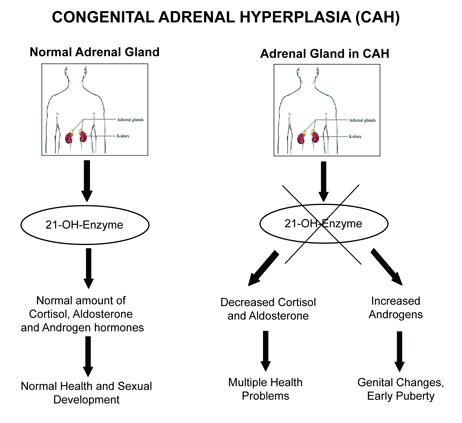
 |
| Outline of the 21-Hydroxylase deficient variant of CAH |
As already mentioned the total range of DSDs may account for only
1-1.7% of live births and that perhaps only 0.2% are made up of conditions
other than Late Onset Congenital Adrenal Hyperplasia (CAH). That means that the
genetically and physiologically typical cases make up at worst over 98%. When
you take into consideration people with Late Onset CAH are karyotypically
normal and experience no physical symptoms until puberty, you are left with a
figure of around 1 in 500 live births potentially showing some signs of DSDs. Also worth
noting is that the cases of ambiguous genitalia - the DSD that gets most
coverage in popular media - affects an estimated 1 in 4500 births.
If this weighting
were taken into account the graphic would look very different indeed. The
typical biological male and female, which in Montañez's version form the
extreme ends of her spectrum would, when weighted correctly, look like brick
sized slices of bread between which an ultra wafer-thin slice of cheese would
be located representing the totality of DSDs. Would a non-specialist looking at
such a graphic be likely to conclude that biological sex exists as a spectrum?
I suggest this is unlikely and what such a weighted visualisation would instead
do would be to emphasise that biological sex is only intelligible as a binary,
but that there also exist a small minority of exceptions to the typical cases,
which are of wide ranging types.
However, those exceptions are only explainable
as exceptions by relation to the typical binary cases. Androgen insensitivity
is only observable owing to the fact of the typical level of "sensitivity"
being understood; just as mutations in CYP21A2 or SRD5A2 genes are only
understood owing to the sequence for the functioning enzymes they code for
being known from the typical cases. None of the conditions falling under the
category of DSDs are defensible as discrete sexes in their own right. They are
quite simply different kinds of things to gender and sexual identities and to
treat them as if they were not is nonsensical.
I said above
that the 2nd definition of spectrum - to classify something in terms of its
position on a scale between two extreme points - might superficially have
greater applicability to biological sex. At least this notion of spectrum
acknowledges the validity of the extreme points; something the continuum
version of spectrum - the one used when we talk about sexuality and gender -
does not. It does however make little sense to claim that DSDs represent
"gradations" between the typical biological male and female that can
be used to plot a scale from one to the other.
Each condition has its own
specific aetiology and characteristics at the genetic, hormonal and
physiological level. Classifying them as more or less male or female is a
forced abstraction that is rooted neither in the science or the way in which
these conditions are approach from a practical medical standpoint. And even if
one could in some remote way describe the distribution visualised by Montanez
as having genuine "spectrum-like" qualities it is still less than
obvious what the political significance and benefits of this might be for those
individuals who could be described as belonging to one or more new non-binary
sexes.
What are the Political Implications?
So what are some
of the political implications at stake here? What would be the virtue of
arguing for a spectrum of the sexes and how might such an interpretation impact
current advocacy issues around Intersex people?
Homosexuality
used to be considered a illness with potential criminal tendencies; it was treated "medically" with
drugs and torturous treatments like electric shocks. Despite homosexuality
being legalised in the UK in 1967 it wasn't until 1987 that it was fully
removed as a "mental disturbance" from the DSM (The American
directory of mental disorders). Depathologizing homosexuality was a big step towards
reducing social stigma and paving the way for gay rights in areas such as
anti-discrimination law and most recently marriage.
DSDs, however, are by
definition disorders, their cause is traceable to anomalies in the building
blocks of life, our DNA, and can result in extreme cases (as with the salt-wasting
variant of Congenital Adrenal Hyperplasia) in life threatening illness. As
genuine medical conditions many of them demand some kind of appropriate,
compassionate medical response, and it is not at all clear how depathologising
them under the rubric of a new spectrum of the sexes would benefit people born
with DSDs.
A great deal
of Intersex advocacy does focus on healthcare responses. One area where there
is a considerable amount of work being done is in the area of laws protecting
the bodily integrity of intersex people, especially where it concerns
non-consensual genital surgeries, sometimes called "assigned sex".
This is to do with those rare cases of babies born with so-called ambiguous
genitalia and the medical responses that ensue. In many cases there is little
in the way of ambiguity and the child's sex is not in dispute. Surgery might
take place - for example in boys - because the genitals are not considered
"male" enough. This has resulted in cases where new born boys have
had their penises removed and been raised as girls, sometimes only finding out
the truth much later in life.
 |
| The Phall-O-Meter, developed in the 1990s
by the Intersex Society of North America (ISNA), was a satirical
activism tool to highlight how doctors made subjective judgements about
atypical genitalia then based their surgical advice on that analysis. From Human Rights Watch Website | |
There is also evidence that in cases of serious
ambiguity the tendency in the past has been to surgically create genitals that
appear male, thus effacing many women at birth.
Intersex advocacy tends to focus on delaying non-consensual and
irreversible surgeries until an intersex person reaches the age of informed
consent. From a consent perspective there seems to be little that is added by
way of arguing for a spectrum of the sexes.
There is also
little evidence that the interpretation of sex as a spectrum is being driven by
Intersex people themselves. The decision in Germany in 2013 to allow some
Intersex infants to be classified as a third sex was roundly criticised by
rights groups and Intersex advocates. There is a concern that allowing a
newborn child to be registered as a third sex would encourage more surgeries on
intersex infants as parents are unlikely to feel comfortable with the
uncertainty. Many countries also have sex based rights legislation or link
access to certain welfare provisions to sex . Subsequently, Intersex people
classified other than male or female may well fall between the cracks while
legislators attempt to catch up with the new non-binary system.
Thinking of
DSDs as constituting sexes in their own right would also appear to reverse the
famous anti-reductionist mantra that "genes are not destiny". Now it
appears to some extent they are. You are your persistent Mullerian duct
syndrome, your defective androgen receptors, your ambiguous genitalia. Your
hidden fallopian tubes are the secret of your true nature rather than just a
rare and slightly Lovecraftian result of a point mutation in a single gene.
Is there any
reason to believe that people with Turner or Klinefelter syndrome need to be
classified as a unique sex in order to access specific legal rights and
protections that are currently unavailable to them, or that this would lead to a
better quality of life? Many of the conditions categorised as DSDs do not
result in symptoms that put the sex of the person into question. MRKH affects
genetic females and causes incomplete development of the uterus, cervix and/or
vagina. Though they do have normal ovaries, people with MRKH are sterile. Being
told that such a condition means you are not a biological female doesn't sound
like a very progressive move.
The same could be said of Klinefelter syndrome
which involves a genetic male having an additional X chromosome. Symptoms are often
subtle and hard to detect even after the onset of puberty. Would such a person
benefit from being classed as other than male at birth? And finally, would
social justice in general be served by treating biological sex as a spectrum
rather than binary? These are the sorts of questions which are as yet
unanswered by advocates of the spectrum interpretation.
There is an
assumption among many radical social constructivists and theorists of
detraditionalization that any increase in indeterminacy or breakdown of
hegemonic norms is by definition emancipatory. There seems to be little reason
to take this for granted. It is perhaps worth bearing in mind the fact/value
distinction; the distinction between "is" and "ought" which
captures the difference between scientific claims and value or ethical claims.
The value claims made (or assumed) from interpreting biological sex as a
spectrum do not necessarily follow from the facts, and need to be argued for on
their own merits rather than asserted on the basis of their applicability for
gender identity and sexuality. Traditional LGBT+ activism may well have an
important role to play as an ally in advocating against unnecessary surgery,
especially where such surgery has tended to favour "masculinisation"
of ambiguous genitalia; or in resisting the impact of gender stereotypes on
Intersex people whose conditions mean they don't necessarily fit the mould.
There
is however a potential conflict as currently one major aspect of trans-rights
is arguing for access to precisely the kind of medical interventions (hormone
treatment and surgery) that many Intersex advocates are trying to minimise. We
live at a time where public self-assertion and group-think often run ahead of a
cool examination of the facts and the implications of drawing communities with markedly
different concerns into already matured forms of political activism and
ideology. How the current articulation of medical interventionism and identity
politics would impact Intersex people if the spectrum interpretation prevails
is unclear. In any case we might well question whether dragging individuals
with a complex range of conditions into the current culture war is at all desirable.