Saturday, 11 April 2020

Plague Power #2: States of Exception and the Demobilised Zoon Politikon


1.

Total mobilisation was one of the key military concepts bequeathed to us from the war experience of the 20th century. It finds its counterpart today under conditions of pandemic in the notion of total confinement. If, as Ernst Jünger puts it, total mobilisation is the conversion of life into energy at the level of the society, then total confinement must be the withdrawal of energy from that same social life. What is essential to note is that in both instances it is life which is the object of conversion or diminution. But the life targeted here is not the mere biological life of the human animal but the life particular to homo sapiens as the zoon politikon, the political animal of Aristotle's philosophy.


Under conditions of total mobilisation the energy of an entire population is harnessed as projective force to secure its survival in wars, which thanks to the reign of destructive technology, have become equally total. Thus, contrary to the rhetoric of "defending our way of life", which we still hear from politicians today, the life being secured in such cases is not that of the zoon politikon - the qualified form-of-life which the Greeks called bios - but rather it is the bare biological life of the population, which is the life common to all living things. We thus have a paradox of sorts, where the form-of-life that is most particular to humans is being sacrificed, converted by the great war machine of modern states for the sake of saving, or preserving its biological life.


At this level the two concepts, total mobilisation and total confinement, are entirely aligned. In both cases power sacrifices what is most proper to the human in order to conserve (and in the process capture) its biological existence.

This process is a familiar theme in the political writings of Giorgio Agamben, for whom the State of Exception (which total mobilisation and total confinement are extreme iterations) is the moment when the otherwise regulated relationship between power, life and Law is broken, and power (specifically sovereign power) appears in its most arbitrary and potentially murderous form.


We have got used to thinking of power under neoliberalism in that "capillary" model that Foucault described so well in the 1970s; reaching down to the smallest quanta of human activity; monitoring, recording, governing and conducting; and usually coupled - in his account - with a corresponding loss of the sovereign or charismatic mode of governing. As the entropy of government increases, power and authority become diffuse, unlocalisable to a central point. "Central government" then becomes little more than a clearing house. This is the type of elite technocratic governance caricatured by modern populists like Donald Trump, Bolsonaro, Salvini and the rest.


Now, what we're observing under conditions of contagion is the blood being drawn back from the extremities, back into the major arteries of state and police functions. The current pandemic has confirmed much of what we knew or at least suspected was always in the arsenal of modern states in the era of smart phones, big data and the complete interpenetration of civil and security technologies.


2.

In February you'd be forgiven in Europe for watching with a wry smile as the Chinese deployed drones to track individuals suspected of carrying the virus, and even confronting people deemed outside unnecessarily, sometimes following them back to their homes. Only a few short weeks later the tactics we'd like to palm off onto undemocratic states like China appeared in Spain and in the UK, where in Derbyshire the police (in a typically English display of pettiness) used a drone to film people walking their dogs or driving to secluded country spots to take their exercise, neither of which are prohibited under the new "guidelines". 


A similar functional adaptation has been seen with the use of smart phone tracking and card transactions to monitor where infected persons have been and who they may have come into contact with. In Israel and elsewhere all that has been needed to achieve this is the generalising of already existing anti-terror legislation to cover all citizens; an age old slippage that has been repeated throughout modern history where provisions originally designed for criminals get migrated over to the general population. Bertillon cards, the precursor to the modern biometric ID card developed by Alphonse Bertillon in the late 19th century is exemplary in this regard. It should not surprise us that early biometrics were pioneered by the son of a statistician working as a clerk for the Parisian police. Google have now weighed in, helpfully offering to make mobility data from tracking your phone available to help governments "manage the outbreak".


As well as enabling extrapolitical measures likes these, governments around the world have been passing emergency legislation giving them bold new powers over everything from speeding up burials, to closing down schools, shops and business, to detaining those suspected of being infected with the virus. In France where an especially severe lockdown has been implemented, individuals need to fill out a form before they can leave their own homes and present it to any police officer who challenges them. Tens of thousands of fines have already been issued to people deemed to be outside unnecessarily.

Throughout continental Europe only food shopping for essential items is now permitted, though there is no advice on what precisely these essential items are. One might well ask, if only the essentials should be purchased why are supermarkets still selling anything else? In the UK there have been incidents of police searching through shopping bags, with Easter eggs falling foul of the restrictions. In wartime, essential food items were defined and allocated through the rationing system. Inessential items were more or less unavailable. Bananas were one item that vanished from shop shelves entirely during the 1940s.


Without a transparent and properly defined system the police have effectively been given arbitrary powers, and worryingly have had to be reminded that they should be sticking within the guidelines rather than adopting the interpretations of ministers given during press conferences as instructions. At the bottom of that particular slippery slope lies fuhrerprinzip and Nomos Empsychos (living Law).


The Hungarian Prime Minister Viktor Orban is never one to let a crisis go to waste. Last week, as a response to the pandemic his country's parliament voted to give him the power to rule by decree indefinitely. Hungary thus becomes the EUs first bona fide dictatorship; though as yet there is no talk of kicking them out of that accommodating club. Orban's powers arrived with additional legislation outlawing "fake news" about the government's response to the virus. Anyone deemed by the State to be spreading misinformation could be jailed for up to five years. Orban's power grab, as well as punitive measures and emergency powers adopted by governments across the world amplifies an authoritarian trend which was already in process long before the current crisis.


It's important however not to overstate the totalitarian potential at work in these events. Jünger's total mobilisation is more of a regulating ideal than an actually achieved state of affairs, and the same goes for total confinement. In the UK the memory of the riots in the summer of 2011 is still strong, and with police numbers having fallen by 20,000 over the intervening period the capacity for law enforcement in the case of widespread civil disobedience is limited.

Despite briefings to the contrary there is widespread belief that the UK's relatively mild lockdown conditions reflect the Conservative government's continued commitment to a strategy of "herd immunity". Hardly constituting a strategy at all, it is in effect allowing the virus to tear through the country so that enough people contract, survive, and build immunity that in great enough numbers would act like a firebreak against further epidemics. The cost of this strategy would be tens of thousands of preventable deaths, not only from Covid-19 but from other medical conditions that an overwhelmed health service could not properly treat. Formally such planed negligence would be the opposite of an authoritarian response, but it is no less destructive, no less biopolitical in its cold economic calculation of mass death and suffering.


There is undoubtedly a danger in all this is that once the pandemic passes we will be faced with years of struggle to roll back the sweeping powers assumed by the State, which will likely be redeployed to serve other purposes and other "emergencies", depending on their perceived utility. Fears over the disappearance of cash, the further erosion of privacy, and the integration of big data across government and corporate institutions are all valid concerns under circumstances where oversight is limited and the normal rules don't apply.


3.

The last few weeks have seen states take actions that we had been led to believe were impossible; massive injections into the economy for the sake of safeguarding workers, the debt of the NHS written off, railway and airline companies renationalised, hospitals constructed in days. All these things that in the UK were propagandised against by the Conservative party during the general election of December 2019. Thinking back to Thomas Hobbes, it’s as if the miraculous power which Western politics has for centuries thought it had cast out from the concept of sovereignty has returned, with the Leviathan revealing itself once more as “that mortal God” to which we owe, under the immortal God, our peace and defence.


There is an intense need for awareness and scrutiny of the decisions being taken in the present circumstances, and to resist the urge - in a situation of understandable fear and uncertainty - of collapsing all social and political life into the management of the (biological) life of the people. Dark undertones have already been glimpsed, such as 'do not resuscitate' (DNR) forms being sent out to disabled people by some GPs in the UK as part of the Coronavirus response. Battlefield triage is the paradigm being reached for to describe the extremely tough decisions having to be made by doctors allocating scarce resources to so many critically ill people. It is one of the very few scenarios where a strict application of the utilitarian principle of maximising quality of life outcomes for the greatest number of people is the most appropriate ethical response. However, generalised to public policy and welfare it very quickly turns into eugenics. 


Italian philosopher Giorgio Agamben, who has done more than anyone in warning of the dangers of a generalised state of exception, has been accused of downplaying the significance of the Coronavirus pandemic and the need for drastic action in a piece for Quodlibet

The piece, written at the end of February, does indeed seem naive in its assessment of the impact of the outbreak and the Italian government's measures which he describes as "frenetic, irrational and entirely unfounded".  However in a clarification issued shortly afterwards the properly ethical philosophical core of his position is clearer:  


"The first thing that the wave of panic that has paralyzed the country obviously shows is that our society no longer believes in anything but bare life. ... Bare life - and the danger of losing it - is not something that unites people, but blinds and separates them. ... People have been so habituated to live in conditions of perennial crisis and perennial emergency that they don’t seem to notice that their life has been reduced to a purely biological condition, as has not only every social and political dimension, but also human and affective. A society that lives in a perennial state of emergency cannot be a free society. We in fact live in a society that has sacrificed freedom to so-called “reasons of security” and has therefore condemned itself to live in a perennial state of fear and insecurity".


The point to make here is that this is not a moral condemnation of the emergency measures taken by governments; it would be foolish to suggest that the "virtue" of the governing class should somehow form a bulwark against the despotism of technicity, or that there was some other obvious response to the pandemic that should have been adopted. What we are seeing now has always been there as a capacity and a real possibility. As Agamben has repeatedly argued - following the insight of Walter Benjamin - the state of exception in which we now live has become the rule. The Coronavirus pandemic functions like a moment of concentration in which political, governmental, and also ethical and social forms are revealed to be shot through with an already existing weight of fear and anxiety. We were already afraid, and were already habituated to sacrificing our freedom to health and security, to the empty city depicted on the frontispiece to Hobbes' Leviathan. What is happening now - while far from an authoritarian takeover - is an acceleration of a process that has been underway for decades.


The Dance of Death - 16th Century German, annonymous artist
Finally, it is worth bearing in mind that there is another side to the "dream" of plague uncovered by Foucault's researches, one pregnant with images of individuals throwing off their masks (metaphorically but may as well be literally) and abandoning their social status to the great debauchery of those who know they are going to die. "Plague overcomes the law just as it overcomes the body". An overcoming of Law and the contiguity between a state of exception and a state of festive anomie is similarly evoked in Agamben's extensive writings. If there is a deeper meaning to the pandemic, one that might point the way towards a different kind of world and a different kind of life in the aftermath, then it may be found here.

Saturday, 4 April 2020

Plague Power #1: Soldiers and Plague Doctors in the Political Imaginary of the State


1.
 The plague town is a zone of indistinction, a place where boundaries are set-up and undermined. The logic of contagion challenges divisions between individuals, dissolving separateness into a mass of intermingling and potentially contaminated bodies; while at the same time lockdown suspends life and "social distancing" turns every stranger one encounters into a possible killer.

As I write, nearly one half of the world's population is under a lockdown of one sort or another. It's striking reading over the methods by which plague was controlled in centuries past to see that so little has changed. Stop the spread, control the disorderly flow of bodies and the invisible evil passing between them. Separate, isolate, create distance, but also totalise by way of an analysis that takes in the whole population and characterises it down to the finest grain; infection rates broken down into boroughs and wards, death rates, age and "underlying conditions". 

On that latter point, never has hearing of a deceased person's underlying conditions (which we should remember can include everything from high blood pressure to terminal cancer) given so much relief to so many of the living. Everyone is now getting a crash course in epidemiology and virology; modern perspectives on contagion which produce demands quite different from the theory of miasmas. Few people are desperately perfuming their homes in an attempt to avoid infection, but in the stretched queues outside supermarkets the red raw marks of excessive hand washing are plainly visible.

Although the pandemic is being given the window dressing of a state of war the analogy is in fact quite insufficient. "Send Coronavirus packing!" was Boris Johnson's half hearted attempt to conjure a Churchillian moment from out of his bag of bluster and incoherence, just before he contracted the disease himself. He had little hope of success as the paradigm of plague doesn't lend itself well to the kind of jingoism and will-to-heroics that military conflicts do. In the first instance the "enemy" has no face and so cannot be propagandised against. So much of the get-up-and-go which characterises mobilisation for war is made off the back of leveraged prejudices; "send the Krauts packing!" 

This hasn't, however, stopped Donald Trump from calling it the "Chinese virus"; an act inspired by racialised economic warfare, repeated by many of his officials and which has done nothing but contribute to a rise in attacks on Asian looking people in the US. Infantry and air power are futile against a microscopic army, but he'll send the troops and fire off the Tweets anyway. The image Trump was hoping to evoke (it is the only one he knows)  is that of an external threat; the barbarian at the gates, and the necessity to mobilise to defend the homeland.

All this is useless when the threat is within the body of the people itself, an internal contagion for which an analogy with rebellion or civil war is more apt. As in the case of insurrection and "risings", a strict disciplinary regime is imposed in order to divide the sick from the well, the loyal from the seditious, isolate the infection and characterise the nature of its spread. By what means does it move across the land? through what disorderly conduct? We are by now familiar with the biopolitical implications of all this; the hot-house of modern disciplinary power that is implicit in the politically operationalised concept of population, and the management of its health. 

Only with the rise of statistics and the developing sciences of microbiology and pathology did it become possible to visualise the biological life of a population and make of it an object of political rationality. But even before the advent of those sciences, the plague and its management was an event where the bare-life of a whole community was made palpable and open to capture. Now, in this unprecedented moment the same rupture appears on a world scale. The coronavirus pandemic marks the appearance of bare-life elevated under the rubric of a generalised state of emergency to the life of the entire global population.

2.
"The plague-stricken town, traversed through-out with hierarchy, surveillance, observation, writing; the town immobilized by the functioning of an extensive power that bears in a distinct way over all individual bodies - this is the utopia of the perfectly governed city". Michel Foucault - Discipline and Punish

No image speaks to the authentic core of State power more than the famous frontispiece to Thomas Hobbes' Leviathan. The engraving shows the crowned figure of Leviathan towering over a land speckled with churches and villages. Its torso and limbs are composed of the people (or dissolved multitude as Hobbes puts it) who are turned towards the face of the giant figure, each having agreed to enter a covenant to give up their Right to the sovereign in exchange for peace and security within the body of the State. This is the well known contractual side to Hobbes political ontology. The frontispiece also contains many mysteries and much symbolism that has contributed to its notoriety.

The depiction of the city in the foreground is of special interest to us. Several scholars have noted how the city appears devoid of inhabitants, including the figure of the sovereign itself which seems to hover beyond the horizon of the territory over which it reigns. One explanation for this paradox offered by Italian philosopher Giorgio Agamben is that it reflects the non-political status of the people in Hobbes' philosophy. As a "dissolved" multitude within the body of the State the people do not have autonomy apart from their representation by the sovereign. They cannot take back the agreement they have made, nor limit the extent of the power they have engendered. Conversely, prior to them giving up their Right to the sovereign the people are a "disunited" multitude within the state of nature, a pre-political state according to Hobbes. So although the multitude - which made the original covenant - continues to exist dissolved in the body of Leviathan, the people (as that collective will) no longer has any independence apart from the State. The people appear only in the moment the sovereign State is constituted before vanishing again. It is for this reason the city appears to be empty. Empty that is apart from two sets of figures, soldiers and what some scholars have identified as plague doctors.

The presence of soldiers, who in the image patrol outside a fort, neatly ties in with the symmetry of the frontispiece, the left side of which is given over to symbols representing the temporal power, the most visceral of which being the sword of justice held in the right hand of the giant figure. The plague doctors can be seen outside the cathedral on the opposite side, which  predominantly features symbols of the spiritual or ecclesiastical power. The significance of the inclusion of plague doctors is not immediately obvious, and the interpretation is admittedly a little incongruous with the overall symmetry of the symbolic scheme (could they not be wearing ecclesiastical vestments; the elongated "nose" rather meant to depict a hood?). It becomes more plausible when we consider the political significance of plague more generally.

3.
Agamben in his interpretation is I think drawing on Michel Foucault's description of the management of the plague town as a step towards modern forms of surveillance and rationalised systems of power based on division of labour and authority. The term Foucault identifies from the archives is quadrillage a word without direct translation into English but which has connotations of ordering, division and management of a territory. As he writes in Abnormal (1975): "from the sentries who kept watch over the doors of the houses from the end of the street, up to those responsible for the quarters, those responsible for the districts and those responsible for the town, there is a kind of pyramid of uninterrupted power. It was a power that was continuous not only in this pyramidal, hierarchical structure, but also in its exercise, since surveillance had to be exercised uninterruptedly".

This disciplinary mode of power over a population (which he would later go on to call biopolitics), based on inclusion, ordering and observation was opposed in Foucault's account  to the treatment of lepers, who were excluded from the community, almost as an act of purification, and who were stigmatised rather than monitored and categorised. Indeed he even goes so far as to suggest that the management of plague and of lepers represent the only two major models for the control of individuals in the West. We can perhaps distil this claim to its most basic characteristic, that each model is based on either inclusion or exclusion of individuals. Even so, this opposition is perhaps a little too black and white, especially in the light of modern state run health and welfare systems which are often the site of exclusions, albeit by way of nationwide bureaucratic decision making.

Following Agamben's logic we might evoke the liminal or threshold concept of the inclusion/exclusion dyad, which would help us understand how a form of organisation that takes in every individual through observing, recording and monitoring, is also capable of asserting a right over life and death in a manner we associate with the Medieval sovereign. That is after all what large scale healthcare systems and governments are now in the process of doing, deciding where resources are allocated, who gets tested and who is left to die alone without treatment. It is for this reason that I think Agamben likes to pair the soldiers in Hobbes' frontispiece with plague doctors. 

The plague doctor symbolises the extreme moment (like a state of war) when the bare-life of the population appears most clearly as an object of political decision making. This is when the power over life and death that we associate with pre-modern rulers appears clearly as an ever present part of our nominally modern and rational systems of government. Foucault describes this as the political "dream" of the plague, "in which the plague is the marvellous moment when political power is exercised to the full". It is a dream inextricably linked to the dream of a military society.

According to this reading Hobbes' frontispiece suggests a powerful and dark vision of political life. The ultimate expression of sovereign power is a city entirely given over to the management of health and security. It is this paradigm we are now undoubtedly seeing unfolding across the globe. We are living through a time where the power of the State looms large over an empty city, and where the only people permitted to walk the streets are security personnel and health workers.

Monday, 2 March 2020

Rhetorics of the Culture Wars: Is Biological Sex a Spectrum?


There's a moment during V for Vendetta when the voiceover tells us ominously that at a certain point in the recent history of the authoritarian dystopia which the film depicts, "America's War" reached England. The film was released during the days of the War of Terror and is saturated with the rhetoric and imagery of that era. Fifteen years on and it is the American Culture Wars that are threatening to make a wholesale jump over the Atlantic, and nowhere is this felt more strongly than in the politics of sex and gender. 

One skirmish linked tangentially but significantly to current struggles over transgender-rights is whether biological sex is binary or exists as a "spectrum". A relatively recent article in Scientific American by their associate graphics editor Amanda Montañez, has even gone so far as to create a visualisation purporting to show the spectrum of biological sex and how each position within the spectrum relate to each other during development from birth, through puberty to adulthood.

The Anglophone world has seen huge changes over the past half century in the way in which sexuality and gender are conceived. We're by now familiar with thinking of both in a variety of different ways, and thankfully long gone are the days when homosexuals like Alan Turing would be prosecuted and subjected to electric shock treatment. More recently has been a rise in the prominence of trans-politics and rights claims being made in order to depathologize and demedicalize the status of transgendered people and the process of changing a person's legal gender. In the UK this has risen to public consciousness owing to proposed changes to the Gender Recognition Act (2004) that would allow a person to change their legal gender without the need for approval by doctors or psychiatrists. 

The proposals and subsequent public consultation have elicited a backlash from some women's groups; one of their claims being that so called "self-ID" would undermine women's spaces by making it too easy for biological men to change their gender and access them. There are also questions about the impact of potentially removing the sex based exemptions from the UK Equality Act which has allowed spaces like women's refuges to deny access to trans-women and to exclude them from women's sports.

In most discussions around these issues the biological basis of sex is still thought of as binary. That being said there is also evidence of a great deal of slippage and imprecision between notions of biological sex, a person's gender "identity", and their legal gender. It is occasionally difficult to establish precisely what is being disputed or the depth and breadth of some of the claims being made. Beneath the radar however it is clear that the binary basis of sex has begun to be challenged and several controversial articles in scientific publications have appeared in recent years. At the core of the argument is the expanding field of research into so called differences or disorders of sex development (DSDs) and the status and significance of Intersex people. 

To give some indication of the ground being covered and what "biological sex" here refers to, here is a concise summary from a review article in Nature from 2014: "Mammalian sex determination is the unique process whereby a single organ, the bipotential gonad, undergoes a developmental switch that promotes its differentiation into either a testis or an ovary. Disruptions of this complex genetic process during human development can manifest as disorders of sex development (DSDs)".

One of the first articles I've seen (also from the Nature website) which cites the notion of a spectrum of sex is Claire Ainsworth's informative summary of our broadening understanding of the developmental processes involved in biological sex from genetics, through endocrinology and anatomy. Although the data on these expanding bodies of knowledge is compelling she does not so much argue the claim that sex is a spectrum as assume it based on the very fact of the variety of intersex conditions. This is clearly question begging. The same can be said for a more recent article by Liza Brusman which presents some of the same data from the Ainsworth's article but with a far stronger emphasis on the spectrum interpretation and its possible political ramifications. 

For instance she suggests expanding the language of US civil rights law such as Title IX to include "all" sexes and genders. Though clearly to do that we would need to first settle on precisely what and how many new sexes we are talking about, and which Intersex conditions to append them to. Brusman though is adamant that society has to catch up: "The science is clear—sex is a spectrum".
Is this really the case? Does the diversity of DSDs and our broadening understanding of them at multiple levels of the human organism force us to conclude that sex is a spectrum?

It's worth noting that the category DSD is not some old-world received medical term designed to erase the hitherto unacknowledged existence of a spectrum of the sexes. It was in fact brought in with the Consensus Statement on Management of Intersex Disorders in 2006, which was the outcome of an international conference involving experts from a diversity of fields and patient advocates under the auspices of the Pediatric Endocrine Society and the European Society for Paediatric Endocrinology. 

It replaced otherwise unscientific and stigmatising terms such as pseudohermaphroditism, hermaphroditism and sex reversal from the accepted medical terminology. Despite this, some Intersex advocacy groups reject the term on the basis that 'disorder' remains stigmatising. DSDs are defined in the literature as “congenital conditions in which development of chromosomal, gonadal, or anatomic sex is atypical”. Nowhere in this medical literature is an argument made for DSDs constituting 'new' sexes.

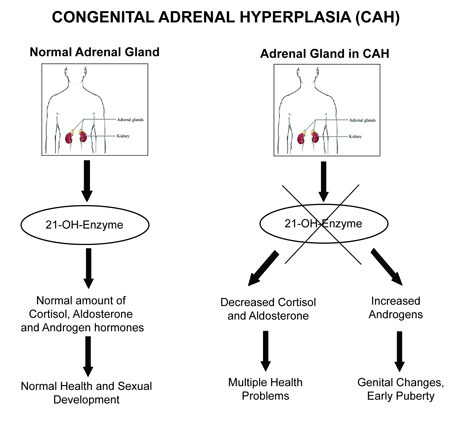
As the most up-to-date of the writing on this subject concedes, the total proportion of live births with conditions falling under the general category of DSDs may amount to no more than 1-1.7%. Of these cases the vast majority consist of late onset (non-classical) Congenital Adrenal Hyperplasia, a condition caused by a deficiency in one of a number of enzymes involved in hormone production, and which only presents symptoms at puberty. The remaining proportion of DSDs include a wide range of genetic conditions, each impacting on an individual's appearance, fertility and development in different ways and to different degrees. Amanda Montañez' graphic demonstrates this quite neatly and has considerable didactic merit in this regard.   

To better answer the question (which by now the reader should recognise as very much a meta question) of whether DSDs constitute evidence of a spectrum of the sexes, we might start with asking what exactly IS a spectrum, and what is it the claim that sex is a spectrum is actually meant to do to our traditional understanding of sex as binary. To enquire in this way is not to question the science; the science is clear, there are lots of different DSDs and people with intersex characteristics as a consequence. This is a question about how a large body of scientific and medical research enters public consciousness and intersects with the demands and hopes of political activists and commentators. It is necessarily a question of interpretation.

Spectral Rhetoric in LGBT+ Discourse
Dictionaries are rarely reliable places to discover the meaning of terms as they are used in the heat of contemporary political disputes. It's a particularly pedantic trapping of Anglophone culture to demand strict consistency with dictionary definitions when engaged in argumentation. Anglo-Saxons are still resistant to the notion that the ultimate meaning of words come through their use, and similarly that the endless possibilities inherent in human practices consequently means that a word's definition can never be final. 

Nevertheless the Oxford English dictionary offers two definitions for spectrum: 1. a band of colours, as seen in a rainbow, produced by separation of the components of light by their different wavelengths. 2. Used to classify something in terms of its position on a scale between two extreme points.

The second of these definitions would seem to have obvious significance for describing biological sex as a spectrum, especially as it is visualised by Amanda Montañez in her graphic. The extreme points would be the typical biological male and typical biological female. And indeed it is at the extreme edges of her graphic that we find those positions. The first definition highlights that spectrum was first used in a scientific sense to classify the range of colours in the rainbow and later by extension the whole continuum of wavelengths of electro-magnetic radiation. The paradigmatic spectrum then is the rainbow, which is also the iconic flag of the LGBT+ movement. This is not without significance, nor is the fact that Montañez has used the rainbow as an indicative part of her graphic. The semiotics of the rainbow and by extension the way in which the term spectrum is used within LGBT+ discourse draws in a wide variety of inferences and associations which makes the claim about biological sex more complex than it seems.

The "spectrum model" of gender and sexuality is a much more familiar notion than a spectrum of the sexes. It's become a more common description as the range of sexual practices and gender identifications continues to diversify in Western societies. Dating apps are good place to get up to speed on the cutting edge ways in which many people identify themselves and their sexuality. In addition to hetero, homo and bisexuality it's not uncommon to see people identify as Queer, pansexual, sapiosexual, and even asexual. 

There are also intermediate and modal variations which signify that an individual may identify with two or more forms of sexuality. Or in the case of so-called homo and hetero-"flexibles" a person may have a general tendency but admit exceptions and not wish to identify as bisexual. Diversity is implicit in the iconography of the rainbow and is matched by the avowed openness of the LGBT+ movement to both non-conformity and change.  

The situation is at least if not more diverse in the case of gender, as the concept draws in a broader range of influences than just those involved with sexuality. The website Genderspectrum.org describes gender as involving a complex interrelationship between our experience of our body, our identity and society. It's arguable that each of these categories imply each other and indeed it would seem impossible to think of a personal identity that could exist without a social component. If there are no private languages then by extension that would seem to rule out private identities. Another way of thinking these three domains might be as the embodied, the personal, and the interpersonal. Gender identity - as the website states - is "our internal experience and naming of our gender. It can correspond to or differ from the sex we were assigned at birth".

We would expect the naming of our gender identity to also involve these three domains of experience. Names never exist in isolation and the signification of a gender identity is a matter of social contestation, appropriation and development. Think of how the notion of masculinity has been challenged, reasserted and reappraised during just the latter half of the 20th century. Think of how "traditional" ideas of womanhood have changed during the same period, often in response to developments in reproductive technologies or the wholesale entry of women into the workforces of Western economies. Indeed it is commonly held that "detraditionalisation", as it is known in the sociological literature, has been one of the principal drivers of diversification in the fields of gender and sexuality.

Like those traditional categories of man and woman, contemporary gender identities like non-binary, transgender, genderfluid and genderqueer are similarly rooted in social practices and so are never stable or fixed; further diversification and change is inevitable. The variety of sexual and gender identities are social facts, continuously emerging from the complex interplay of forces within modern societies. Analogous to the openness of language itself, conceiving gender and sexuality as spectra is a necessary correlate to the fact of human freedom and the capacity for change and diversification brought about though human practices. Another way of putting it is that their existence depends on the nature of the human as a free, acting and self-fashioning being.

Can we say the same for biological sex?

One of the many graphics illustrating the spectra of gender identity and sexuality. This one also includes biological sex.

One thing the LGBT+ movement has been extremely good at is contesting the hegemony of the so-called typical case. In sexuality this has traditionally been targeted at the assumption that heterosexuality is the norm (so-called heteronormativity). And in gender there have been significant advances in challenging social stereotypes associates with being a man or a woman, as well as the opening up of a myriad of gender non-conforming identities. Insofar as the rainbow is synonymous with the spectrum model, it signifies clearly that there is no typical case, no hegemonic norm. All positions within the spectrum are equally valid, and equality - especially in Law but also in terms of cultural legitimacy - are two of the principle political aims of LGBT+ activism and advocacy. 

This is the context and set of inferences brought to bear when it is argued that biological sex is also a spectrum. We could say then that to describe it as such is to claim biological sex territorially for the semiotics of LGBT+ discourse. It is to say that the things which are ordered within the observable range of biological sex are ordered in a way significantly similar to those things within the spectra of sexuality or gender. It is also to contest the hegemony of the norm, which in this case is the status of the "typical" biological male and female.

Unpicking the meaning of the attribute "spectrum" when used in this context helps us to understand the incongruities when it is applied to something like DSDs and biological sex more generally. The most important difference is this: DSDs like PMDS, 5-alpha reductase deficiency, and conditions caused by missing or additional sex chromosomes are not the product of human freedom and practice. They are not social facts. Before these conditions were discovered and their genetic basis understood they still existed. The biological basis of DSDs is not sustained by discourse and contestation; they are not brought into being by creative self fashioning. They are very different types of things to gender or sexual identities. 

There are also only so many DSDs (currently about 40 are known). Unlike the open ended nature of human practices they do not admit to the infinite realm of possibilities that we associate with the continuum of sexual and gender identities captured by the spectrum model. This is not to say that new DSDs won't be discovered or appear owing to natural genetic variation, but here we are clearly talking of discovery rather than creation.

The scientific significance of DSDs is undoubted. But scientific significance does not automatically equate to political significance, or at least the kind of political significance that neatly maps onto established strategies and forms of argumentation within the LGBT+ movement. As mentioned above, one of the signal functions of LGBT+ activism is to contest the validity of hegemonic norms and assert the equality of all members within the spectrum of identities. This is problematic in the case of biological sex for at least two reasons. 

Firstly, even Montañez's graphic marks biological male and female as the typical cases to which all the DSDs are related. Indeed it's questionable whether any of the "gradations" she visualises can be thought of independently of their relation to one or both of those typical cases. This is especially so as each of the DSDs included are caused by genetic defects of what would otherwise have been a typical case.

To better illustrate this point lets go back to the spectrum of sexual identities. Let's consider Sapiosexual, which is someone who identifies with being particularly attracted to intelligence. In order to understand this do we need to make reference to other identities within the spectrum? Seemingly not. Aside from a general understanding of what a sexual identity is Sapiosexual is perfectly intelligible without reference to other points on the spectrum. Indeed even if there were no other sexual identities Sapiosexual would still be intelligible in every significant way. It is a discrete member of the set of sexual identities. This however is not the case with DSDs. Each condition by its nature is a specific variation from the typical observed case and this is reflected in the names given to many DSDs such as "deficiencies", "dysgenesis", "disorders" etc.

Secondly, there is I think a strong claim that Montañez's graphic and much of the popular writing which uses DSDs to claim that sex is a spectrum misrepresents the data. It is always worth remembering that the way complex scientific data is presented goes a long way when making arguments that revolve around interpretation. It is undeniable that the way the graphic is presented - especially with the inclusion of the rainbow strip on which are listed the names of various DSDs - calls out "spectrum". But this is only one way of showing the data and perhaps it is missing a very important component, weighting. 

Outline of the 21-Hydroxylase deficient variant of CAH
As already mentioned the total range of DSDs may account for only 1-1.7% of live births and that perhaps only 0.2% are made up of conditions other than Late Onset Congenital Adrenal Hyperplasia (CAH). That means that the genetically and physiologically typical cases make up at worst over 98%. When you take into consideration people with Late Onset CAH are karyotypically normal and experience no physical symptoms until puberty, you are left with a figure of around 1 in 500 live births potentially showing some signs of DSDs. Also worth noting is that the cases of ambiguous genitalia - the DSD that gets most coverage in popular media - affects an estimated 1 in 4500 births.

If this weighting were taken into account the graphic would look very different indeed. The typical biological male and female, which in Montañez's version form the extreme ends of her spectrum would, when weighted correctly, look like brick sized slices of bread between which an ultra wafer-thin slice of cheese would be located representing the totality of DSDs. Would a non-specialist looking at such a graphic be likely to conclude that biological sex exists as a spectrum? I suggest this is unlikely and what such a weighted visualisation would instead do would be to emphasise that biological sex is only intelligible as a binary, but that there also exist a small minority of exceptions to the typical cases, which are of wide ranging types. 

However, those exceptions are only explainable as exceptions by relation to the typical binary cases. Androgen insensitivity is only observable owing to the fact of the typical level of "sensitivity" being understood; just as mutations in CYP21A2 or SRD5A2 genes are only understood owing to the sequence for the functioning enzymes they code for being known from the typical cases. None of the conditions falling under the category of DSDs are defensible as discrete sexes in their own right. They are quite simply different kinds of things to gender and sexual identities and to treat them as if they were not is nonsensical.

I said above that the 2nd definition of spectrum - to classify something in terms of its position on a scale between two extreme points - might superficially have greater applicability to biological sex. At least this notion of spectrum acknowledges the validity of the extreme points; something the continuum version of spectrum - the one used when we talk about sexuality and gender - does not. It does however make little sense to claim that DSDs represent "gradations" between the typical biological male and female that can be used to plot a scale from one to the other. 

Each condition has its own specific aetiology and characteristics at the genetic, hormonal and physiological level. Classifying them as more or less male or female is a forced abstraction that is rooted neither in the science or the way in which these conditions are approach from a practical medical standpoint. And even if one could in some remote way describe the distribution visualised by Montanez as having genuine "spectrum-like" qualities it is still less than obvious what the political significance and benefits of this might be for those individuals who could be described as belonging to one or more new non-binary sexes.

What are the Political Implications?
So what are some of the political implications at stake here? What would be the virtue of arguing for a spectrum of the sexes and how might such an interpretation impact current advocacy issues around Intersex people?

Homosexuality used to be considered a illness with potential criminal tendencies; it was treated "medically" with drugs and torturous treatments like electric shocks. Despite homosexuality being legalised in the UK in 1967 it wasn't until 1987 that it was fully removed as a "mental disturbance" from the DSM (The American directory of mental disorders). Depathologizing homosexuality was a big step towards reducing social stigma and paving the way for gay rights in areas such as anti-discrimination law and most recently marriage. 

DSDs, however, are by definition disorders, their cause is traceable to anomalies in the building blocks of life, our DNA, and can result in extreme cases (as with the salt-wasting variant of Congenital Adrenal Hyperplasia) in life threatening illness. As genuine medical conditions many of them demand some kind of appropriate, compassionate medical response, and it is not at all clear how depathologising them under the rubric of a new spectrum of the sexes would benefit people born with DSDs.

A great deal of Intersex advocacy does focus on healthcare responses. One area where there is a considerable amount of work being done is in the area of laws protecting the bodily integrity of intersex people, especially where it concerns non-consensual genital surgeries, sometimes called "assigned sex". This is to do with those rare cases of babies born with so-called ambiguous genitalia and the medical responses that ensue. In many cases there is little in the way of ambiguity and the child's sex is not in dispute. Surgery might take place - for example in boys - because the genitals are not considered "male" enough. This has resulted in cases where new born boys have had their penises removed and been raised as girls, sometimes only finding out the truth much later in life.
The Phall-O-Meter, developed in the 1990s by the Intersex Society of North America (ISNA), was a satirical activism tool to highlight how doctors made subjective judgements about atypical genitalia then based their surgical advice on that analysis. From Human Rights Watch Website
There is also evidence that in cases of serious ambiguity the tendency in the past has been to surgically create genitals that appear male, thus effacing many women at birth.  Intersex advocacy tends to focus on delaying non-consensual and irreversible surgeries until an intersex person reaches the age of informed consent. From a consent perspective there seems to be little that is added by way of arguing for a spectrum of the sexes.

There is also little evidence that the interpretation of sex as a spectrum is being driven by Intersex people themselves. The decision in Germany in 2013 to allow some Intersex infants to be classified as a third sex was roundly criticised by rights groups and Intersex advocates. There is a concern that allowing a newborn child to be registered as a third sex would encourage more surgeries on intersex infants as parents are unlikely to feel comfortable with the uncertainty. Many countries also have sex based rights legislation or link access to certain welfare provisions to sex . Subsequently, Intersex people classified other than male or female may well fall between the cracks while legislators attempt to catch up with the new non-binary system.

Thinking of DSDs as constituting sexes in their own right would also appear to reverse the famous anti-reductionist mantra that "genes are not destiny". Now it appears to some extent they are. You are your persistent Mullerian duct syndrome, your defective androgen receptors, your ambiguous genitalia. Your hidden fallopian tubes are the secret of your true nature rather than just a rare and slightly Lovecraftian result of a point mutation in a single gene.

Is there any reason to believe that people with Turner or Klinefelter syndrome need to be classified as a unique sex in order to access specific legal rights and protections that are currently unavailable to them, or that this would lead to a better quality of life? Many of the conditions categorised as DSDs do not result in symptoms that put the sex of the person into question. MRKH affects genetic females and causes incomplete development of the uterus, cervix and/or vagina. Though they do have normal ovaries, people with MRKH are sterile. Being told that such a condition means you are not a biological female doesn't sound like a very progressive move. 

The same could be said of Klinefelter syndrome which involves a genetic male having an additional X chromosome. Symptoms are often subtle and hard to detect even after the onset of puberty. Would such a person benefit from being classed as other than male at birth? And finally, would social justice in general be served by treating biological sex as a spectrum rather than binary? These are the sorts of questions which are as yet unanswered by advocates of the spectrum interpretation.

There is an assumption among many radical social constructivists and theorists of detraditionalization that any increase in indeterminacy or breakdown of hegemonic norms is by definition emancipatory. There seems to be little reason to take this for granted. It is perhaps worth bearing in mind the fact/value distinction; the distinction between "is" and "ought" which captures the difference between scientific claims and value or ethical claims. 

The value claims made (or assumed) from interpreting biological sex as a spectrum do not necessarily follow from the facts, and need to be argued for on their own merits rather than asserted on the basis of their applicability for gender identity and sexuality. Traditional LGBT+ activism may well have an important role to play as an ally in advocating against unnecessary surgery, especially where such surgery has tended to favour "masculinisation" of ambiguous genitalia; or in resisting the impact of gender stereotypes on Intersex people whose conditions mean they don't necessarily fit the mould. 

There is however a potential conflict as currently one major aspect of trans-rights is arguing for access to precisely the kind of medical interventions (hormone treatment and surgery) that many Intersex advocates are trying to minimise. We live at a time where public self-assertion and group-think often run ahead of a cool examination of the facts and the implications of drawing communities with markedly different concerns into already matured forms of political activism and ideology. How the current articulation of medical interventionism and identity politics would impact Intersex people if the spectrum interpretation prevails is unclear. In any case we might well question whether dragging individuals with a complex range of conditions into the current culture war is at all desirable.